🧁 Powdered Sugar Cup Weight Converter
Convert confectioners sugar cups into grams, ounces, pounds, tablespoons, and batch-ready amounts using sifted, unsifted, settled, or packed cup weights.
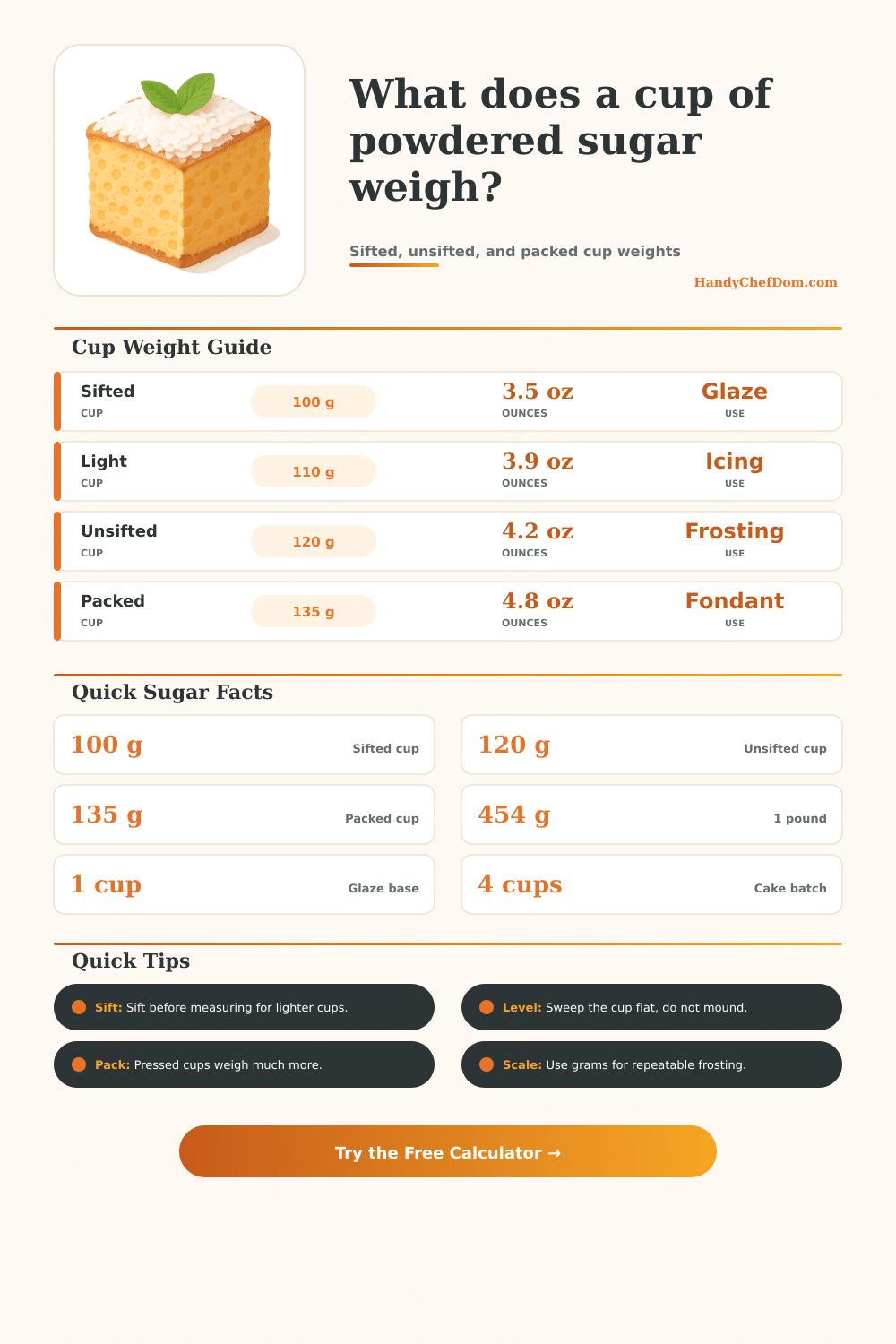
Powdered sugar cup weights change a lot with aeration. A sifted cup can be about 100 g, an unsifted cup about 120 g, and a pressed confectioners sugar cup about 135 g.
| Powdered Sugar Cup Style | Grams Per Cup | Ounces Per Cup | Best Use |
|---|---|---|---|
| Sifted before measuring | 100 g | 3.53 oz | Thin glaze, dusting, delicate icing |
| Lightly spooned and leveled | 110 g | 3.88 oz | Soft icing and whipped frosting |
| Unsifted from bag, leveled | 120 g | 4.23 oz | Buttercream and most bakery formulas |
| Settled pantry bag cup | 125 g | 4.41 oz | Opened bags with compacted sugar |
| Pressed confectioners sugar cup | 135 g | 4.76 oz | Fondant, candy work, firm packing |
| Custom house standard | Your value | Auto | Repeatable bakery or home notes |
| Recipe Use | Typical Cups | Texture Choice | Scale Note |
|---|---|---|---|
| Thin glaze or drizzle | 1 to 2 cups | Sifted | Use lighter cups for a smooth pour |
| Loaf cake icing | 1.5 cups | Light spooned | Add reserve for bowl streaks |
| Layer cake buttercream | 4 cups | Unsifted | Most recipes assume leveled bag cups |
| Cupcake frosting tray | 5 to 6 cups | Unsifted | Batch count matters more than rounding |
| Royal icing cookies | 4 cups | Sifted | Sifting prevents piping clogs |
| Fondant kneading | 6 to 8 cups | Packed | Reserve extra for the board |
| Common Amount | Sifted Weight | Unsifted Weight | Packed Weight |
|---|---|---|---|
| 1/4 cup | 25 g / 0.88 oz | 30 g / 1.06 oz | 34 g / 1.19 oz |
| 1/2 cup | 50 g / 1.76 oz | 60 g / 2.12 oz | 68 g / 2.38 oz |
| 1 cup | 100 g / 3.53 oz | 120 g / 4.23 oz | 135 g / 4.76 oz |
| 2 cups | 200 g / 7.05 oz | 240 g / 8.47 oz | 270 g / 9.52 oz |
| 4 cups | 400 g / 14.1 oz | 480 g / 16.9 oz | 540 g / 19.0 oz |
| 8 cups | 800 g / 28.2 oz | 960 g / 33.9 oz | 1080 g / 38.1 oz |
| Package Weight | Sifted Cups | Unsifted Cups | Packed Cups |
|---|---|---|---|
| 8 oz bag | 2.27 cups | 1.89 cups | 1.68 cups |
| 16 oz box | 4.54 cups | 3.78 cups | 3.36 cups |
| 24 oz bag | 6.80 cups | 5.67 cups | 5.04 cups |
| 32 oz bag | 9.07 cups | 7.56 cups | 6.72 cups |
| 2 lb bag | 9.07 cups | 7.56 cups | 6.72 cups |
| 4 lb bulk | 18.14 cups | 15.12 cups | 13.44 cups |
A cup of confectioners’ sugar (a.k.a. Powdered sugar) doesn’t weigh the same every time; it’s not a standard measure. Depending on how tightly packed or sifted a cup of sugar is, it will vary by about thirty-five grams: that makes a huge difference between a glossy glaze and a grainy mess. Did you crack your cake? Did your frosting vanish into the sponge? Then the problem probably wasn’t your technique, it was amount of sugar in each cup.
But volume isn’t a good measurement for ingredients with air in them, which is why I made this calculator. Powdered sugar, for example, is full of air, and how you treat it affect its density. If you scoop straight out of the bag after it’s been sitting in there for a week, the sugar will be packed together and heavy. If instead you sift the sugar first, you will trap air between each grain. This give you a lighter weight even though the measuring cup looks as full as ever.
Why You Should Weigh Your Powdered Sugar
And that variation throw off baking formulas that depend on exact proportions of sugar-to-fat. Buttercream, in particular, doesn’t take kindly to having too much or too little sugar compared to butter. Too much, and it goes dry; too little, and it just melts. All you need do is choose your method of measurement (i.e. Did you pack it down? Spoon lightly?) and the tool does the math for you.
For example: a typical level cup without sifting has about one hundred twenty grams; a completely packed cup weighs in at one hundred thirty-five grams. Fifteen grams per cup can add up quickly in a four-cup recipe like frosting. While maybe you won’t notice if you’re making just one recipe, over a whole recipe, that difference will shift the balance.
Beyond chemistry, there’s a functional benefit here: Unless you have an incredibly large kitchen scale, most bakers don’t have one big enough to weigh out five pounds of sugar with ease. Yet professional baking recipes is nearly universally measured by weight, so they can be repeated exactly. With these reference tables, though, you can still use volume measurements from your preferred cookbook and convert them directly into the grams your mixer will require.
This comes in handy when adjusting batch sizes. For example, if you are following a recipe calling for three cups and want to double it, it is not simply twice as much. Rather, you are getting double the possible error margin if the original wasn’t measured consistantly. The calculator has fields for both of these things, batch count and a reserve percentage (to act as a buffer for loss or friction).
That’s an acknowledgement of life because it’s not all going to go into the cake. Some will be lost as it sifts, and some will be lost when you scrape the bowl around. And let’s face it: even if you get the amount right, you could still end up with something lumpy if the sugar has absorbed moisture from the air. To make up for that friction, add a five percent reserve so you don’t have to stop midway through whipping just to order another bag. It’s just a little cushion, one that will save you time in the future.
In sensitive uses (e.g., royal icing, glaze), the sifting/not-sifting question is most important. The reason: Sifting eliminates those little lumps caused when sugar absorbs some humidity from the air. When a recipe calls for sifted ingredients, do not scoop them first. Measure the amount in the cup and then sift it into your mixing bowl. Otherwise, you’re really piling on more sugar (in terms of weight) different than the recipe wants! It is a small detail, but it is a disaster if you want to pipe something.
In tough buttercreams, where lumps would of been broken down anyway through creaming with the butter, unsifted scoops will be enough. Baking is all about the ratio, after all. And volume measures add some noise to the ratio; everyone packs their sugar a little differently each time. Grams eliminate that guessing game.
Four hundred grams of sugar? Sure thing. Four cups? Well…how hard did you press it in? How full was your bag? The converter will help you solve the riddle, so your next batch is as planned, smooth and consistent instead of stiff and sad.