🍮 Gelatin Packet Calculator
Calculate how many gelatin packets to open from liquid volume, packet grams, packet teaspoons, firmness, bloom water, and batch scale.
Use the packet size printed on your gelatin box, choose how firm the finished set should be, then scale the batch without guessing how many envelopes to open.
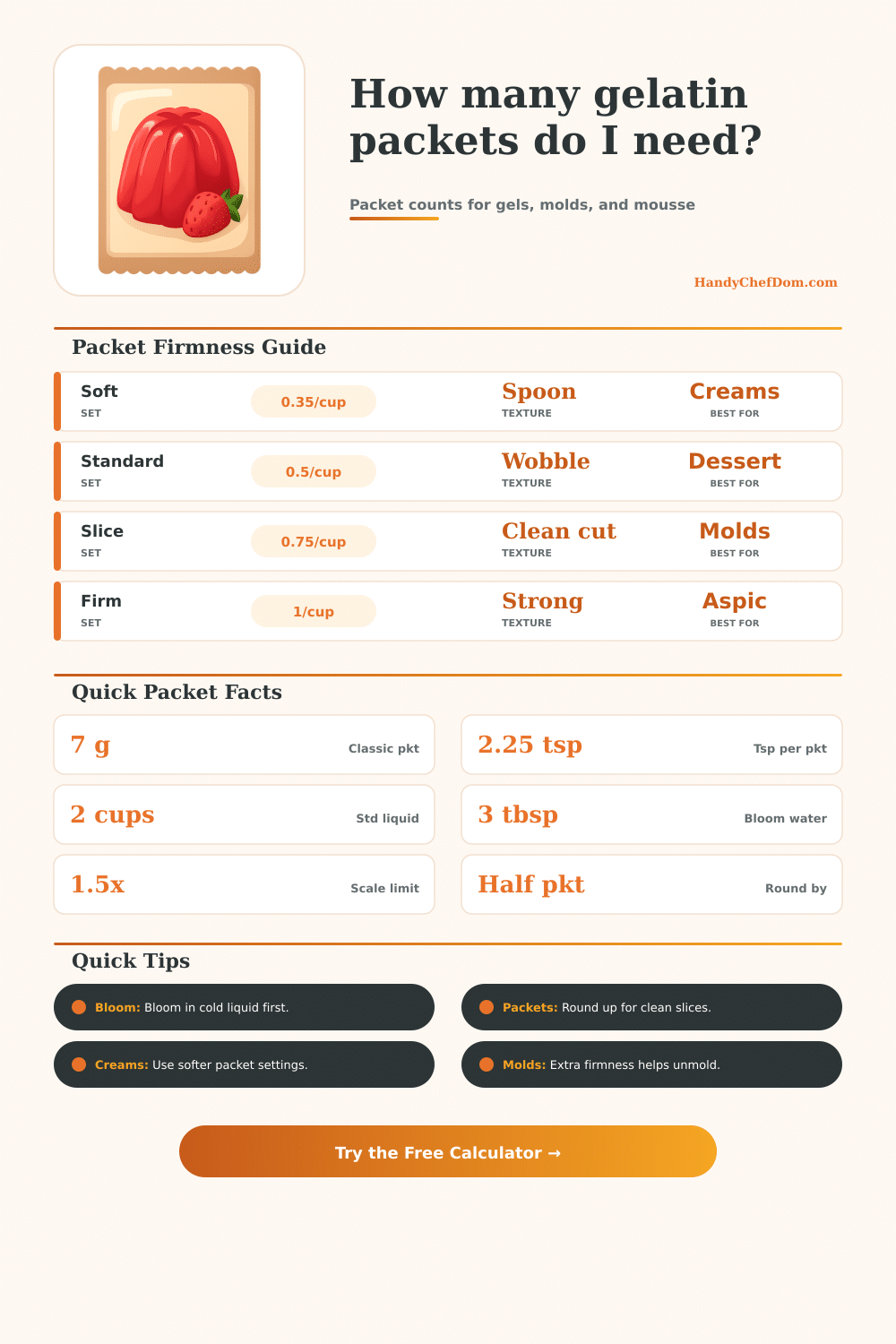
| Firmness Setting | Packets Per Cup | Texture Goal | Best Packet Use |
|---|---|---|---|
| Very soft spoon set | 0.25 | Barely set and creamy | Mousse cups, whipped desserts |
| Soft cream set | 0.35 | Gentle wobble | Panna cotta, custard cups |
| Standard dessert set | 0.50 | Classic spoonable gel | Fruit gelatin cups |
| Sliceable mold set | 0.75 | Clean slices | Layered trays, molded desserts |
| Firm unmolded set | 1.00 | Holds shape firmly | Aspic, tall molds, travel portions |
| Very firm gummy style | 1.35 | Chewy and dense | Snack gels and firm cubes |
| Packet Format | Powder Weight | Powder Volume | Typical Label Use |
|---|---|---|---|
| Classic envelope | 7 g | 2.25 tsp | Sets about 2 cups at standard firmness |
| Small packet | 6 g | 2 tsp | Useful for small dessert cups |
| Large packet | 10 g | 3.25 tsp | Good for tray batches and molds |
| Powder swap | 8 g | 2.5 tsp | Matches many bulk powder scoops |
| Half packet | 3.5 g | 1.13 tsp | Fine tuning soft sets |
| Quarter packet | 1.75 g | 0.56 tsp | Small correction for firm recipes |
| Batch Example | Liquid Volume | Standard Packets | Firm Mold Packets |
|---|---|---|---|
| Small dessert cups | 2 cups | 1 packet | 2 packets |
| Family bowl | 4 cups | 2 packets | 4 packets |
| Layered square pan | 6 cups | 3 packets | 6 packets |
| Party tray | 8 cups | 4 packets | 8 packets |
| Large mold | 10 cups | 5 packets | 10 packets |
| Gummy cube batch | 3 cups | 1.5 packets | 4 packets or more |
| Liquid Style | Multiplier | Packet Effect | Packet Note |
|---|---|---|---|
| Water, tea, clear juice | 1.00x | Baseline packet rate | Use printed packet strength normally |
| Milk or dairy base | 1.05x | Slightly stronger | Rounds up nicely for creamy cups |
| Creamy custard base | 1.10x | More support | Helps rich bases hold a spoon set |
| Acidic fruit juice | 1.15x | Extra packet buffer | Useful for citrus and tart juices |
| Fruit puree blend | 1.20x | Thicker mix support | Purees often need more packet strength |
| Wine or alcohol blend | 1.25x | Highest dessert buffer | Round up when setting cocktail style gels |
Packet rates are practical kitchen planning estimates for unflavored powdered gelatin. Very acidic, enzyme-rich, or unusual ingredients may need a recipe-specific test batch.
When measuring gelatin, your hand twitches: Do I have just enough? Will it be ruined by overdoing it? Will half an envelope do for this panna cotta, or will I need two envelopes to make something like aspic? More often than not, your hunch is wrong. Too little gelatin will result in a runny mess that lack substance; too much produces a hard rubber block that spring back into shape upon a poke.
To hit the sweet spot between failure and success, you must account for how various liquids and textures interacts with the powder, which is why you’ll want to know how much to add. How much gelatin to add depends on what type of liquid are used as the base. A normal ratio for gelatin added to a cup of clear water or tea will set up hard, in a predictable way.
How to Use Gelatin Correctly
If you use a dairy-based liquid, such as whole milk, it’s thicker and richer, which means you have to be careful not to let it mess with hydration. The calculation takes that into account and spares you having to do any math by hand. Because dairy contains protein that compete with the gelatin strands, you’ll often need more gelatin when using those liquids then you would for equal wobble. If using an acidic juice (citrus or maybe some pineapple), the lower pH may break down the gel structure during heat if left too long. Those variables will alter how much gelatin you should of add. Know your base.
The firmness isn’t black-and-white; it’s not all-or-nothing, solid-liquid. It’s a continuum and while there’s no single right answer, you want something that has just enough body to quiver: typically, half an envelope per cup of base liquid. For a shape you’ll be unmolding and/or slicing up neatly, you’d use twice as much. Why? It is too weak and you may have trouble getting the dish out of mold.
What do you plan to do with this thing once you’ve made it? Is it going to sit in the bowl it was cooked in, like a soft-set panna cotta? That requires a softer set different than something meant to stand upright by itself, on someone’s plate. Don’t guess how many envelopes to use; the gadget converts your ideal level of chewiness into teaspoons and grams.
The other confusing factor for new cooks is bloom water. You have to add cold water to the gelatin powder and let it sit so granules can hydrate. If there isn’t enough water, you’ll end up with dry lumps; if there’s too much, recipe will unexpectedly get watered down. When you look at the reference table, see how many tablespoons of cold liquid are to be set aside (reserve) as compared to total volume. For most classic packets, it’s 3 tablespoons or so of cold liquid per envelope. That water goes into final mixture and therefore has to be accounted for in the amount you plan to make. Especially when making a large batch for a party tray, this adds up fast, and sometimes you may need half a cup of bloom water just by itself.
The most common failure point in any recipe is scaling. Doubling a recipe results in double everything, including the gelatin. Tripling it will result in more than three packets because there isn’t enough structure at that scale. When a lot of stuff is cooling, it cools slower which impacts the hydration process and how the gel set. Small amounts can also help with changes in room temperature. This accounts for travel time between the kitchen and the table, providing a little bit of a buffer.
You’d rather have a firmer set than no set, as you can soften a firm dessert by adding cream but you cannot fix a runny mess. It’s patient and exacting, but it also forgives, at least when made from gelatin. Calculating what you need and getting those pots on the heat take away the fear. It’s a guide and the numbers point you to consistent results. Use the proper amount of packets, bloom correctly and wait. Wobble is coming your way.