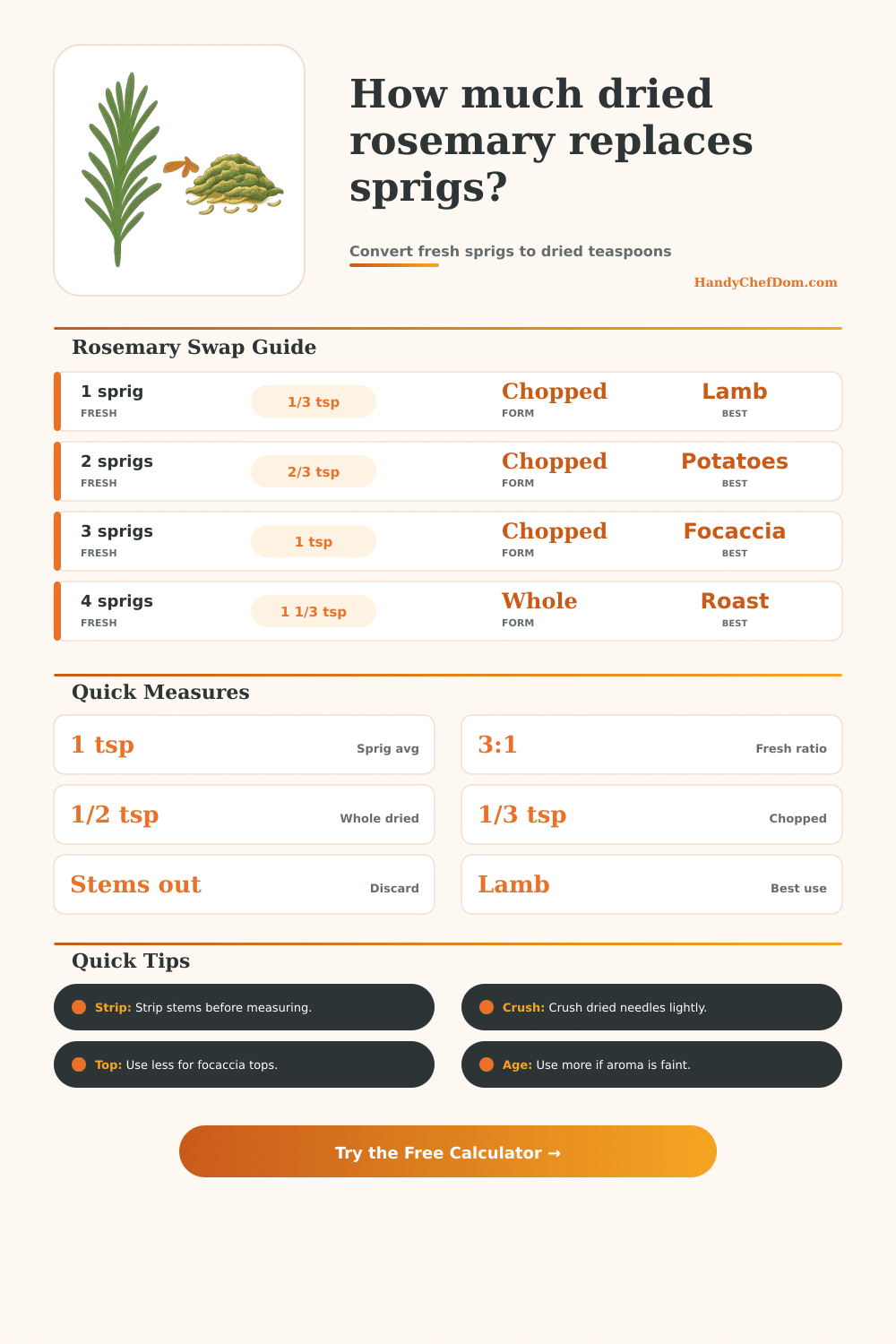
🌿 Rosemary Sprig To Dried Converter
Convert fresh rosemary sprigs into dried needles, chopped teaspoons, and dish-ready amounts for lamb, potatoes, focaccia, marinades, and roast pans.
Use the needle-bearing part of the rosemary sprig. The calculator removes woody stem waste, adjusts for sprig size, and converts the fresh needle yield to chopped dried or whole dried needles.
| Fresh sprig type | Estimated stripped yield | Best estimate | Stem note |
|---|---|---|---|
| Short tender tip, 2 to 3 inches | 0.5 to 0.7 tsp fresh needles | Use 0.6 tsp | Very little woody stem |
| Standard grocery sprig, 4 inches | 0.8 to 1.2 tsp fresh needles | Use 1 tsp | Strip leaves, discard stem |
| Long garden sprig, 5 to 6 inches | 1.2 to 1.6 tsp fresh needles | Use 1.35 tsp | Older base may be woody |
| Extra long branch, 7 inches | 1.6 to 2.1 tsp fresh needles | Use 1.75 tsp | Count only needle-bearing tips |
| Bushy mature sprig | 1.2x to 1.6x normal yield | Adjust upward | More needles per inch |
| Sparse winter sprig | 0.6x to 0.8x normal yield | Adjust downward | Stems dominate volume |
| Fresh rosemary | Chopped dried | Whole dried needles | Powdered dried |
|---|---|---|---|
| 1 tsp stripped fresh needles | 1/3 tsp | 1/2 tsp | 1/6 tsp |
| 1 tbsp chopped fresh rosemary | 1 tsp | 1 1/2 tsp | 1/2 tsp |
| 1 average sprig | 1/3 tsp | 1/2 tsp | Small pinch |
| 2 average sprigs | 2/3 tsp | 1 tsp | 1/3 tsp |
| 3 average sprigs | 1 tsp | 1 1/2 tsp | 1/2 tsp |
| 6 average sprigs | 2 tsp | 1 tbsp | 1 tsp |
| Dish focus | Rosemary behavior | Conversion nudge | Good form |
|---|---|---|---|
| Lamb roast or chops | Can handle a stronger piney note | Use 1.15x | Chopped or rubbed dried |
| Roasted potatoes | Needs even coating without twigs | Use 1.00x | Chopped dried needles |
| Focaccia topping | Dry herb sits on surface and tastes louder | Use 0.85x | Lightly crushed whole needles |
| Oil marinade | Oil blooms dried herb aroma well | Use 1.10x | Rubbed dried rosemary |
| Long-simmer stew | Flavor spreads through liquid over time | Use 1.05x | Whole needles in sachet |
| Herb butter | Dried rosemary is concentrated in fat | Use 0.80x | Very finely chopped dried |
| Stem condition | Discard setting | What to measure | Kitchen cue |
|---|---|---|---|
| Tender green tips | 5% | Needles plus soft tip | Bends easily between fingers |
| Mixed grocery sprigs | 12% | Strip needles from central stem | Most supermarket packs fit here |
| Woody garden stems | 20% | Needles only, no brown stem | Stem snaps instead of bending |
| Thick branches | 30% | Needle-bearing side shoots only | Use for skewers, not chopped herb |
| Whole sprig garnish | 0 to 5% | Leave intact if removed later | Good for roast pan aroma |
| Chopped into food | 12 to 30% | Discard all woody pieces first | Avoid twiggy bites in potatoes |
Unlike most herbs that we keep in the fridge which are leafy tissues, rosemary is woody, with an accompanying change of physics. So many formulas for how to convert one to the other don’t work, three times as much dried rosemary equals one part fresh, etc.; because nature of plant alters things. The dried herb behave differently. The potency vary. It cook up different than whatever you make with it. You know what I mean if youve been roasting potatoes and discovered a mouthful of tough, chewy bits.
Precision is key here. But after adjusting for the variables of your own sprigs (see the calculator above), it do the math for you, so you don’t have to guess if they are sparse or dense. Dense in a bunch. Not all rosemary sprig are created equal. A 4-inch sprig from the supermarket isn’t going to produce nearly as many needles as a 6-inch branch from your backyard bushes.
Why Rosemary is Different
So when it prompt you to adjust for length and fullness, remember: those things affect amount of actual herb you get to work with based off the inedible wood you throw away. They also affect how much leafy material you strip off when you remove the leaves, which result in lost mass. And we must calculate that before converting to dried form.
Dried rosemary comes in different forms, ranging from finely crushed powders to whole, needle-like versions that is still somewhat tough even when cooked briefly. Finely chopped dried needles will blend into butter and rubs more easily than whole ones; those whole ones has more drama but can stay tough during short cooking times. The converter know the difference, so that you don’t wind up overpowered with a blast of piney goodness from that finely crushed stuff, or with insufficient flavor because you used only whole needles.
Less volume equals fewer essential oils (water has been removed), but concentrated ones. The amount should of be adjusted by context, too. Focaccia dough require a slight hint of piney flavor that doesn’t overpower the salt and olive oil; lamb can take a stronger hit. The intensity of dish calls for the adjustment. A marinade with herbs left for half an hour will release a different amount of flavor compared to one simmered for hours. This is why the tool allow for such variations.
If you chop rosemary fine, it will melt into herb butter instead of remaining as isolated chunk floating in fat. In the same way, needles stuck onto potato cubes for roasting will cling to starch without becoming overly woody.
You know that your dried stock isn’t all new. With rosemary, for instance: Those volatile oils have evaporated from an old jar, so you’ll need more herb by weight than when using a new one to get the same aromatic effect. That’s why the calculator allow for this factor of age: Using stale ingredients at normal proportions yields poor food. It does not only measure but also compensate for the loss of strength. If your stash is older, crush the whole dried needles in your hands first before adding it help release the oils, and thus close the gap.
In the end, though, transforming rosemary isn’t so much an exercise in precise math as it is a lesson in knowing what it is we’re talking about: swapping water weight for concentrated flavor, soft texture for fibrous resilience, and uniform distribution for variable potency. One sprig is just a stem with a few needles on it, really, a fact that makes everything else fall into place.
You want fragrance, not twigs; and seasoning, not stabbing. Your potatoes should have flavor, not holes. And your lamb roast? Fragrance, please. So give the herb its due, and be aware of its nature as you treat it in the kitchen.