Pizza Dough Weight Calculator
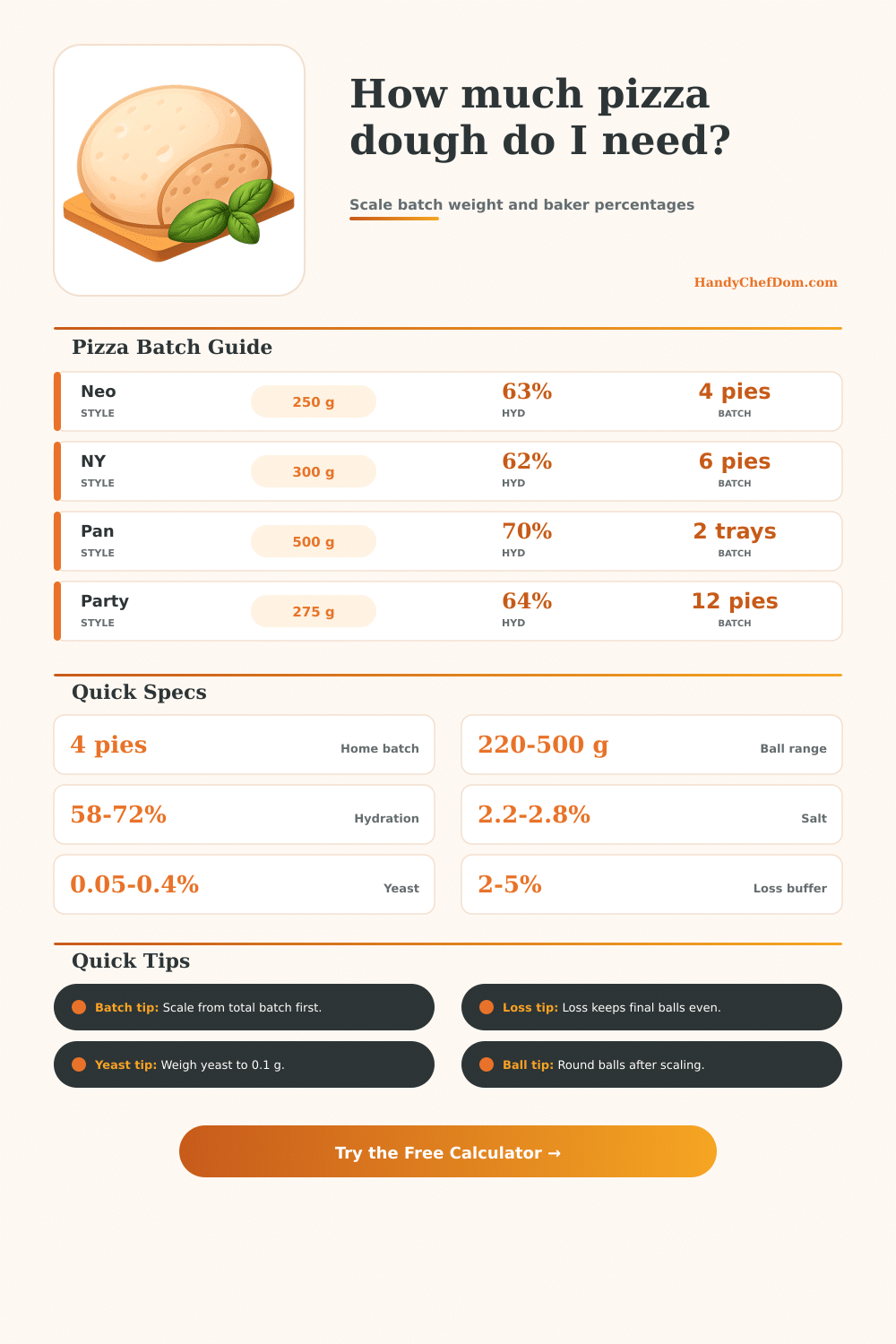
Scale a complete pizza dough batch from total dough target, pizza count, dough ball weight, baker percentages, proofing loss, and production multiplier.
Use count mode when you know the number of pizzas and dough ball weight. Use total batch mode when you already know the finished dough target and want the calculator to solve the ball yield.
| Pizzas | 240 g Balls | 275 g Balls | 320 g Balls |
|---|---|---|---|
| 2 | 480 g | 550 g | 640 g |
| 4 | 960 g | 1100 g | 1280 g |
| 6 | 1440 g | 1650 g | 1920 g |
| 8 | 1920 g | 2200 g | 2560 g |
| 12 | 2880 g | 3300 g | 3840 g |
| 18 | 4320 g | 4950 g | 5760 g |
| Formula | Hydration | Salt | Yeast | Oil |
|---|---|---|---|---|
| Neapolitan | 62-65% | 2.5-2.8% | 0.05-0.20% | 0-1% |
| New York | 60-64% | 2.3-2.7% | 0.12-0.35% | 1-3% |
| Thin crust | 56-60% | 2.0-2.4% | 0.18-0.40% | 0-2% |
| Pan pizza | 68-74% | 2.1-2.6% | 0.15-0.40% | 3-6% |
| Cold ferment | 62-68% | 2.4-2.8% | 0.04-0.15% | 0-2% |
| Loss Buffer | Use When | 1 kg Target | 5 kg Target |
|---|---|---|---|
| 0% | Exact weigh | 1000 g mix | 5000 g mix |
| 2% | Careful home | 1020 g mix | 5100 g mix |
| 3% | Normal divide | 1030 g mix | 5150 g mix |
| 5% | Busy service | 1050 g mix | 5250 g mix |
| 8% | High handling | 1080 g mix | 5400 g mix |
| Scale Plan | Multiplier | Example Balls | Best Use |
|---|---|---|---|
| Half test | 0.5x | 2 of 4 | Formula trial |
| Single batch | 1.0x | 4 of 4 | Home night |
| Double batch | 2.0x | 8 of 4 | Party prep |
| Triple batch | 3.0x | 12 of 4 | Service run |
| Production | 6.0x | 24 of 4 | Bulk mixing |
Getting the weight of the pizza dough batch correctly is important because the weight of the batch will determine the consistencies of the pizzas that are baked. If the weight of each pizza dough ball is consistent, then each ball will divide clean and each ball will be similar in size. If the weight of each batch of pizza dough are not correct, then there may be thin spots in some of the balls of dough and some of the center may be too large for the other pizza balls.
By getting the weight of the pizza dough batch correctly, the bakes will all be consistencies. Many cooks will attempt to guess the amount of dough that will be need to create one pizza. Using this method, however, the amount of dough that will be created may differ from the amount that is desired.
How to Weigh Pizza Dough for Even Pizzas
A more reliable method for create the dough will require the person to start with the weight of the finished dough that is desired and work backward to calculate the percentages of flour, water, and salt that will be required. Because these ingredients will remain in balance with one another through these percentages, the recipe will allow for adjustment to the total amount of dough that will be created. Hydration percentage will play a key role in the system of creating dough.
Higher percentages of hydration will create dough that is soft and more extensible. Lower percentages will create dough that is tight and more structured. Additionally, oil and sugar will also affect the dough balls.
Oil will help the crust to release from the pan in which it is bake. Sugar will help the crust to brown. These ingredients may be small in number but will contribute to the total weight of the batch of dough when prepared in large quantity.
Yeast will have an effect upon the time during which the dough is fermented but will not impact the texture of the pizza dough. Too much yeast will cause the dough to rise too quick. Too little yeast will prevent the dough from developing the flavor that is desired.
The types of yeast that is used matter as well. The percentages of yeast will need to be adjusted according to the type of yeast that is used in order to account for the different rising time of each type. Salt will impact the flavor and the strength of the dough.
The amount of salt that should be used is approximately 2.5% of the total weight of the dough. Using less than 2.5% of salt may lead to dough that do not have enough structure. Using more than 2.5% may lead to a flavor that is too strongly.
Because salt is also measured as a percentage of the total weight of the flour, the amount of salt will remain the same regardless of how much dough is to be created. In addition to the ingredients, dough may also need to be account for the amount of proofing and handling loss. Dough may stick to bowls or the persons hands and may lose moisture while resting.
If the dough is divided according to the total weight of the batch alone, the last few balls of dough may be too small to be divided even. In this situation, the total batch of dough needs to be weighted with an additional percentage to account for this potential loss. A larger percentage may need to be accounted for in a restaurant environment with high demand for pizza versus in the home kitchen.
One of the benefits of the dough system is that it can be scaled to create different amounts of dough. For instance, the cook can halve the batch of dough in order to test new type of hydration. The batch can be doubled or tripled to provide enough dough for more people.
Each ingredient can be doubled or tripled to account for the additional dough, but the percentages will remain the same. The target weight for the individual dough balls can be decided prior to measuring the weight of the flour. By first deciding the desired weight of the balls, a calculator can help reveal the amount of flour that will be need.
By making this decision first, the cook will not waste time and ingredients in creating a large batch of dough only to divide it into balls that are either too heavy or too light for the oven. Using weights of ingredients rather than cups or scoops will allow for the recipe to be repeated. If a certain hydration and salt percentage lead to the best texture for the pizza dough balls, the weights of each ingredient can be noted and used to create the same dough balls in the future.
Additionally, if the equipment that is used to mix the dough balls change, the percentages will remain useful for the creation of the dough. The value of the system of making pizza dough is based off the relationship between the ingredients. Understanding each ingredient and its impact upon the others will allow cooks to create batches of dough that lead to even baked crusts.
If the weights of each batch of dough are even, the time that the pizzas spend in the oven will be even as well, and even bake times will ensure that each crust is evenly browned.