🍋 Limes Per Cup of Juice Calculator
Estimate how many Persian, Key, or mixed limes you need for cups of juice, cocktails, marinades, ceviche, pulp straining, and real juicer losses.
Choose the target juice volume, lime variety, size, juicer method, and pulp handling. The calculator converts cups to tablespoons and milliliters, then adds realistic yield loss and spare fruit.
| Lime Type | Tiny | Small | Medium | Large |
|---|---|---|---|---|
| Persian lime | 1.2 tbsp | 1.6 tbsp | 2.0 tbsp | 2.6 tbsp |
| Key lime | 0.45 tbsp | 0.75 tbsp | 1.0 tbsp | 1.35 tbsp |
| Mexican lime | 0.55 tbsp | 0.9 tbsp | 1.2 tbsp | 1.55 tbsp |
| Bearss lime | 1.5 tbsp | 2.0 tbsp | 2.5 tbsp | 3.1 tbsp |
| Makrut lime | 0.35 tbsp | 0.55 tbsp | 0.75 tbsp | 0.95 tbsp |
| Finger lime | 0.25 tbsp | 0.4 tbsp | 0.55 tbsp | 0.7 tbsp |
| Mixed citrus bin | 0.8 tbsp | 1.1 tbsp | 1.5 tbsp | 2.0 tbsp |
| Juicer Method | Efficiency | Best For | Yield Note |
|---|---|---|---|
| Hand squeeze | 72% | Wedges and small amounts | Leaves juice in pulp |
| Fork twist | 80% | Kitchen backup method | Good for soft limes |
| Citrus reamer | 86% | Fast cups of juice | More pulp enters juice |
| Hand press | 92% | Cocktails and prep | Consistent half-lime squeeze |
| Electric citrus juicer | 96% | Batch marinades | High yield with foam |
| Cold-press batch | 98% | Large service batches | Best extraction, more setup |
| Recipe Use | Common Target | Pulp Loss | Planning Note |
|---|---|---|---|
| Cocktails | 0.75-1 oz each | 5-10% | Fine strain for clean pour |
| Marinades | 0.25 cup per lb | 0-5% | Pulp is usually fine |
| Ceviche | 0.5 cup per lb | 3-8% | Use extra for full contact |
| Dressing | 2-4 tbsp batch | 5-12% | Strain seeds and large pulp |
| Dessert | 0.5-1 cup batch | 8-15% | Fine strain for smooth filling |
| Table wedges | 1 lime per 6-8 wedges | 0% | Reserve whole limes separately |
| Target Juice | Persian Medium | Persian Large | Key Medium | Metric |
|---|---|---|---|---|
| 1/4 cup | 2-3 limes | 2 limes | 5-6 limes | 59 ml |
| 1/2 cup | 4-5 limes | 3-4 limes | 9-10 limes | 118 ml |
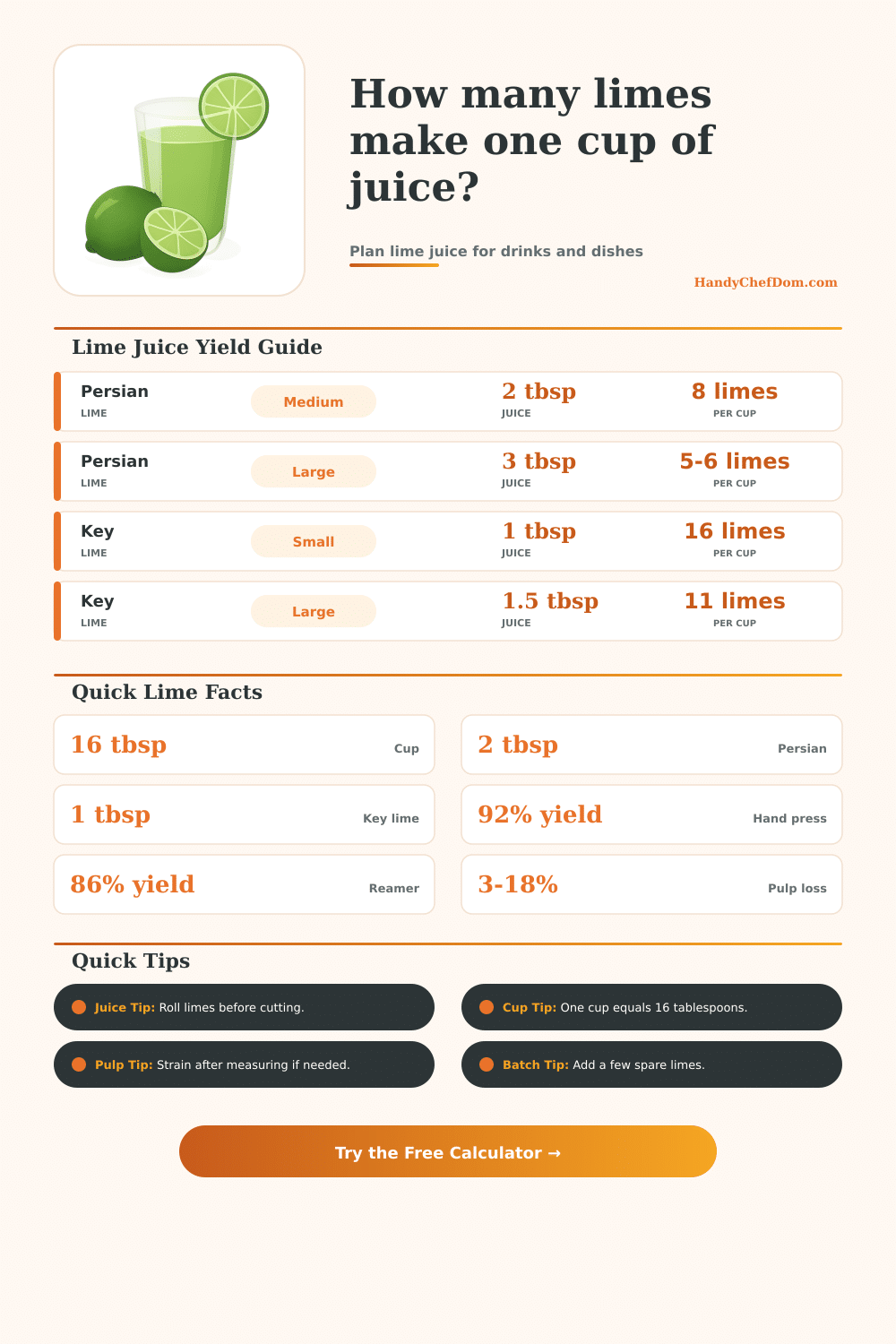
| 1 cup | 8-10 limes | 6-7 limes | 16-19 limes | 237 ml |
| 2 cups | 16-20 limes | 12-14 limes | 32-38 limes | 473 ml |
| 1 quart | 32-40 limes | 24-28 limes | 64-76 limes | 946 ml |
| 1 liter | 34-43 limes | 25-30 limes | 68-80 limes | 1000 ml |
How many limes do I need if a recipe asks for X number of lime juice? For example: “You’ll need one cup,” but then what? How much fruit is in a cup? The answer depends on size of your fruit. And how will you know which ones to pick up at the store? Well now you don’t have to because this page’s calculator figure out the rest for you. No more guessing, just make the drink already!
How big a lime will vary the count, too. You’ll need roughly one cup of juice, which needs eight or nine medium-sized Persian limes (each producing approximately two tablespoons worth of juice). If you’re using smaller key limes, almost double that; they yields less juice per fruit. And it’s not only the volume of juice involved. Although resulting output might be the same, it will take longer to squeeze out juice from a bunch of tiny Key limes compared than a handful of large Persian ones. Your workload depends on size, and the chart on opposite page details this.
How to Figure Out How Many Limes You Need
You need to know the method though. Squeezing it yourself will yield less (your arms will tire) and you’ll have leftover juice in the lime pulp. A lime reamer or a handheld citrus press yields ~90% of juice. This leads to different result. Depending on what device you use, the calculator takes that into account. Does it take a fork-twist? Or an electric juicer? Fewer limes means buying fewer limes. Using proper equipment also saves time.
There’s also the pulp. Some recipes depend on its texture: think ceviche. Other drinks are clear, such as certain cocktails, that require no solids in their juices. If you strain juice, you lose some. When you pour the juice over a sieve, some will remain behind along with the fiber and seeds. With the tool, you can enter how much of this you lose. It sounds minuscule, but if it makes the difference between running out on your final drink, it doesn’t. Plan for it so you won’t scramble later.
The juicer isn’t working as well when it’s not ripe. When the lime is cold and firm, it doesn’t want to give up its juice. When the lime are room temp, it’s softer and lets go of more juice. If you have some old or dry fruit, the calculator has a little buffer for that. This is a good idea since all produce from grocery store isn’t always good. You’ll always have some bad limes in every bag. The spare lime setting save you from a bad one that won’t yield anything.
This isn’t a hard-and-fast rule, exactly; more like a get-you-started tool to use with your own good judgment. Cut the limes after first rolling them around on countertop. That loosens the insides, making for easier juicing with far less effort. A little thing. But it makes an immediate differance. Because older limes dry out and shrink, their juice content will be lower than fresher ones’. If the bag seem light when you shake it, the fruits are probably low-moisture.
The correct amount of juice balances the flavor. You don’t waste money and you don’t have leftover fruit. Exact amounts of acidity can make or break a dish. Buy a bit more lime than recipe calls for once you have the numbers. Running out at the end ruins the flavor profile of your batch. Squeeze away with confidence, knowing exactly how much acid you are adding. You should of bought extra if the limes was old.