🍬 Mini Marshmallows Cups Per Bag Calculator
Convert bag ounces into usable mini marshmallow cups, then size recipe demand, cereal treat pans, cocoa bars, garnish cups, and reserve.
Use bag weight for the supply side and cup demand for the recipe side. Packing style changes the cups-per-bag estimate because mini marshmallows settle, scoop, and compress differently.
| Bag Weight | Loose Poured Cup | Level Scooped Cup | Lightly Packed Cup |
|---|---|---|---|
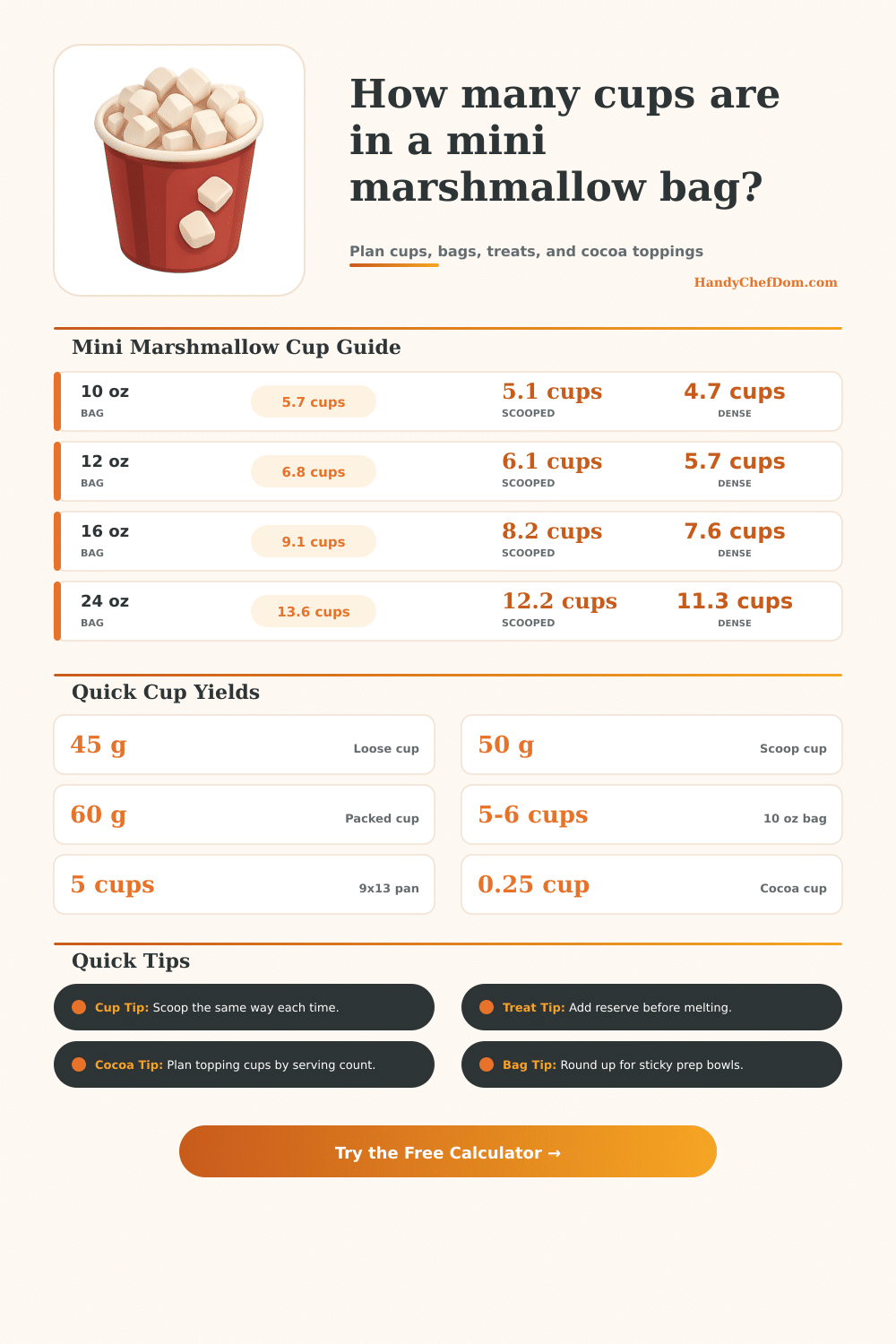
| 8 oz bag | 5.0 cups | 4.5 cups | 3.8 cups |
| 10 oz bag | 6.3 cups | 5.7 cups | 4.7 cups |
| 12 oz bag | 7.6 cups | 6.8 cups | 5.7 cups |
| 16 oz bag | 10.1 cups | 9.1 cups | 7.6 cups |
| 24 oz bag | 15.1 cups | 13.6 cups | 11.3 cups |
| 32 oz bag | 20.2 cups | 18.1 cups | 15.1 cups |
| Packing Style | Typical Density | Best Use | Cup Yield Effect |
|---|---|---|---|
| Loose poured | 45 g per cup | Cocoa bars and snack bowls | Highest cups per bag |
| Level scooped | 50 g per cup | Recipe cards and cereal treats | Balanced kitchen estimate |
| Settled cup | 55 g per cup | Pre-measured prep bins | Moderate yield reduction |
| Lightly packed | 60 g per cup | Sticky treat bowls | Lower cups per bag |
| Pressed measure | 65 g per cup | Dense melt prep | Lowest visible volume |
| Kitchen Use | Mini Marshmallow Cups | Serving Yield | Planning Note |
|---|---|---|---|
| 8x8 cereal treats | 3 cups | 9 squares | Small family pan |
| 9x9 cereal treats | 4 cups | 12 squares | Thicker snack pan |
| 9x13 cereal treats | 5 cups | 20 squares | Standard party pan |
| Half sheet treats | 10 cups | 40 squares | Large party tray |
| Hot cocoa bar | 0.25 cup each | 1 mug | Generous topping scoop |
| Dessert garnish | 0.08 cup each | 1 dessert | Light scatter topping |
| Mini Style | Base Density | Best Cup Setting | Yield Note |
|---|---|---|---|
| Classic vanilla minis | 50 g per cup | Level scooped | Most recipe labels match this style |
| Extra airy minis | 47 g per cup | Loose or scooped | More visible cups from the same bag |
| Fruity colored minis | 48 g per cup | Level scooped | Good for cocoa bars and party mixes |
| Vegan mini marshmallows | 52 g per cup | Settled cup | Slightly denser in many bags |
| Dehydrated mini bits | 45 g per cup | Loose poured | Small bits fill gaps more evenly |
| Homemade mini cubes | 54 g per cup | Settled cup | Powdered coating changes the scoop |
Cup weights are practical kitchen averages for mini marshmallow planning. Actual label yield can vary by brand, humidity, coating, and how firmly the measuring cup is filled.
Most people purchase a bag of mini marshmallows believing it will be sufficient for whatever recipe they’re making. More often then not, this is false. There’s a problem of density and also volume here which affects how much you think you’ll get out of a package versus what you actualy do. For example, one cup of marshmallows will contain more material if they was scooped loosely than if they were packed into a measuring cup. When scaling up your recipe to feed more people, this matter.
After selecting your packing style and bag size, the calculator does the math for you (above). No need to guess at conversions.
Why Marshmallow Measurements Matter
To help you understand why those entries matter, it’s important to know that packing density is the main factor of concern for home bakers. Minis poured out of the bag settle into an arrangement with air gaps in-between. That’s a loose measure. Pouring that same bag of ten ounces result in five or six cups, when loose. Scoop and gently pack to fill the voids, and you’ll get just four or five cups from the same bag. It makes all the difference when you are short on ingredients halfway through melting butter.
How about a recipe for cereal treat? To mix that cereal in a standard nine by thirteen inch baking dish, you need about five cups of melted marshmallow. How many marshmallows does that take? Well, if they’re poured loosely from a bag, a ten-ounce bag probably won’t be enough for a 9×13 pan; you’ll get some dry spots in the center.
But the tool knows that. And it figures out how much you need based off the way you measure. Want to include a ten percent buffer for tasting spoons and sticky bowls? No problem. Because sticky molten sugar sticks to side of the pot, too, and you don’t want to waste any of it.
Consider hot cocoa bars: Here the quantity changes from bulk volume to the amount for one person (a.k.a. “servings”). A heavy-handed sprinkling could be a quarter cup per serving; a dainty dusting is just an eighth of a cup. Multiply this by your guests and you’re looking at a fast-growing pile of fractions.
Enter the calculator, which takes your serving sizes and expresses that need as a number of whole bags. It helps you connect vague volume to specific buying. You won’t have to guess anymore. Just order up exactly what you need.
Measurements also vary by brand and humidity. Sugar + gelatin = mini marshmallow. And mini marshmallows respond to water in the air. Even though two bags may weigh exactly the same, they could of been purchased on different days, one on a humid day and one in dry weather, so the bag feels puffier or lighter. This leads to slight changes in your real-life cup yield based on where you store them.
People often treat volume as a fixed constant, but it’s actualy not. It’s not. It’s a fluid estimate based on how the product settle after it was shipped. These densities have been broken down nicely into specific categories with the reference tables that come with the tool. For casual things like snack bowls you can get away with a loose pour. You might want to use a level scoop for something more precise, like when you are baking. Then there’s packed measures if you want as much as you can possibly fit into a mould. Using the guide from the table and aligning your measurement style with what it suggests reduce the variation. Now you’ve got a process that gives you reliable results each time you bake.
Remember: marshmallows aren’t exact science, but it’s all about planning ahead. Round up with one more bag if unsure. No need to worry about an empty bowl once you start cooking. It is better to finish with a few too many mini-marshmallows to snack on afterwards than to run out while entertaining guests.
That’s where the calculator comes in. You’ll be able to see that buffer and turn guesswork into simple inventory management. Measure consistently every time, stock your pantry properly, and savor the experience without any stress.