🍚 Couscous Water Calculator
Calculate water, broth, oil, salt, cooked yield, and servings for Moroccan, Israeli, pearl, whole wheat, and larger couscous styles.
Enter dry couscous by cups, grams, or serving count. The calculator applies the selected couscous style ratio, broth blend, oil, salt, and covered rest buffer.
| Couscous Type | Liquid per Dry Cup | Dry Cup Weight | Cooked Yield |
|---|---|---|---|
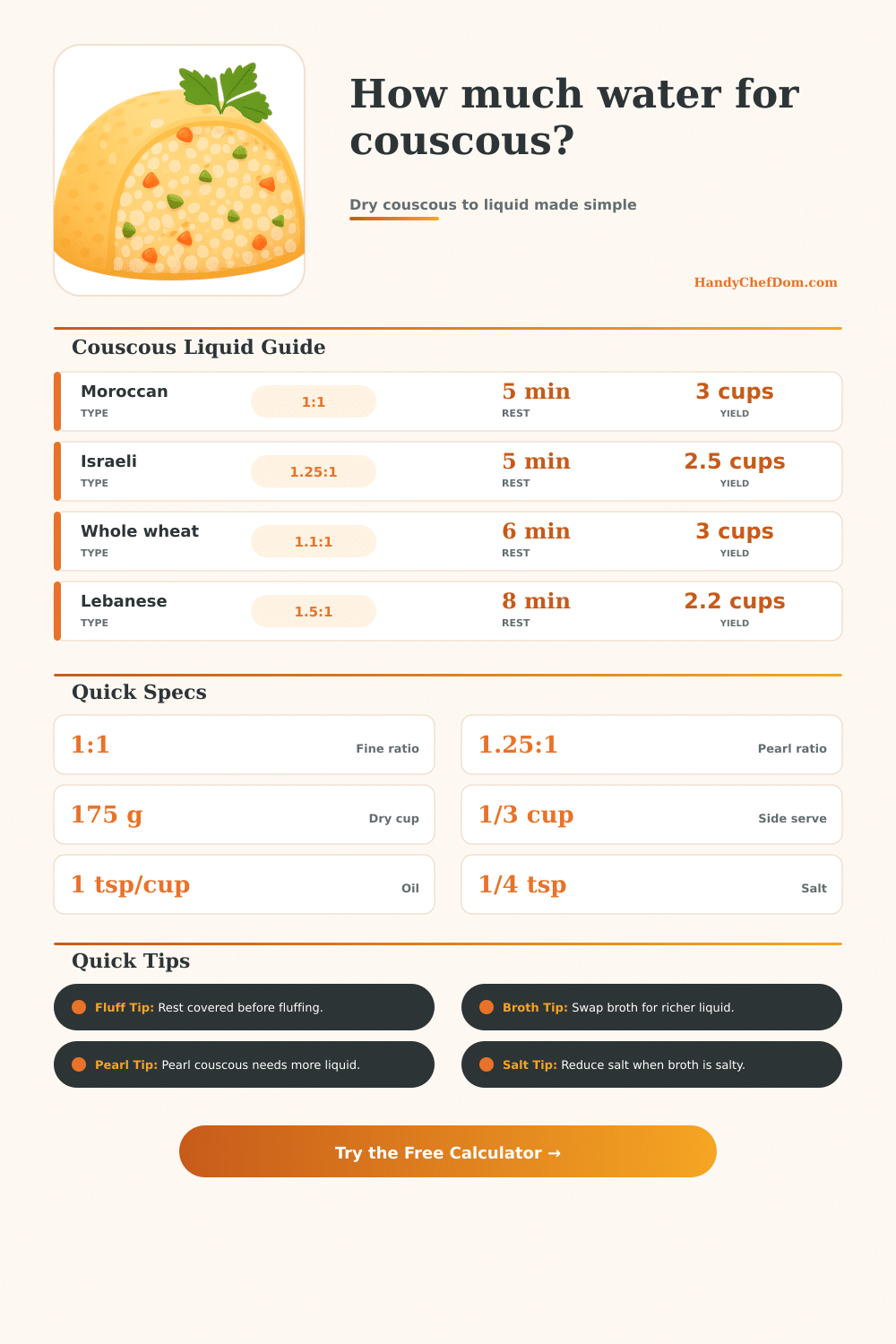
| Moroccan fine couscous | 1.00 cup | 175 g | 3.0 cups |
| Moroccan medium couscous | 1.05 cups | 175 g | 2.9 cups |
| Whole wheat couscous | 1.10 cups | 170 g | 3.0 cups |
| Instant couscous | 0.95 cup | 175 g | 2.8 cups |
| Israeli pearl couscous | 1.25 cups | 175 g | 2.5 cups |
| Tri-color pearl couscous | 1.25 cups | 175 g | 2.5 cups |
| Lebanese moghrabieh | 1.50 cups | 185 g | 2.2 cups |
| Maftoul couscous | 1.35 cups | 180 g | 2.4 cups |
| Serving Style | Dry Couscous Per Person | Cooked Portion | Best Use |
|---|---|---|---|
| Small tasting serving | 1/4 cup | 2/3 to 3/4 cup | Multi-side plate |
| Side dish serving | 1/3 cup | About 1 cup | Dinner plate |
| Main bowl serving | 1/2 cup | 1 1/4 to 1 1/2 cups | Grain bowl |
| Chilled salad serving | 3/8 cup | About 1 cup | Make-ahead salad |
| Buffet side serving | 0.30 cup | About 3/4 cup | Large spread |
| Group Size | Moroccan Dry | Moroccan Liquid | Israeli Liquid |
|---|---|---|---|
| 4 side servings | 1 1/3 cups | 1 1/3 cups | 1 2/3 cups |
| 6 side servings | 2 cups | 2 cups | 2 1/2 cups |
| 8 side servings | 2 2/3 cups | 2 2/3 cups | 3 1/3 cups |
| 12 side servings | 4 cups | 4 cups | 5 cups |
| 25 buffet servings | 7 1/2 cups | 7 1/2 cups | 9 3/8 cups |
| 40 buffet servings | 12 cups | 12 cups | 15 cups |
| Style | Oil or Butter | Salt | Covered Rest |
|---|---|---|---|
| Moroccan fine | 1 tsp per cup | 1/4 tsp per cup | 5 minutes |
| Whole wheat | 1 tsp per cup | 1/4 tsp per cup | 6 minutes |
| Israeli pearl | 1 1/2 tsp per cup | 1/4 tsp per cup | 5 minutes |
| Tri-color pearl | 1 1/2 tsp per cup | 1/4 tsp per cup | 5 minutes |
| Lebanese large | 2 tsp per cup | 1/3 tsp per cup | 8 minutes |
| Maftoul | 1 1/2 tsp per cup | 1/3 tsp per cup | 7 minutes |
The box tells you to cook couscous by pouring boiling water over top and waiting three minutes. Then it’s usually pretty dry in the middle, and kind of clunky. Maybe you screwed up? No. That’s just bare minimum. Badly prepared couscous is actualy fine; couscous are forgiving that way. But then there are certain types (fine Moroccan versus Israeli pearl couscous) that don’t fare well if you treats them identically.
The way it works is this: If you know how much of each ingredient goes in (a.k.a., your “variables”) but don’t want to do all that multiplication in your head, use a calculator. Input the variable; in this case, how many servings are you making? Which variety? And it spit out the answer. How much liquid-to-dry ingredients should be used? What does that translate into, in cups or tablespoons of water or broth or oil or salt? But you’ll have to know what the inputs represent in your cooking pot, otherwise, math won’t work right.
How to Cook Couscous Perfectly
The first key is what kind of grain. Fine Moroccan couscous are made from very tiny particles. It soaks up moisture fast and takes less time. You has to be exact with your measurement or else it will turn into glue. Pearl couscous, which has a tighter structure, require a higher proportion of water as well as a longer cook; otherwise it’ll stay tough, while using that same ratio for fine Moroccan couscous would make it turn soggy. Since the bigger ones such as Lebanese moghrabieh are just large enough to require much more moisture than the instant types, they’re included in the reference chart above.
Resting is a step that many home cooks simply skip. Stir it once, pour in boiling water, and onto the table we go. This is a recipe for disaster. At least 5 minutes after turning off the heat, the couscous must rest (covered) so steam will complete its work on the inside, and soften the outside more. And yes, you’ll have a light instead of dense dish. You would of had a fully-plumped up couscous, not a starchy, half-baked mass sitting in your mouth as a result of skipping this step.
Water isn’t everything; fat is important, too. A teaspoon of oil or butter per cup of dry couscous coats each grain, preventing them from sticking together during the fluffing process. Toss in some salt with your cooking liquid, not overtop after serving, but remember that grains absorbs the flavor from the inside out, so don’t be shy. Consider any sodium present in your liquid: If you’re using broth rather than water, include that in your math. Use the calculator to adjust the salt based off how strong your broth is. Is it full strength? dilute it?).
The other problem: how do you scale this up for more than just yourself? Making couscous for four is simple; making couscous for forty is something else entirely. How much water do you need to bring to temperature in what kind of pot? It removes the anxiety of whether you are adding enough water to fill the gaps between thousands of tiny grains. If the pot is too big, or if the heat is too high, your massive batch will have hotspots, some grains will turn to mush while others remains underdone. When you’re cooking for a lot of people, you want consistency over a larger surface area. This tool figures out for you how much liquid you need so every grain is cooked evenly. There’s no worry that you’ll add insufficient water to cover all those tiny gaps between grains.
Respecting the physical properties of couscous will make for good couscous. Couscous is not some magic trick that takes three minutes. There is a careful balance between separation, hydration and rest. Understanding the reasons behind different ratios helps you cook with intention (instead of just guesswork). The goal is light, separate grains that are more airy than dense. And when you get there, you know it isn’t an issue of time or effort but precision. By paying attention to how much water goes into your pot, you move from edibility to delight.