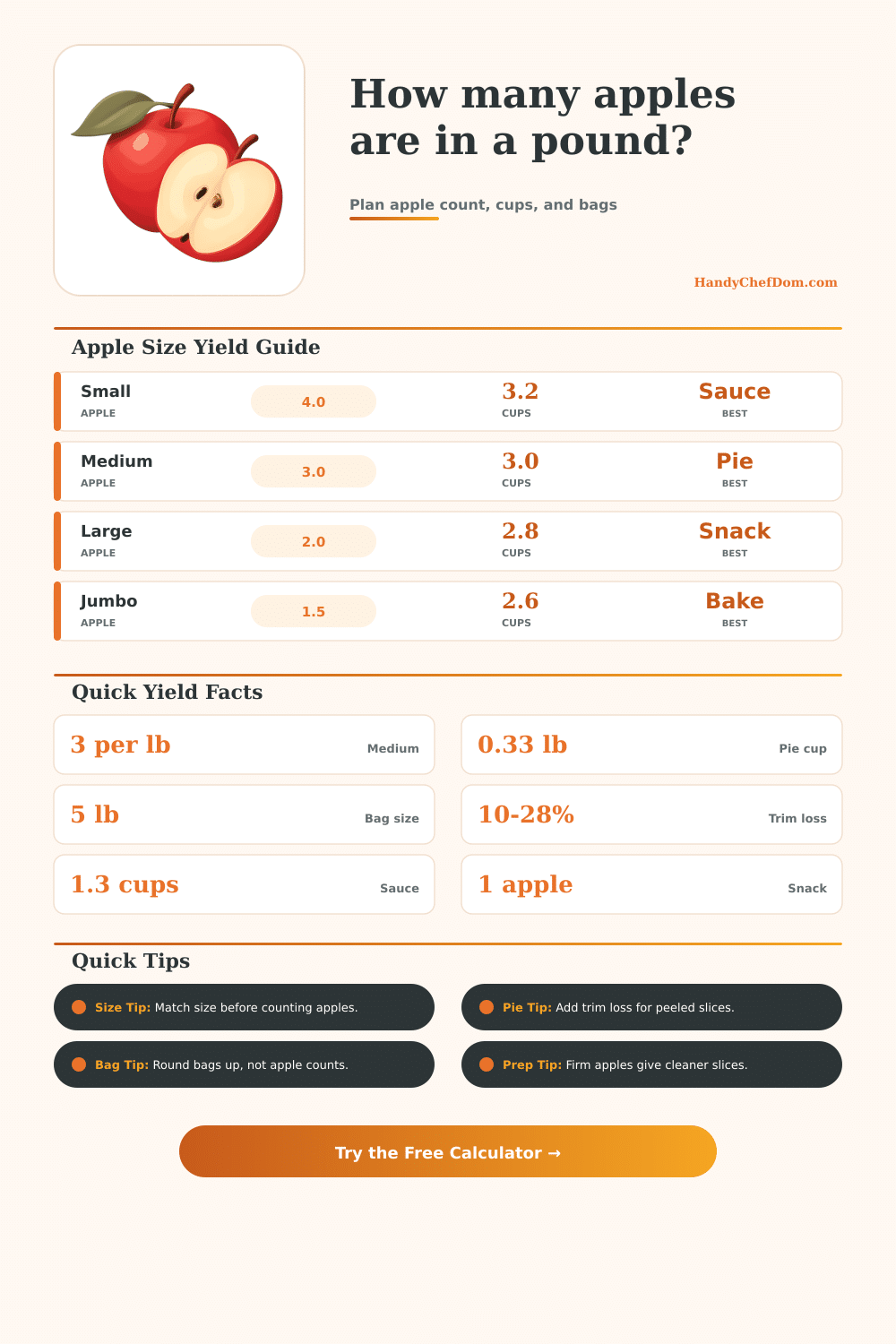
🍎 Apples Per Pound Calculator
Estimate apples per pound, sliced cup yield, peeled and cored loss, and bag planning for pie, sauce, snacks, salads, and baking prep.
Choose whether you are starting with pounds, apple count, needed cups, servings, or grocery bags. The calculator converts size and variety into apple count, usable sliced cups, trimmed yield, and bags to plan.
| Apple type | Typical size | Apples per lb | Cups sliced per lb | Best planning use |
|---|---|---|---|---|
| Gala | Medium | 3.1 | 3.15 | Snacks, salad, mixed pie filling |
| Honeycrisp | Large | 2.2 | 2.85 | Snacks, fresh slices, firm salads |
| Granny Smith | Medium-large | 2.6 | 3.00 | Pie, tart filling, crisp, cobbler |
| Fuji | Large | 2.4 | 2.90 | Snack bags, salads, sweet baking |
| Pink Lady | Medium | 2.9 | 3.05 | Fresh slices, pie blends, lunchbox prep |
| McIntosh | Small-medium | 3.4 | 3.25 | Sauce, soft baking, quick cooked apples |
| Rome | Large baking | 2.1 | 2.75 | Baked apples and structured filling |
| Small bag apples | Small | 4.0 | 3.20 | Kids snacks, sauce, high-count bags |
| Jumbo apples | Jumbo | 1.5 | 2.60 | Display snacks and large sliced plates |
| Use | Suggested prep | Loss to plan | Yield note | Typical amount |
|---|---|---|---|---|
| 9 inch pie | Peeled and cored slices | 22% | Firm packed sliced cups | 6 to 7 cups |
| Deep dish pie | Peeled, cored, extra slices | 24% | Plan a taller mound | 8 to 10 cups |
| Applesauce | Cored chunks, peel optional | 14% | Cooked cups are lower | 1.2 to 1.5 cups per lb |
| Whole snacks | Whole apples | 0% | Count apples, not cups | 1 apple per serving |
| Fresh salad | Cored, unpeeled slices | 10% | Thin slices fill more cups | 0.5 to 1 cup each |
| Crisp or crumble | Peeled or unpeeled slices | 18% | Loose sliced cups work | 5 to 8 cups |
| Freezer slices | Peeled and cored slices | 24% | Use finished cup packs | 3 to 4 cups per bag |
| Bag size | Medium apple count | Large apple count | Usable pie cups | Best use |
|---|---|---|---|---|
| 3 lb bag | 9 apples | 6 to 7 apples | 7.0 cups | One crisp or small snack week |
| 4 lb bag | 12 apples | 8 to 10 apples | 9.4 cups | Deep dish pie or snack mix |
| 5 lb bag | 15 apples | 10 to 12 apples | 11.7 cups | Pie plus a few snacks |
| 8 lb bag | 24 apples | 17 to 19 apples | 18.7 cups | Two pies or sauce prep |
| 10 lb bag | 31 apples | 21 to 24 apples | 23.4 cups | Bulk baking, freezer, sauce |
| 15 lb box | 46 apples | 32 to 36 apples | 35.1 cups | Large prep day, not bushel sizing |
| Cups needed | Medium apples | Approx pounds | With peeled loss | Common use |
|---|---|---|---|---|
| 2 cups | 2 apples | 0.7 lb | 0.9 lb | Small salad or topping |
| 4 cups | 4 apples | 1.3 lb | 1.7 lb | Small crisp or freezer pack |
| 6 cups | 6 apples | 2.0 lb | 2.6 lb | Standard 9 inch pie |
| 8 cups | 8 apples | 2.7 lb | 3.4 lb | Deep pie or crumble |
| 10 cups | 10 apples | 3.3 lb | 4.3 lb | Large pie mound or sauce |
| 16 cups | 16 apples | 5.3 lb | 6.8 lb | Two pies or batch prep |
If there’s such a thing as kitchen panic, it might be standing in front of a recipe that calls for six cups of sliced apples, only to have a bag that says: “five pounds.” You think those measurements mean the same thing, but unless you factor in peeled, cored weight, and keep in mind that each variety is a different size apple, they dont. That is, until now.
The calculator up top figure all that math for you after you input amount you want and the kind of apple you plan on using. It also takes the guessing out off how to convert it. So you know exactly what you need to buy which saves both your money and your pie crust.
How to Use an Apple Calculator for Baking
Which is the point: Volume (or count) isn’t necessarily proportional to weight when talking about an organic product. A pound of small McIntosh apples contains nearly twice as many fruit as a pound of large Honeycrisp ones. That’s fine if you’re turning them all into sauce since everything will be pureed anyway. But for a pie filling, density do matter. The volume and shape of each slice will either make your creation look pathetic or overflow the cup.
It’s impossible to purchase by the recipe; you must first understand what you’re purchasing, then estimate based off that. Trim Loss: Trim loss is the difference between the apple on the tree and the apple in your bowl, usually a lot (it’s what most home cooks forget!). When you peel and core an apple, you lose a wedge of inedible tissue called the core, and that loss gets even greater when you also peel. This tool accounts for the impact of your prepping strategy (do you want to core or do you want to peel, as well?).
If you want to peel, then you must begin with slightly heavier pounds of raw fruit in order to reach your target cup count. Otherwise, you’ll buy the correct weight but there won’t be enough of the actual flesh to make a pie… And too few apples makes a pie all too common. This way, you’ll always know exactly how many pounds of raw apples to buy.
The whole equation revolves around variety. Specifically, it is about what that variety will yield in terms of texture and size. If you use Granny Smith, for instance (a firm apple), you get nice, intact slices; if you opt for something softer (like a gala or fuji), it’ll break up more quickly, a good thing for making sauce but no good at all in a structured dessert such as a pie.
How many pieces are there to a pound? That’s shown in the chart on the page, so a small gala, for example, has more by weight than a big fuji. This is not a small detail. Knowing which apple to choose for the task ensures either happy results or, more likely, a sense of being thwarted by mushiness (or worse: an empty pan).
There’s also the fact that packaged foods sold at the supermarket are prepackaged by size (usually between three and five pounds). You might need four pounds worth of sliced apples, for example, but all the store has is five-pound bags: do you round up? Is it worth it? Do you scale back your recipe accordingly? Should you buy the extra bag?
You might have enough left over to snack on or use in something else later. This transforms what would of been wasted food into a safety net. This is where the calculator factors in. It’s planning, not merely cooking. It’s resource management. The details may feel like overkill but these are the real factors to consider when you want an end result.
Count depends on size. Yield depends on prep method. Loss rate depends on variety. Get all those variables in line and the math adds up, meaning you no longer guess your way to a product, but produce consistent results instead.
Next time a bag of apples catches your eye, read the weight label, but first take a peek at how big those fruits are inside. A simple visual will clue you in to whether or not you’ll have more (or less) work on your hands different than what’s listed on a price tag can convey. Add this little bit of consciousness with some mental math and you’ve transformed a potentially chaotic scenario into a neatly packed plate of food. It all comes from shifting perspective. And it makes all the differance.