🍚 Soy Sauce for Fried Rice Calculator
Estimate soy sauce for fried rice from cooked rice cups, servings, soy type, saltiness target, proteins, eggs, other sauces, pan style, and low-sodium goals.
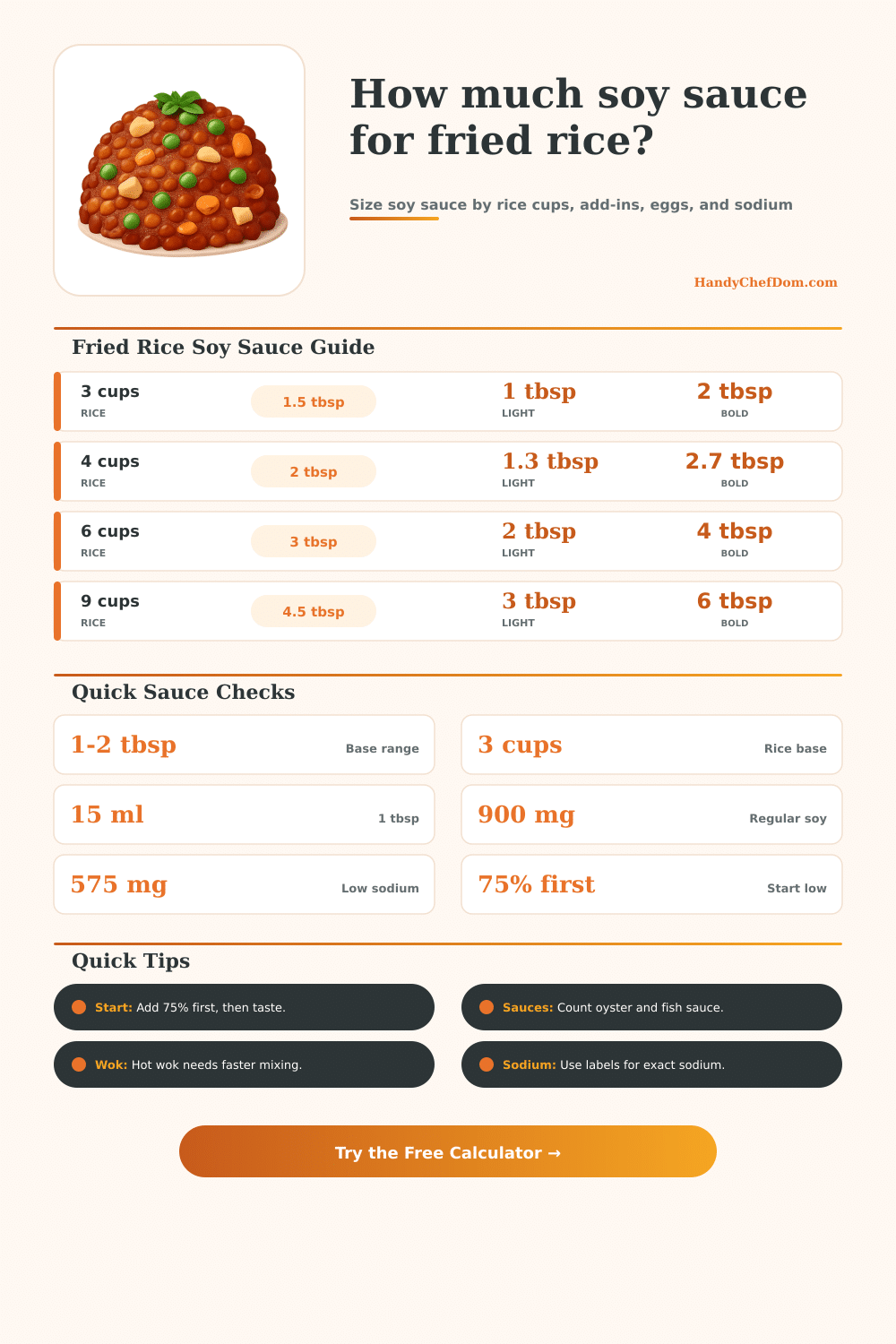
The classic reference is 1 to 2 tablespoons soy sauce per 3 cups cooked rice. This calculator starts from that range, then adjusts for saltiness target, soy sauce type, add-ins, eggs, other salty sauces, pan style, and a per-serving sodium target.
Strong all-purpose choice; use the lower side when sausage, ham, or oyster sauce is included.
Good for larger batches because it gives soy flavor while leaving room for eggs and protein.
Useful for color; pair with less total sauce because the flavor can get molasses-heavy.
Lower sodium and sweeter; the calculator allows more volume but flags a softer salt balance.
| Soy sauce type | Typical sodium per tbsp | Best fried rice use | Calculator note |
|---|---|---|---|
| Regular soy sauce | About 900 mg | Classic fried rice flavor | Default salt reference for balanced batches. |
| Low sodium soy sauce | About 575 mg | Family portions or sodium caps | Needs more volume for the same salty impact. |
| Chinese light soy sauce | About 920 mg | Clean salty seasoning | Similar to regular soy but often sharper. |
| Chinese dark soy sauce | About 750 mg | Color boost and caramel tone | Use less if color is the main goal. |
| Tamari | About 1000 mg | Wheat-free style fried rice | Can be saltier, so the calculator trims volume. |
| Coconut aminos | About 270 mg | Lower sodium, sweeter bowls | Gives color but less classic soy bite. |
| Cooked rice amount | Typical servings | Light soy sauce range | Balanced soy sauce range |
|---|---|---|---|
| 2 cups cooked rice | 1 to 2 servings | 2 teaspoons to 1 tablespoon | About 1 tablespoon for a small skillet. |
| 3 cups cooked rice | 2 to 3 servings | 1 tablespoon | 1.5 tablespoons is the classic middle. |
| 4 cups cooked rice | 3 to 4 servings | 1.3 tablespoons | About 2 tablespoons before add-ins. |
| 6 cups cooked rice | 4 to 6 servings | 2 tablespoons | About 3 tablespoons for balanced seasoning. |
| 9 cups cooked rice | 7 to 9 servings | 3 tablespoons | About 4.5 tablespoons in a tray batch. |
| Add-in or protein | Soy sauce direction | Sodium caution | How calculator adjusts |
|---|---|---|---|
| Plain rice and aromatics | Slightly less soy sauce | Salt comes mostly from soy sauce. | Uses a 0.92x add-in factor. |
| Vegetables, peas, carrots | Neutral or small increase | Vegetables dilute sauce without much sodium. | Uses the balanced 1.00x factor. |
| Chicken, pork, beef, or tofu | Small sauce increase | Unsalted protein needs direct seasoning. | Uses a 1.07x add-in factor. |
| Shrimp or seafood | Moderate, not too heavy | Seafood may already taste briny. | Uses a 1.03x add-in factor. |
| Ham, bacon, lap cheong | Reduce soy sauce | Salty meat can dominate the whole pan. | Uses a 0.82x add-in factor. |
| Protein-heavy dinner bowl | Increase but watch sodium | More food volume needs seasoning. | Uses a 1.15x add-in factor. |
| Sauce combination | Flavor direction | Salt impact | Best calculator setting |
|---|---|---|---|
| Soy sauce only | Clean, classic fried rice | Predictable sodium from one sauce. | Set other sauces to none and use balanced target. |
| Soy plus oyster sauce | Rounder, sweeter, glossy | Oyster sauce adds sodium and body. | Enter oyster sauce teaspoons as other sauce. |
| Soy plus fish sauce | Deep savory aroma | High salt impact from a small amount. | Use fish sauce option and keep soy conservative. |
| Light plus dark soy | Salt plus color control | Dark soy is more for color than salting. | Use dark soy type if most volume is dark soy. |
| Soy plus sweet sauce | Sweeter takeout-style rice | Less sharp salt, more sugar-like balance. | Use hoisin, teriyaki, or sweet soy setting. |
In order to determine the correct amounts of soy sauce to add to the fried rice, it is important to understanding how the amount of soy sauce will determine the flavor of the rice. If there is to little soy sauce in the rice, the fried rice will be flavorless. However, if there is too many soy sauce in the rice, the fried rice will be too salty to eat.
The amount of soy sauce that the recipe require can depend on a variety of factors, such as the volume of the rice to be used, the ingredients that are added to the pan in which the rice are fried, and the heat level of the burner on which the cook will place the pan. Each of these factor can change constantly, which is why a set rule for the amount of soy sauce that should be used will not always work in each instances. The ingredients that are added to the fried rice will impact the amount of soy sauce that is needed.
How Much Soy Sauce to Add to Fried Rice
For instance, ingredients that contains moisture, such as eggs, will contain the same amount of sodium as the soy sauce, but will help to even out the saltiness of the soy sauce, allowing for the use of more soy sauce if products like eggs is added to the rice. Additionally, ingredients that contain water, such as vegetables, will also dilute the flavor of the soy sauce, requiring more soy sauce to provide the rice with flavor. Ingredients that also contain sodium, such as ham or bacon, will counteract the effect of adding soy sauce, forcing the recipe to use lesser soy sauce if ham or bacon are used.
These factors is accounted for in the calculator to determine the proper amount of soy sauce. Factors such as the type of pan used to cook the rice and the heat level of the stove will alter the flavor of the soy sauce in the rice. For instance, pans that are heated to high temperatures will cause some of the liquid in the soy sauce to evaporate.
As a result, the soy sauce will be more concentrated in the rice if the pan is very hot. Additionally, pans that are wider than others may retain more steam than the rice will lose to larger pans, which means that the soy sauce will be less concentrated in the rice if it is cooked in an wider pan. These factors are also considered in the calculator so that the cook can determine the proper amount of soy sauce based off the heat level of the stove on which the pan will be placed.
Sodium levels are another factor to consider in the recipe. Soy sauce contain sodium, and an excessive amount of sodium in the rice may not be good for the health of those who eats the rice. Regular soy sauce contains approximately nine hundred milligrams of sodium per tablespoon.
Low-sodium soy sauce, however, contains only approximately five hundred seventy-five milligrams of sodium per tablespoon. If fried rice is to be prepared for children or individuals with high blood pressure, the sodium content of the rice should be tracked. Such tracking is one of the feature of the soy sauce calculator.
Other sauces that may be added to the rice will alter the amount of soy sauce that should be used in the recipe. Sauces like oyster sauce and fish sauce contains elements of salt and sweetness that will contribute to the flavor of the rice in the same way that soy sauce does. Therefore, if either of these sauces are used in the frying of the rice, the cook should reduce the amount of soy sauce that is added.
The calculator allows for the amount of oyster sauce and fish sauce to be accounted for. Additionally, some may wish to hold back some of the soy sauce until after the rice is cooked so that the soy sauce flavor is not too strongly when eaten. Such an adjustment to the recipe can also be accounted for by the soy sauce calculator.
Finally, while the soy sauce calculator will help to remove guesswork in the kitchen, it is still essential that the cook taste the rice to ensure the flavor is to taste. While the soy sauce calculator may help determine the amount of soy sauce that should be used in the recipe, adjustments can be made according to the taste of the cooked rice. For instance, when the rice is hot to the touch and the eggs (if any are used) is set, the cook can evaluate the taste of the soy sauce.
The soy sauce calculator can be used to make decisions regarding the recipe when the rice contains many vegetable or moderate heat on the stove, as well as when the rice contains many shrimp or experiences high heat on the stove. Thus, while the soy sauce calculator provide a map for the soy sauce to be used in the rice, the final test of the taste of the soy sauce is always required to ensure the fried rice is prepared in the way that one desires.