🥕 Carrots Per Pound Calculator
Estimate carrot counts, trimmed yield, cups, and servings for baby carrots, medium carrots, large carrots, roasting trays, stews, and slaw bowls.
Choose whether you are starting with servings, carrot count, raw weight, or measured cups. The calculator adjusts for carrot size, peel or trim loss, and the way the carrots are cut.
| Carrot Type | Average Weight | Per Pound Count | Best Use |
|---|---|---|---|
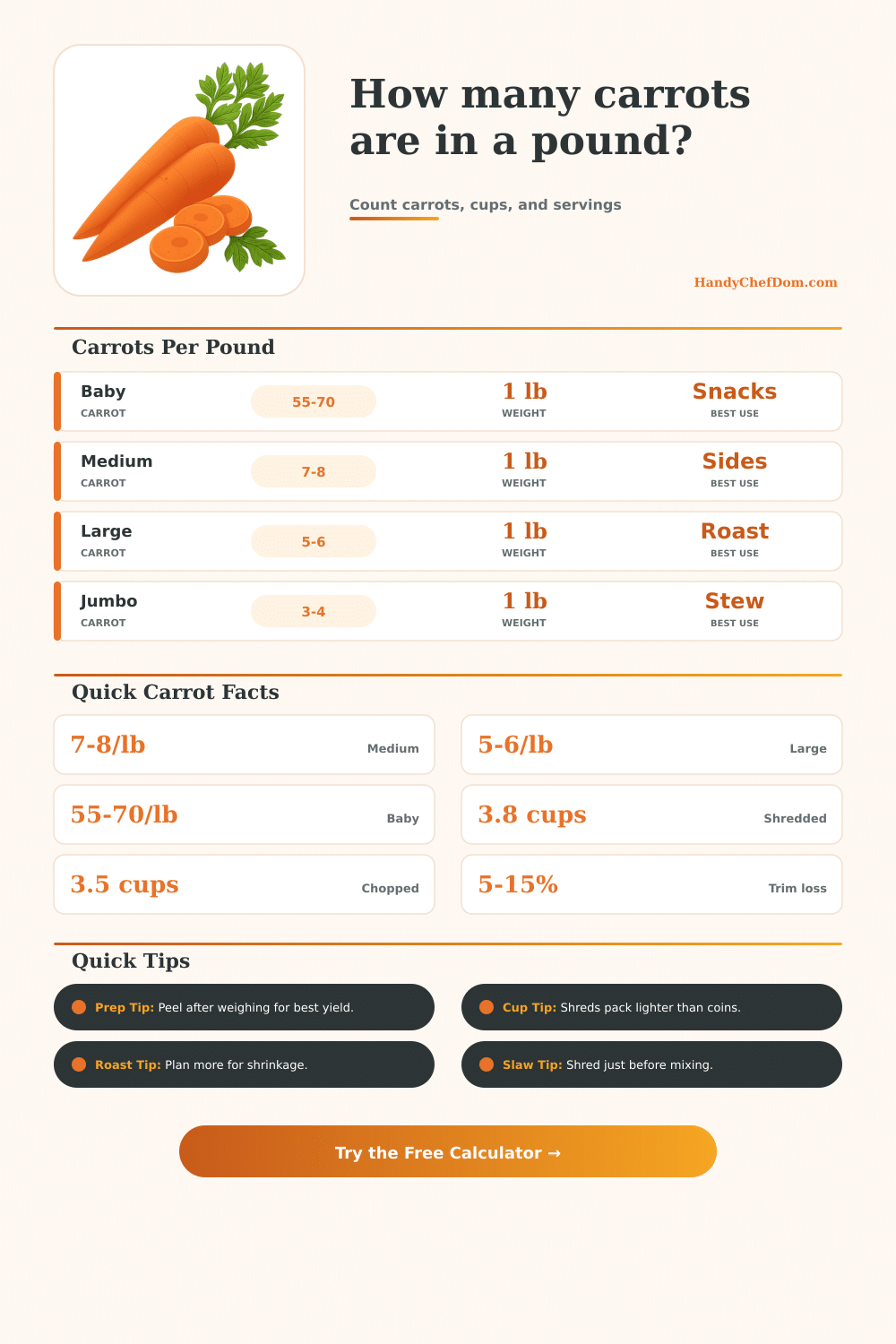
| Baby-cut carrots | 7 g each | 55 to 70 pieces | Snack trays, lunch boxes, quick roasts |
| Medium carrots | 61 g each | 7 to 8 carrots | Everyday sides, chopping, shredding |
| Large carrots | 78 g each | 5 to 6 carrots | Roasting, coins, stews, meal prep |
| Jumbo carrots | 120 g each | 3 to 4 carrots | Large dice, soups, stocks, puree |
| Mixed bunch carrots | 55 g each | 8 to 9 carrots | Flexible kitchen prep when sizes vary |
| Bagged shredded carrots | Ready cut | About 1 lb bag | Slaw, salads, bowls, fast saute prep |
| Pre-sliced carrot coins | Ready cut | About 1 lb bag | Stews, soups, casseroles, sheet pans |
| Cut Style | Cups Per Pound | Grams Per Cup | Planning Note |
|---|---|---|---|
| Whole carrots | Not a cup measure | Varies by size | Best estimated by carrot count and raw weight |
| Baby carrot pieces | 3.0 cups | 150 g | Loose cup measure for snacks and dipping |
| Sliced coins | 3.6 cups | 126 g | Good estimate for soups, stews, and saute prep |
| Chopped carrots | 3.5 cups | 130 g | Useful for mirepoix, stews, and meal prep bowls |
| Shredded carrots | 3.8 cups | 120 g | Looser pack for slaw, salads, and carrot cake prep |
| Matchstick carrots | 3.9 cups | 116 g | Lightly packed for bowls, salads, and garnishes |
| Cooked puree mash | 2.1 cups | 216 g | Denser cooked measure after moisture release |
| Serving Use | Raw Per Person | Trim/Cook Note | Common Cut |
|---|---|---|---|
| Roasting side dish | 5.5 oz | Plan for trim plus roast shrink | Large sticks or coins |
| Stew or soup | 3.2 oz | Moisture stays mostly in the dish | Coins or chopped |
| Carrot slaw | 2.6 oz | Raw shredded yield stays high | Shredded or matchstick |
| Snack tray | 4.0 oz | Little cooking loss, more trim if hand cut | Baby pieces or sticks |
| Cooked side | 4.0 oz | Moderate shrink after steaming or sauteing | Coins or chopped |
| Meal prep bowls | 3.5 oz | Balanced amount with grains and protein | Shredded, coins, or diced |
| Juice or blender prep | 8.0 oz | High raw weight for a small drink yield | Chopped or large pieces |
| Group Size | Roasting Carrots | Stew Carrots | Slaw Carrots |
|---|---|---|---|
| 4 servings | 1.4 lb raw | 0.8 lb raw | 0.7 lb raw |
| 6 servings | 2.1 lb raw | 1.2 lb raw | 1.0 lb raw |
| 8 servings | 2.8 lb raw | 1.6 lb raw | 1.3 lb raw |
| 12 servings | 4.2 lb raw | 2.4 lb raw | 2.0 lb raw |
| 25 servings | 8.6 lb raw | 5.0 lb raw | 4.1 lb raw |
| 50 servings | 17.2 lb raw | 10.0 lb raw | 8.1 lb raw |
Why? The volume isn’t quite what it appears to be. In fact, once you peel and chop them, those big-looking carrots you purchased shrinks up and seem smaller. That’s a common experience for home cooks who do there meal planning by sight, as opposed to weight.
Knowing how much a pound of carrots measures help with shopping, and prepping, as well. It makes it a numbers game instead of a guess.
Why Weight Is Better Than Volume for Carrots
Trim is where most folks drop the ball. The peel and green top add major weight that will not reach your mouth. Once you select your desired cut style and target number of servings, the calculator do the rest. (See above.) It accounts for difference between raw bulk and the edible yield. You input the number of people you’ll be feeding, and whether they’re getting light snack-sized portion or larger side-dish portions. It even takes into account cooking shrinkage. Roasted carrots loses more moisture than those simmering in a stew broth. You want roughly the same portion size when it’s cooked as when it’s plated.
Prep workflow depend entirely on your chosen carrot size. For example, baby carrots are handy but have lots of surface area compared to there weight. Medium carrots is the ideal compromise for shredding/chopping. If you choose large or jumbo, plan on spending time peeling. They reward you, however, with substantial chunk for roasting.
That’s made clear in the reference table on the page. You may get as many as fifty-five pieces in a pound of baby carrots; just three in a pound of jumbo roots. Not only does that vary the count, it will also affect evenness of cooking. Uniform-size cuts creates uniform texture throughout the dish.
To make matters more complex, prep style also changes the volume-to-weight ratio. Sliced coin shapes fill the package in one way; shredded carrots in another. Because there’s space between the strings of shredded, a cup of those will weigh less than a cup of chopped carrot slices. Depending on proportions, if you’re using cups as your measurement, this could of result in either a dense cake or a slushy slaw.
The calculator closes the gap between what you read and what you shop for. It translates volumes used in recipes into weights that our imperfect systems require us to buy. This is also where most plans fall short: trimming behavior. Carrots that have been scrubbed will weigh much more than those peeled. Plan for a larger amount of waste if you’re doing thorough cleaning. This variable can be adjusted in the tool; it’s based off what happens in your own kitchen. A plan that accounts for 10% loss instead of 5 might make all the difference between a full or empty plate. This slight tweak has big impact on meal satisfaction.
Carrots are rich in fiber and beta-carotene (which doesn’t break down with cooking, but roasting may bring out its sugars), making them one of more versatile veggies beyond just being a side dish. They marry nicely in things like cake, soups, and even hearty sauces. The proportions work for one serving or many servings. Whatever your carrot needs, from feeding a crowd to a few days’ worth of meals in a meal-prep container; you’ve got the right amount.
But what about carrots? Carrots are not just another vegetable; they’re an ingredient with a measurable property. Volume conceals the truth. Weight reveals it. Once you know exactly how many carrots make a pound, you no longer fret over running out or overfilling your plate (or any bowl). You shop purposefuly. You chop with care. You cease to treat the bin at the grocery store like a mystery and instead see it as a resource.