🍞 Bread Slices Per Loaf Calculator
Estimate usable slices, heels, sandwiches, toast servings, and tray pieces from loaf weight, loaf style, slice thickness, and serving plan.
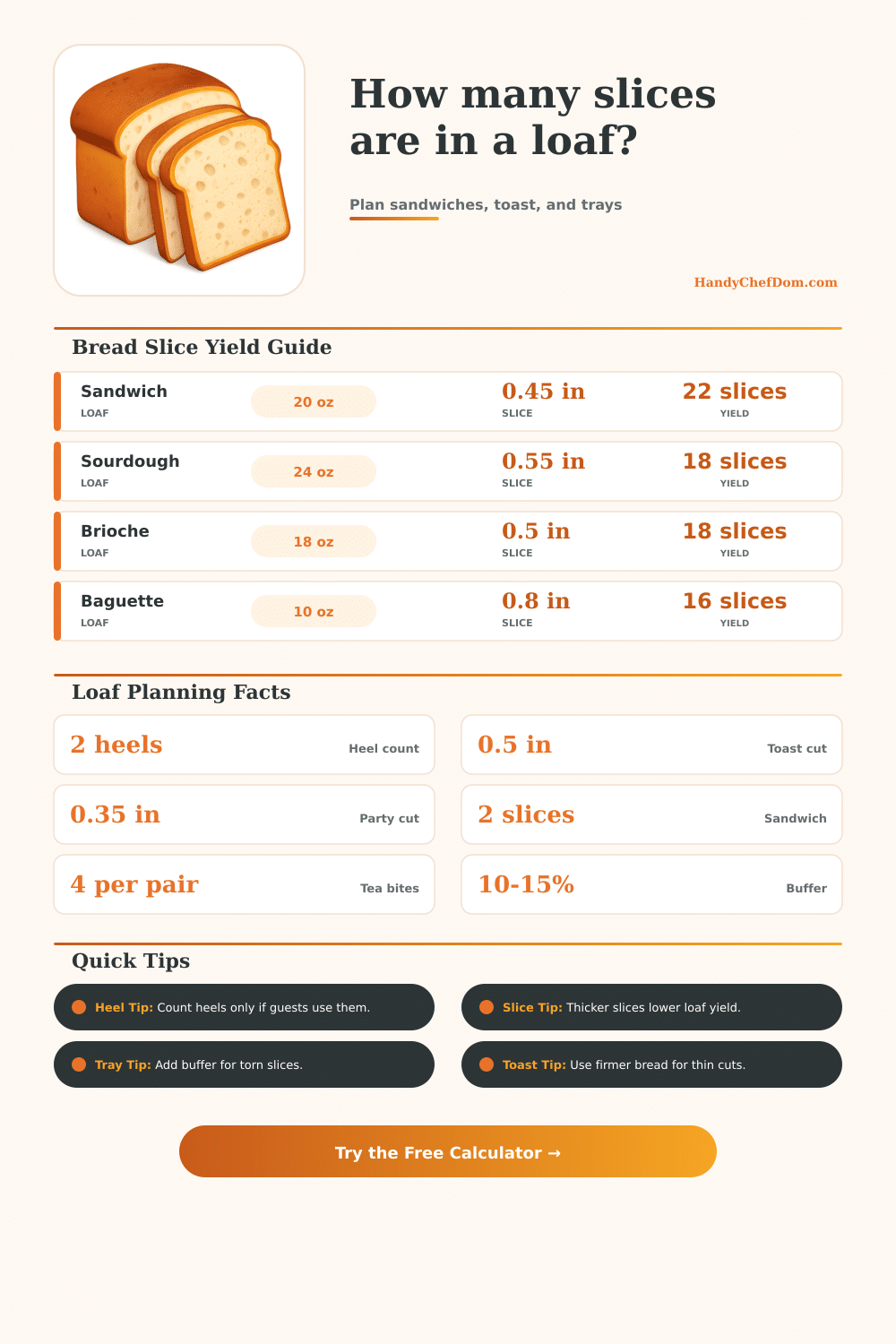
Use actual loaf weight when available. The calculator estimates physical slice yield from loaf style density, slice thickness, heel choice, and practical waste from uneven ends or broken slices.
| Bread style | Typical weight | Usable length | Common slice yield |
|---|---|---|---|
| Pullman sandwich loaf | 20 to 24 oz / 565 to 680 g | 9.0 to 10.5 in | 20 to 26 slices plus heels |
| Whole wheat pan loaf | 20 oz / 565 g | 8.5 to 9.5 in | 18 to 24 slices plus heels |
| Sourdough boule | 24 to 32 oz / 680 to 900 g | 9.0 to 11.0 in cut path | 16 to 22 broad slices |
| Artisan batard | 18 to 26 oz / 510 to 735 g | 11.0 to 14.0 in | 18 to 28 oval slices |
| Brioche loaf | 16 to 20 oz / 450 to 565 g | 8.0 to 9.5 in | 16 to 22 tender slices |
| Deli rye loaf | 24 to 32 oz / 680 to 900 g | 10.0 to 12.0 in | 22 to 30 firm slices |
| Baguette | 8 to 12 oz / 225 to 340 g | 20.0 to 24.0 in | 24 to 36 bias-cut pieces |
| Ciabatta loaf | 14 to 20 oz / 400 to 565 g | 10.0 to 13.0 in | 12 to 20 wide slices |
| Slice use | Thickness | Metric thickness | Best planning note |
|---|---|---|---|
| Party canapes | 0.30 to 0.38 in | 0.8 to 1.0 cm | Use firm bread and add extra for fragile edges. |
| Standard sandwiches | 0.40 to 0.50 in | 1.0 to 1.3 cm | Two slices per sandwich is the main planning unit. |
| Toast plates | 0.50 to 0.65 in | 1.3 to 1.7 cm | Thicker cuts feel generous but reduce loaf count fast. |
| French toast | 0.70 to 1.00 in | 1.8 to 2.5 cm | Use enriched or day-old loaves for cleaner cuts. |
| Crostini rounds | 0.45 to 0.75 in | 1.1 to 1.9 cm | Bias cuts increase surface area but lower count. |
| Deli rye service | 0.35 to 0.45 in | 0.9 to 1.1 cm | Dense loaves hold thin slices better than soft bread. |
| Serving plan | Slices per guest | 20-slice loaf covers | 26-slice loaf covers |
|---|---|---|---|
| Light toast side | 1 slice | 20 guests | 26 guests |
| Breakfast toast | 2 slices | 10 guests | 13 guests |
| Full sandwiches | 2 slices | 10 sandwiches | 13 sandwiches |
| Club sandwiches | 3 slices | 6 sandwiches | 8 sandwiches |
| Tea quarters | 0.5 slice per piece | 40 pieces | 52 pieces |
| Open-face tray | 1 slice | 20 portions | 26 portions |
| Guest count | Toast only | Full sandwiches | Party quarters |
|---|---|---|---|
| 6 guests | 12 slices / 1 loaf | 12 slices / 1 loaf | 24 pieces / 1 loaf |
| 12 guests | 24 slices / 2 loaves | 24 slices / 2 loaves | 48 pieces / 2 loaves |
| 24 guests | 48 slices / 3 loaves | 48 slices / 3 loaves | 96 pieces / 3 loaves |
| 36 guests | 72 slices / 4 loaves | 72 slices / 4 loaves | 144 pieces / 4 loaves |
| 50 guests | 100 slices / 5 loaves | 100 slices / 5 loaves | 200 pieces / 5 loaves |
| 75 guests | 150 slices / 8 loaves | 150 slices / 8 loaves | 300 pieces / 8 loaves |
You have purchased A beautiful loaf of sourdough. It’s big on the countertop. When you pick it up, it’s weighty. You’re going to make some sandwich for eight and think: Two loaves should be fine. And then you begin to slice. Because bread is still soft, initial slices is generous. By mid-loaf, you’re thinning them out so as not to squash the crust. All at once, you look down and notice that what seemed like a huge loaf has dissapears into just six good sandwich and a pile of crumb.
Everyone who buys, or bakes (artisan bread know this feeling). The visual size of a loaf never corresponds very closely to its serving power. This leaves most of us guessing when it comes time to plan an event (unless we plug our weight and preferred slice size into the above calculator, which eliminates need for math).
Why Your Bread Runs Out Faster Than You Think
Generally speaking, a typical white sandwich loaf will produce roughly twenty-two slices. Why? Because that’s how many fit into a given pan, and they all have equal thickness and bake evenly, too. But what happens when you swap out common white loaf for a baguette or a rustic boule? All bets are off.
The shape of your bread determine the amount of waste in crust and heel. Round breads don’t feature any flat sides for slicing, meaning every slice has less of soft interior and more of the inedible perimeter. This geometry doesn’t work in your favor; it won’t factor into your calculations based off weight alone.
Most people aren’t thinking about this until now: Thickness. Before we talk cuts, we need to address the slice itself. What is a slice? A slice will change greatly depending on what you want it to be. A quarter-inch thick piece makes for nice canapé; you’ll get twice as many per loaf (twenty-eight) different than if you’re cutting toast-thick slices (eighteen). Why does it matter? Perception and structure. When you see a thick slice, it feels indulgent. It’s hearty, and it takes up more space on a breakfast plate. With a thin slice, you can make dainty tea sandwiches. You won’t over-fill the sandwich or make your bread look like the star. Thickness matter because it will dictate how many guest you can feed.
Most cooks overlook a key element: the tool takes into account breakage and waste. When cutting bread with a dull knife, or using bread that’s already slightly stale, there will be some amount of wasteful tearing. Stacked on a tray, heels will eventually crumble. For a fancy meal, you may wish to simply not count the heels as part of your servings at all. Are you baking breadcrumb stuffing? Those heels aren’t waste anymore; they’re now a precious ingredient. You can choose how much waste to include based off what you’ll actualy do with it. This helps force you to consider whether that gnarly heel is still food or garbage.
But what about density? How much does that impact yield? Whole wheat or dense rye loaves contains more mass in the same physical volume than, say, an airy brioche. A 20-ounce rye loaf may well make more usable slices than a 20-ounce loaf of sweet dough, since cuts will be firmer and therefore less likely to compress under weight. That’s laid out side by side in the reference table on the page, which compares the styles and shows how you can’t assume that all loaves is interchangeable units just because they have the same weight. Take the structure of the crumb into consideration when figuring your portions.
With crowds, leave yourself a buffer: plan for 10-15% more. Slices drop. People’s appetites varies. If you ask it to, the tool will add that safety margin for you. It turns a raw number into a usable shopping list. No more fretting over whether there’ll be enough halfway through the meal. Now you know just how much bread to purchase for the event.
Next time you’re standing there staring at the bakery case. Or your own baking table (don’t stare at the loafs girth alone). What shape is the crust? How thick are the slices going to be? Consider the thickness of the slice and the shape of the crust. That’s what matters most, not the poundage on the scale. With that in mind, plan accordingly and you would of never find yourself short again. Measure it right from the beginning, and the bread will last as long as your patience lasts.