🥚 Mayonnaise Egg Substitute Calculator
Replace eggs with mayonnaise in cakes, brownies, muffins, meatloaf, and binder-style mixes while scaling tablespoons, cups, oil trims, and liquid adjustments.
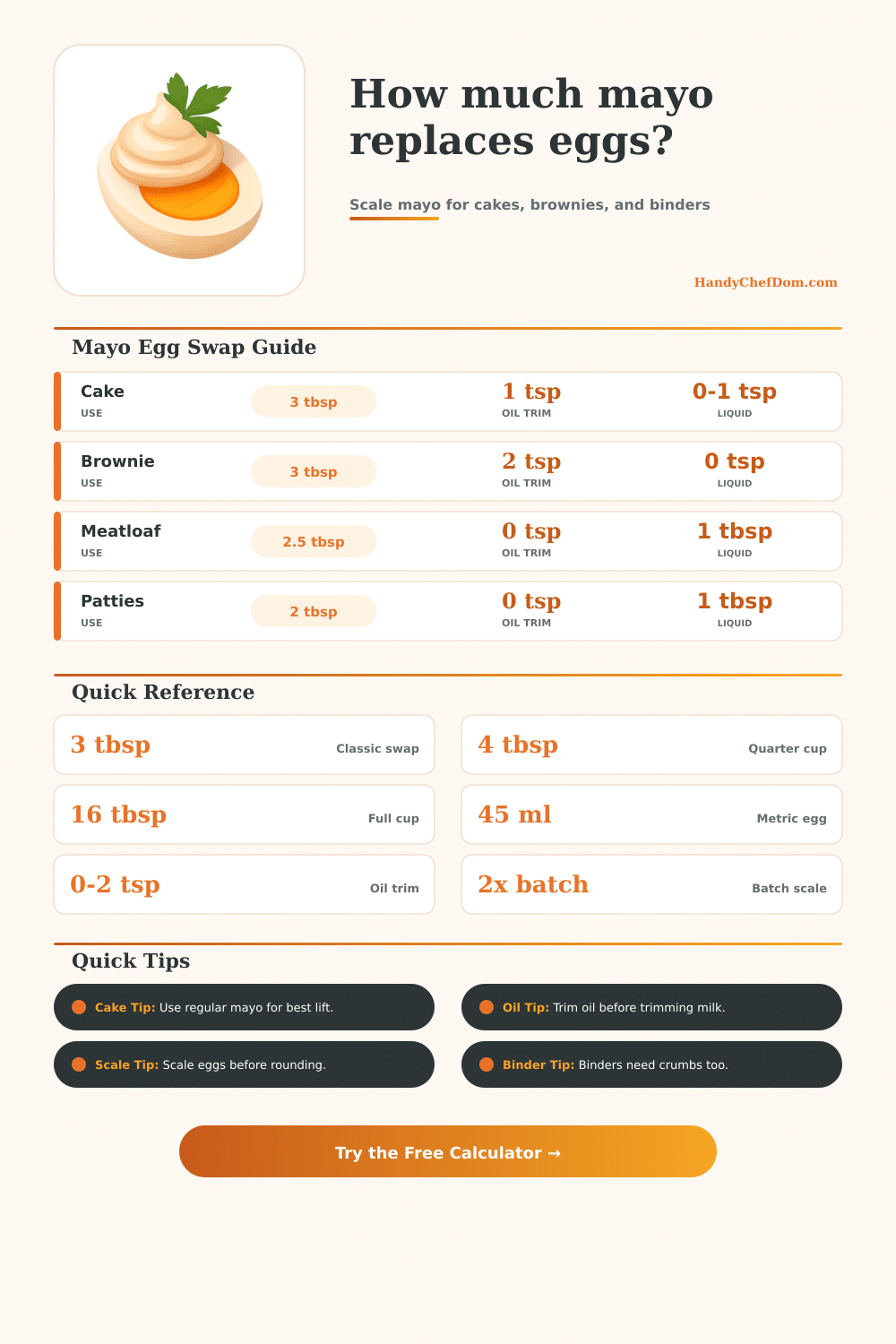
A common starting point is 3 tablespoons mayonnaise for 1 large egg. This calculator adjusts that base by recipe type, mayo style, batch scale, oil, and moisture sensitivity.
| Recipe style | Mayo per egg | Oil adjustment | Moisture adjustment |
|---|---|---|---|
| Cake or snack cake | 3 tbsp | Trim 1 tsp oil per egg | Usually 0 to 1 tsp liquid |
| Cupcakes | 3 tbsp | Trim 1 tsp oil per egg | Use level tablespoons |
| Brownies or bars | 3 tbsp | Trim 2 tsp oil per egg | Do not cut liquid first |
| Muffins | 2.75 tbsp | Trim 1 tsp oil per egg | Cut 1 tsp liquid if batter is loose |
| Quick bread | 2.75 tbsp | Trim 1 tsp oil per egg | Cut 1 tsp liquid per egg |
| Pancakes or waffles | 2.5 tbsp | Trim 1 tsp oil per egg | Hold back 1 tbsp liquid per egg |
| Meatloaf binder | 2.5 tbsp | No oil trim | Add crumbs if mix feels loose |
| Meatballs | 2.25 tbsp | No oil trim | Add crumbs or oats as needed |
| Veggie patties | 2 tbsp | No oil trim | Pair with starch or crumbs |
| Mayonnaise style | g per tbsp | Moisture factor | Best use |
|---|---|---|---|
| Regular full-fat mayo | 13.8 g | 1.00x | Default cakes, brownies, binders |
| Light mayo | 14.5 g | 1.08x | Use slightly less in soft batters |
| Olive oil mayo | 13.7 g | 1.00x | Rich bakes and savory binders |
| Avocado oil mayo | 13.9 g | 0.98x | Moist cakes and dense brownies |
| Vegan mayo | 14.2 g | 1.05x | Emergency egg-free swap |
| Thick deli-style mayo | 14.8 g | 0.94x | Meatloaf and patty mixes |
| Slightly sweet mayo | 14.0 g | 1.02x | Cakes, muffins, quick breads |
| Homestyle mayo | 14.1 g | 1.00x | All-purpose replacement |
| Scaled eggs | Mayo tbsp | Mayo cups | Metric approx |
|---|---|---|---|
| 0.5 egg | 1.5 tbsp | 0.09 cup | 22 ml |
| 1 egg | 3 tbsp | 0.19 cup | 44 ml |
| 2 eggs | 6 tbsp | 0.38 cup | 89 ml |
| 3 eggs | 9 tbsp | 0.56 cup | 133 ml |
| 4 eggs | 12 tbsp | 0.75 cup | 177 ml |
| 6 eggs | 18 tbsp | 1.13 cups | 266 ml |
| 8 eggs | 24 tbsp | 1.5 cups | 355 ml |
| 10 eggs | 30 tbsp | 1.88 cups | 444 ml |
| Binder mix | Egg role | Mayo plan | Support ingredient |
|---|---|---|---|
| Classic meatloaf | Moist binder | 2.5 tbsp per egg | Crumbs or oats |
| Turkey meatballs | Lean binder | 2.25 tbsp per egg | Fine crumbs |
| Bean patties | Soft binder | 2 tbsp per egg | Flour or starch |
| Lentil loaf | Moist binder | 2.25 tbsp per egg | Oats or grains |
| Crab-style cakes | Tender binder | 2 tbsp per egg | Crumbs |
| Stuffed peppers | Filling binder | 2 tbsp per egg | Cooked grains |
What’s that? When you need eggs, you’ve got none? It happens at the exact wrong time. And there’s always flour and sugar waiting in a bowl on counter. Should you head to the store? Or should you skip baking altogether?
But wait… What about all the mayonnaise chilling in your fridge? Yes, it’s magic. And it saves the day, no trip down the grocery aisle required.
How to Use Mayo Instead of Eggs in Baking
Why mayonnaise, though? Until you understand chemistry, it sounds like a wacky substitution. Eggs is an emulsion of fat and moisture. Mayo is egg yolk and oil emulsified with lemon juice or vinegar. Half the job’s already done.
How do you know how much mayo to substitute (without turning your meatloaf to soup, or your cake into a greaseball)? All you have to do is enter what kind of recipe you’re making into calculator, and it will take care of math for you. You won’t have to wonder if three tablespoons is too much or too little and end up with a flooded batter.
For most common substitutions, starting with three tablespoons mayo per large egg removed should of fine. This works because three tablespoons of mayo has about as much fat and volume as one egg, and its acidity also helps tenderize baked goods.
There’s no need to exactly replicate all an egg’s roles. While mayo is excellent at binding and providing some moisture, it doesn’t whip up like whole eggs and get as airy and light. So recipes where you rely on whipped eggs for their leavening, like fluffy angel food cake, is still off-limits. But it works well for something hearty, like a meatloaf binder or a dense chocolate brownie. Those are great places for this swap.
So what’s the key? As it turns out, it’s about tweaking the rest of wet ingredients in whatever recipe you’re baking from. Because there is already oil in mayonnaise, you will want to compensate by using less fat different than what original recipe directs. So if cake recipe asks for one/2 cup of vegetable oil and you swap out two eggs for an equal amount of mayo, you’ll want to drastically trim down the amount of oil. Why? Because otherwise you’ll wind up with something overly rich instead of tender and crumbly, not exactly what you were going for.
This is where calculator comes into play: It calculates necessary adjustments depending on how thick (muffins) or light (cupcakes) your creation will turn out. It also factors in what kind of mayo you happen to have available. For example, light versions versus regular full-fat options behaves differently; some are more acidic or thicker in consistency. Those nuances come into play when accuracy matters.
Recipes heavy with binder ingredients is another matter altogether. Eggs act as binders in meatloaves and veggie patties. They help hold the ground ingredient together when they’re cooked. Mayonnaise provides moisture, but it does not provide as much structural firmness than a cooked egg white network would. That can mean you have to supplement those missing binder benefits with additional oats or breadcrumbs. Again, this is not a volume-for-volume substitution because knowing what the egg does in a recipe makes all the difference. Want it rich? Mayo’s your girl. Need a solid structure? You’ll want some dry ingredient support behind the egg swap. The page lays it out nicely in the reference tables so that you can see how shifting liquids and oils affect other components of dish.
If it’s not quite as you’d expect on initial go, don’t fret. Because mayo contains so much fat, its texture swap trends more towards dense and moist. That’s good for something like fudge brownies or banana bread, where you seek out a rich, heavy sensation in your mouth. If you’re baking something lighter, you may wish to omit a teaspoon or two of water or milk, since there will be an added amount of moisture due to the mayo substitute. Basically, just adjust the wet/dry ratio until everything balance out. After some practice getting used to what mayo does to other ingredients (sugar, flour), it’ll start feeling intuitive, not experimental.
At its core though, it’s just knowing what’s in your pantry and being a little more resourceful. Good baking doesn’t require specialty ingredients. In fact sometimes, the best solution is already sitting in your fridge. That jar of mayo is just waiting to jump into action when you grab an otherwise empty carton. Sure it sounds weird initially, but be certain, the chemistry works out quite nicely in the end.