🥓 Bacon Calorie Calculator
Estimate calories, protein, fat, and sodium from bacon slices, raw weight, cooked weight, crumbles, cups, servings, thickness, and drained fat.
Choose the bacon label, portion style, slice thickness, servings, and drained fat level. The calculator converts raw slices, cooked slices, weights, and crumble cups into nutrition totals.
| Bacon Label | Calories | Protein | Fat | Sodium |
|---|---|---|---|---|
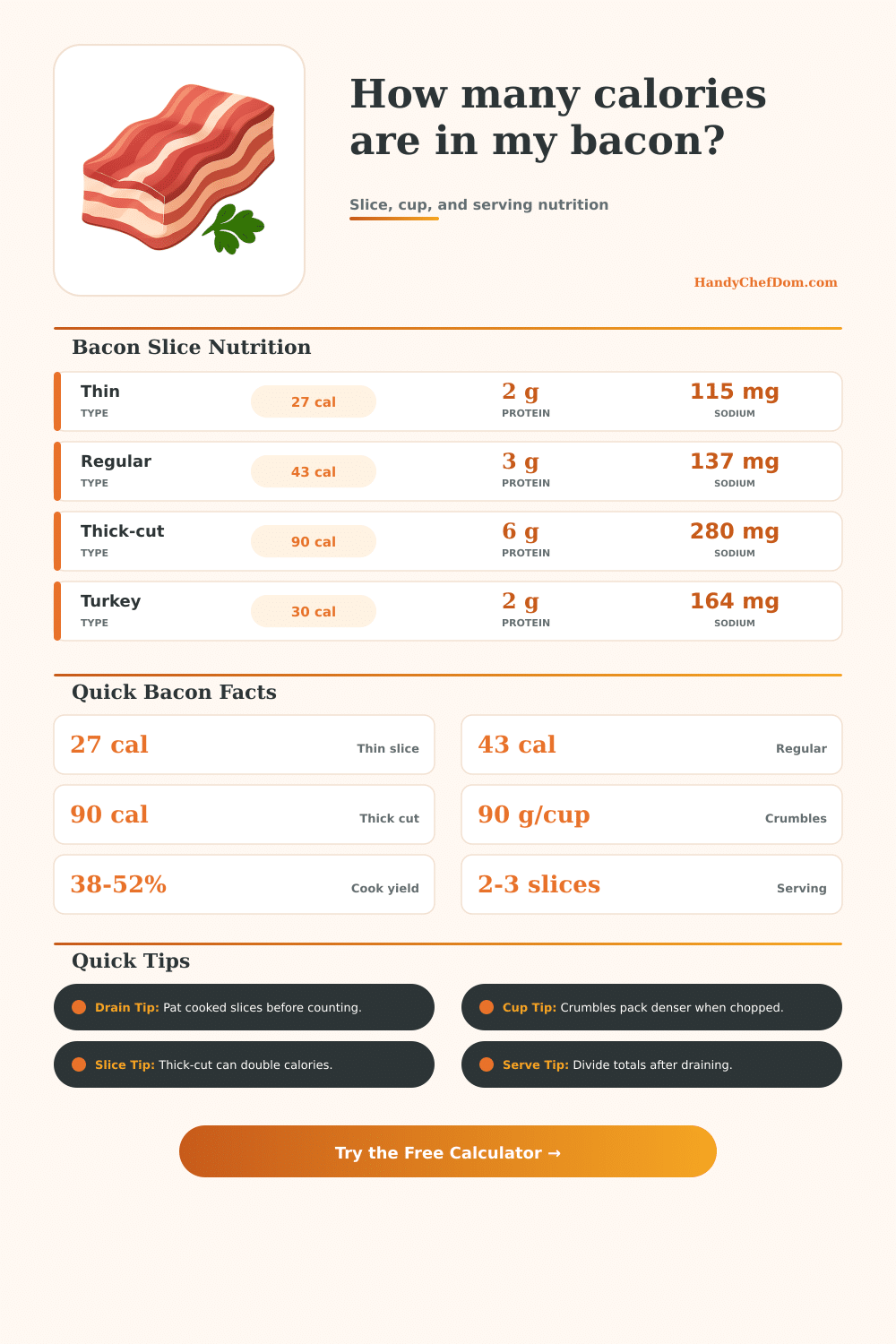
| Thin pork bacon | 27 cal/slice | 2.0 g | 2.1 g | 115 mg |
| Regular pork bacon | 43 cal/slice | 3.0 g | 3.3 g | 137 mg |
| Thick-cut pork bacon | 90 cal/slice | 6.0 g | 7.0 g | 280 mg |
| Center-cut pork bacon | 35 cal/slice | 3.0 g | 2.5 g | 150 mg |
| Applewood smoked bacon | 45 cal/slice | 3.0 g | 3.5 g | 160 mg |
| Peppered bacon | 50 cal/slice | 3.5 g | 3.8 g | 190 mg |
| Turkey bacon | 30 cal/slice | 2.0 g | 2.0 g | 164 mg |
| Canadian bacon | 45 cal/slice | 6.0 g | 1.5 g | 230 mg |
| Slice Thickness | Multiplier | Cooked Slice | Raw Slice | Best Use |
|---|---|---|---|---|
| Extra thin | 0.75x | 6 g | 12 g | Crumbles |
| Thin | 0.88x | 7 g | 14 g | Sandwiches |
| Regular | 1.00x | 8 g | 16 g | Breakfast |
| Thick | 1.35x | 14 g | 28 g | Burgers |
| Extra thick | 1.75x | 18 g | 36 g | Platters |
| Measurement | Approx Amount | Cooked Weight | Slice Equivalent | Note |
|---|---|---|---|---|
| 1 cooked slice | Regular | 8 g | 1 slice | Label base |
| 1/4 cup crumbles | Loose cup | 22.5 g | 2.8 slices | Topping |
| 1/2 cup crumbles | Loose cup | 45 g | 5.6 slices | Salad bowl |
| 1 cup crumbles | Chopped | 90 g | 11.3 slices | Batch prep |
| 4 oz raw bacon | Package weight | 48 g cooked | 6 slices | After yield |
| 1 lb raw bacon | Package weight | 192 g cooked | 24 slices | Party batch |
| Serving Scenario | Servings | Regular Bacon | Thick-Cut Bacon | Crumbles |
|---|---|---|---|---|
| Breakfast for 2 | 2 | 6 slices | 3 slices | 1/2 cup |
| Family plate | 4 | 12 slices | 6 slices | 1 cup |
| Brunch tray | 8 | 24 slices | 12 slices | 2 cups |
| Burger night | 6 | 12 slices | 6 slices | 1 cup |
| Salad bar | 10 | 20 slices | 10 slices | 1.75 cups |
| Party garnish | 24 | 36 slices | 18 slices | 3 cups |
There’s always that pause before picking up the pan: Bacon tastes amazing but it’s also chock-full of calories, salt, and smoke. Not all bacon are created equal. That slab of turkey bacon appears to be a healthy thin slice. That chunky cut of pork might appear to be applewood smoked. But those numbers don’t add up different than at all.
We think we’re adding one cup of crumbles as a garnish when we’ve really added three. We might also think our breakfast plate seem so full because we had a thin slice when we actualy had two. If you follow a macro diet, watch your sodium, or just want to know what you’re putting into your body, knowing those numbers is important.
How to Count Bacon Calories Correctly
So all you do is tell the calculator your sort of bacon (thin? thick?) and let the calculator handle the rest. It’ll force you to specify cooked yield versus raw weight which is where a lot of people’s estimation goes wrong. An ounce of raw bacon will reduce by quite a bit during rendering: it shrinks significantly as it renders fat. So if you start with an ounce of raw bacon, you’re probably going to end up with half an ounce of crispy deliciousness. So if you start with an ounce of raw bacon, you’re probably going to end up with half an ounce of crispy deliciousness. The calculator take this into account automatically.
It also allows you to play with thickness. While a regular slice has ~forty-three calories, a thick cut approaches nearly twice that number at almost a huge ninety calories per slice. When you’re feeding the family, that’s no small difference. Do you prefer the texture of thick cuts or the quantity of thin slices? The calculator tells you how much that choice come out to in terms of protein and fat.
The other input people tend to overlook: the drained fat factor. For instance, if you cook bacon and then let it sit at the bottom of the pan all the way through, you’re taking in every single calorie that was released from those strips. Letting it hang out on a rack or draining it on paper towels will change the number. The tool lets you set a drain multiplier so that it takes into account how aggressively you drained the excess oil, lowering the overall fat content. This is a realistic adjustment that’s useful in real-world cooking. Unless you intentionally pour the puddle of fat still left in the pan over your eggs, you don’t eat that. Tweak this setting to make your numbers more realistic. This prevents them from just reading off a static label without considering what actualy happens when you prepare food.
There’s also another sneaky number: Sodium. Because bacon is a cured meat, there’s a whole lot of salt baked into its makeup well before you even think about heating it up. Regular, not-so-thick pork bacon will hover around a hundred and thirty-seven milligrams per slice, whereas thicker pieces tends to skew closer to two-hundred and eighty. So if there are certain foods you’re trying to avoid for health reasons; or if high blood pressure is an issue, simply tallying up your slices won’t do. You’ve got to become familiar with the sodium content across all types of furnitures.
The reference tables on the page make it easy to see: You’ll see where, say, center-cut selections may contain a bit less fat but retain that same smoky goodness. Compare those figures side-by-side beforehand… You don’t want to be caught off guard by the salt load at the end of your meal.
What about crumbles? Chopping bacon changes both its volume and density. A half cup of crumbles can appear as a small pile on top of a salad. It’s equivalent to over five normal slice. See where they go wrong? When an ingredient has been rendered or chopped, the volume isn’t proportional to the weight. This is why people underestimate big batches and overestimate small ones. With this tool, cups becomes the same thing no matter if you’re serving bits or strips. You get standard so that you know exactly what’s going in, no more guessing.
It’s simpler with some planning. If you’re cooking for the week, or whipping something up at brunch for your friends, having an idea of what you’re eating beforehand cuts down on guessing (and time) later. You could create presets based off common scenarios such as burger night, or family breakfast to get an idea of how portions will scale up. No more freakouts about whether that additional slice will send you over the edge.
Bacon is inherently indulgent, there’s no need to make it mysterious. Once you understand the inputs, you’re in control of the outputs. Have fun eating it while knowing exactly what you’re getting. Ultimately, it’s about accuracy. It doesn’t matter if you love every single number on the package, but you should of understand what those numbers mean. How many ounces were lost in cooking? Is this a thick cut or a thin one? Did I drain any fat? All these variables affect your total and give you the ability to adjust until you’re no longer guessing, but instead you know. And when you have that, you can eat your bacon confidently, not hesitantly; and you can taste each bite because you decide how much is right for you.