🐖 Pork Brine Calculator
Get exact salt, sugar & spice amounts for a perfectly balanced brine — every time
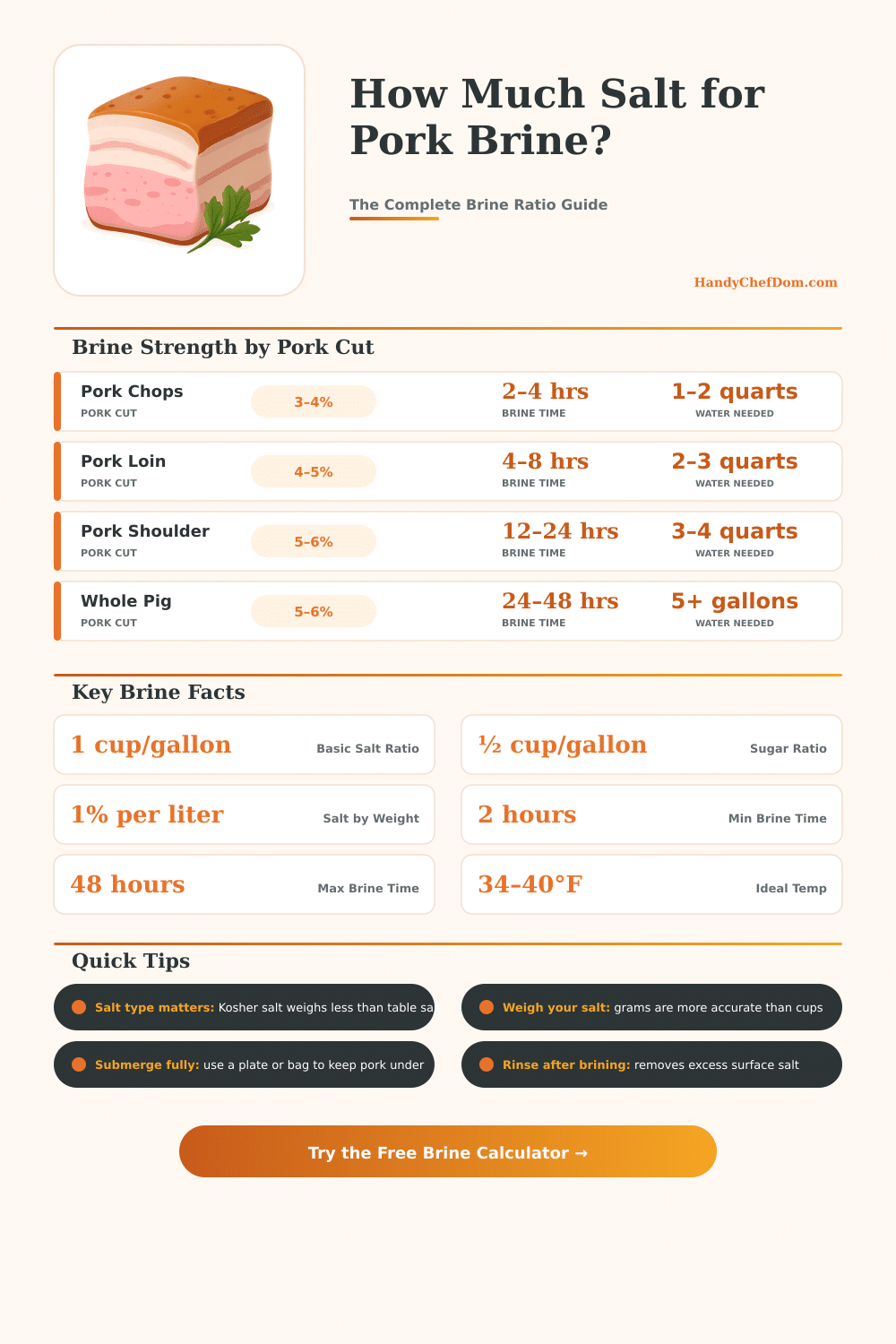
| Pork Cut | Salt % | Brine Time | Water (approx.) | Notes |
|---|---|---|---|---|
| Pork Chops (1") | 3–4% | 2–4 hrs | 1 qt / 1 L | Thin — don't over-brine |
| Pork Tenderloin | 3–4% | 2–4 hrs | 1 qt / 1 L | Lean, brine gently |
| Pork Loin (2–3 lb) | 4–5% | 4–8 hrs | 2 qt / 2 L | Standard wet brine |
| Pork Shoulder (5–8 lb) | 5–6% | 12–24 hrs | 1 gal / 4 L | Thick — needs full submersion |
| Baby Back Ribs | 4–5% | 4–6 hrs | 2 qt / 2 L | Remove membrane first |
| Spare Ribs | 4–5% | 6–12 hrs | 3 qt / 3 L | Larger — more brine needed |
| Pork Belly (skin-on) | 5–6% | 12–24 hrs | 2 qt / 2 L | Score skin for penetration |
| Whole Pig (50 lb) | 5–6% | 24–48 hrs | 5 gal / 20 L | Inject as well as submerge |
| Salt Type | Grams / Cup | Grams / Tbsp | Grams / Tsp | Relative Saltiness |
|---|---|---|---|---|
| Table Salt | 288 g | 18 g | 6 g | Most salty (benchmark) |
| Kosher Salt — Morton | 240 g | 15 g | 5 g | 83% of table salt |
| Kosher Salt — Diamond Crystal | 142 g | 9 g | 3 g | 50% of table salt |
| Sea Salt (Coarse) | 220 g | 14 g | 4.5 g | 76% of table salt |
| Pink Himalayan (Fine) | 280 g | 17.5 g | 5.8 g | 97% of table salt |
| Imperial | Liters (approx.) | Milliliters | Common Use |
|---|---|---|---|
| 1 cup | 0.237 L | 237 mL | Small brine, chops |
| 1 quart | 0.946 L | 946 mL | Chops, tenderloin |
| 2 quarts | 1.89 L | 1,893 mL | Loin, ribs |
| 1 gallon | 3.785 L | 3,785 mL | Shoulder, large cuts |
| 2 gallons | 7.57 L | 7,570 mL | Large shoulder, ribs |
| 5 gallons | 18.93 L | 18,930 mL | Whole pig |
Brines for pork are made up of saltwater with various tasting extras that serve to soak the raw meat before cooking it. By means of that the salt and flavors soak into the flesh, what helps it stay more wet. Like this one gets always juicy tender and tasty pork.
Cuts from pork commonly have the name of being too dry. Salty soaking can turn plain dry cuts into truly impressive bites. It works as the best way to restore moisture to meats, that naturally dry out, for instance to pork cuts.
How to Brine Pork for Juicy, Tender Meat
Even only two minutes more time for the process makes it entirely worthwhile.
Simple brine works with only three basic elements. For instance, one easy version requires five items, between them crushed garlic and fresh ginger. Typical extras for such saltwater is salt, brown sugar, water, peppers, garlic, bay leaves, thyme and rosemary.
Sweetener forms the main spice for sokaing. It can happen by means of sugar, brown or white, molasses or maple syrup. Also honey and coffee well work here.
Apple vinegar works as a good extra, but one must mix it with water and balance by means of salt and sugar, so that the meat does not get too bitter taste. Soy sauce or the Japanese rice wine mirin add more eastern touch.
The brine must be cool entirely, first before soaking the meat. Soaking in warm liquid can indeed start the cooking and cause problems. For the dip works a big sealed bag or slim baking plate.
Cuts from pig stay in the saltwater at least one hour, until most six. For thick pieces one can extend until twelve hours. Whole pork loin one can leave two until four days.
Two hours form the ideal time for tenderloins. Indeed, pork tenderloin requires less time compared to wait than cuts, because its long fiber pulls the brine more quickly into the flesh.
Important spot to check is, does the pork already come pre-brined. When the label talks about salt solution, one must skip the soaking. Adding brine to already treated meat makes it too salty and tough.
Better choose fresh, never treated pig for that, because it allows deep deposits of taste in the flesh, that simple rubs do not manage to reach.
After the brining, one must check well. The outer parts can stay salty, so they need extra washing. Also the brine one can prepare until five days before, what saves time.
The method works for every type of pork, including tenderloin, shoulder and ribs. Brined pig stays wet, and inside it seems a bit pinker than unbrined, butthat shade does not cause issue. Another option is to inject the brine, especially for big pieces like pork loin, where it soaks more deeply to flavor every part.