🥪 Turkey Slice Protein Calculator
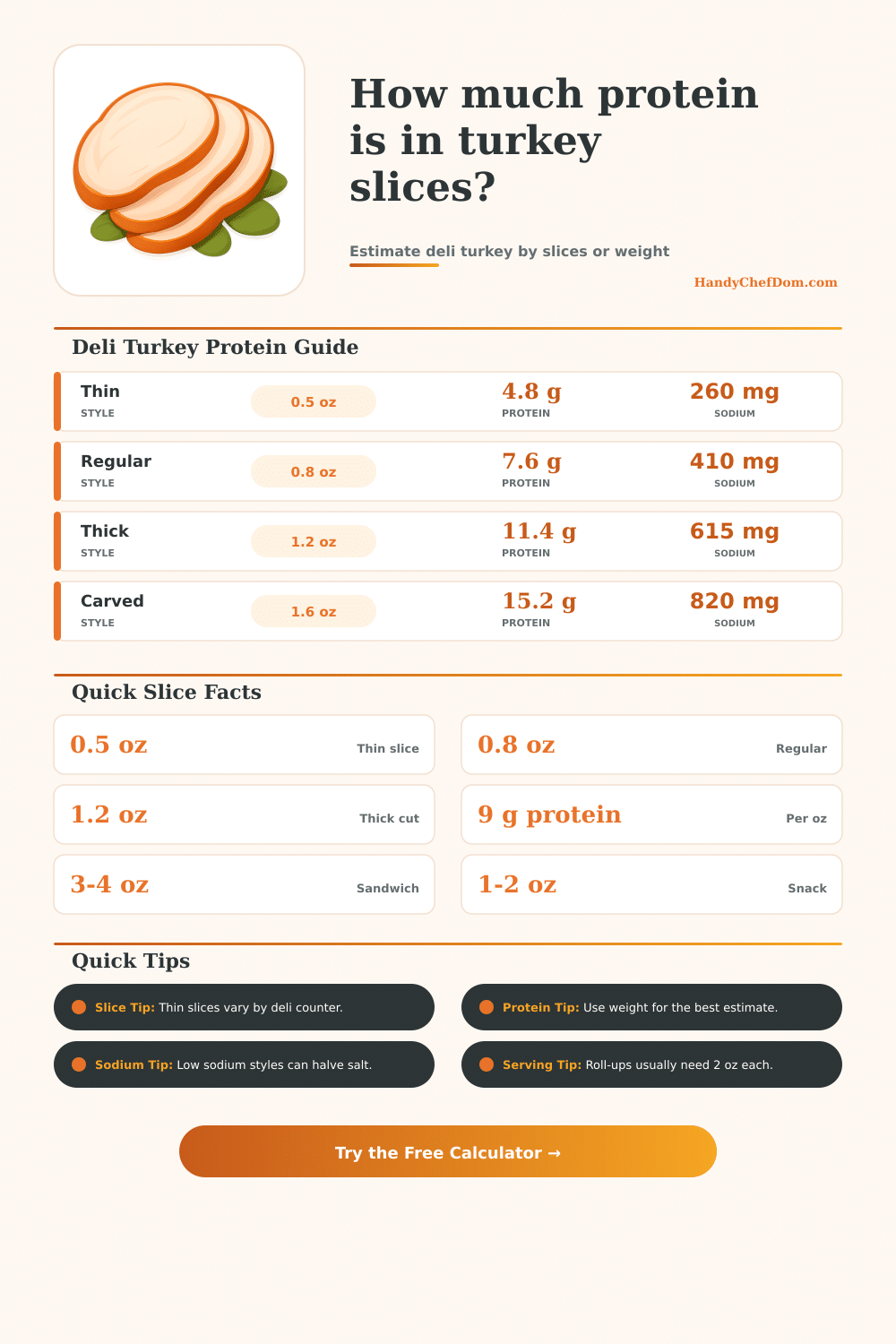
Estimate protein, calories, sodium, and serving portions for deli turkey slices by count, thickness, ounces, grams, or lunch meat style.
Choose slices, package weight, or serving style. Values are estimates because deli slices vary by counter, brand, moisture, and slice thickness.
| Slice Label | Typical Weight | Best Use | Protein Estimate |
|---|---|---|---|
| Shaved deli slices | 0.35 oz / 10 g | Folded sandwiches | 3.2 g each |
| Thin sandwich slices | 0.55 oz / 16 g | Lunch boxes | 5.0 g each |
| Regular deli slices | 0.80 oz / 23 g | Everyday sandwiches | 7.2 g each |
| Thick sandwich slices | 1.20 oz / 34 g | Hearty stacks | 10.8 g each |
| Carved lunch slices | 1.60 oz / 45 g | Snack plates | 14.4 g each |
| Folded stack slices | 0.70 oz / 20 g | Club sandwiches | 6.3 g each |
| Snack tray slices | 0.45 oz / 13 g | Roll-ups | 4.1 g each |
| Lunch Meat Style | Protein Per Oz | Calories Per Oz | Sodium Per Oz |
|---|---|---|---|
| Oven roasted deli turkey | 9.0 g | 32 kcal | 485 mg |
| Smoked turkey breast | 8.8 g | 34 kcal | 520 mg |
| Honey roasted turkey | 8.2 g | 38 kcal | 470 mg |
| Cracked pepper turkey | 9.1 g | 33 kcal | 500 mg |
| Low sodium turkey | 9.0 g | 32 kcal | 240 mg |
| Thick carved turkey | 9.4 g | 36 kcal | 430 mg |
| Ultra thin turkey | 8.7 g | 31 kcal | 455 mg |
| Turkey pastrami | 8.5 g | 42 kcal | 590 mg |
| Serving Style | Typical Turkey | Slice Guide | Protein Range |
|---|---|---|---|
| Snack plate | 1-2 oz | 2-4 thin slices | 9-18 g |
| Sandwich stack | 3-4 oz | 4-6 regular slices | 27-36 g |
| Turkey roll-ups | 2-3 oz | 4-6 thin slices | 18-27 g |
| Wrap or flatbread | 3-5 oz | 4-7 regular slices | 27-45 g |
| Salad topper | 2-4 oz | 3-5 regular slices | 18-36 g |
| Meal prep box | 4-5 oz | 5-7 regular slices | 36-45 g |
| Common Amount | Approx Grams | Regular Slices | Use Case |
|---|---|---|---|
| 2 oz | 57 g | 2-3 slices | Snack plate |
| 3 oz | 85 g | 3-4 slices | Light sandwich |
| 4 oz | 113 g | 5 slices | Hearty sandwich |
| 6 oz | 170 g | 7-8 slices | Two lunches |
| 8 oz | 227 g | 10 slices | Small pack |
| 16 oz | 454 g | 20 slices | Meal prep |
If you’ve ever been to a deli counter, gazed at the stacked slices of turkey, and wondered whether it’s even enough food for the price, you’re not alone. The guy behind the counter doesn’t look up as he folds the meat into tidy packages. Chances are, you grab three slices, that seems like the right amount for a sandwich, right? Then when you go home and check your nutrition app, you see there was barely an ounce of meat in those three slim slices.
That disconnect makes tracking protein hard. Our body process protein in ounces, but we think about it in slices. The calculator above connects dots by allowing you to enter either the number of slices or the actual weight (depending on what info you know).
Why You Should Weigh Your Deli Turkey
The other variable is thickness. Some pieces is carved thick at one and a half ounces, while others are sliced as thin as possible at a half ounce. To address that variability, the tool lets you pick what kind of style you want, whether it’s a nice chunky breast cut for roasting, or something realy thin like a snack pack.
Why does this matter? The amount of protein in an ounce is about the same no matter how thinly or thickly they carve meat. No matter the style, it is about nine grams of protein per ounce, whether you’re eating smoked with cracked pepper or honey roasted. But the sodium content vary widely. Low-sodium options has half the sodium of normal deli turkey. That makes a big difference to the nutrition facts, but keeps the protein intact.
Finally, most folks greatly undervalue the number of slices required to make a hearty meal. For example, a standard sandwich should be made from three to four ounces of meat so that you’re not depending solely on bread for fullness. Two and a half thick slice (or maybe five regular) should do the trick. For turkey roll-ups where the meat works as both filling and structure, figure two ounces per wrap. There’s a table of references on the page that makes it all clear: how many slices equate to what real world weight. It is a small conversion, but it would of keep you from not eating enough protein just because the portion looks larger while folded up.
This totally flips things around when it comes to meal prepping. Instead of getting out a knife and counting every slice of turkey, why bother? Why not just measure out entire package (let’s say it’s 16 ounces) and enter that amount into the calculator? Then split that amount up amongst however many meals you want to create from it. It’s so much more accurate than eyeballing how high the pile is! Plus, if you know you’re prone to over-portioning yourself, you can include some extra buffer in there with this method, so you don’t get caught off-guard when tracking macros gets too hard to use in real life.
Deli meats are tricky for most folks because they’re loaded with sodium. Traditional guidelines suggests you should try to keep it below two thousand three hundred milligrams per day. However, some health plans has a target closer to one thousand. Regular oven-roasted turkey contains almost half a gram of sodium in each ounce, meaning if you go for four ounces, you’ll hit your quota for the day and not even have any room left for cheese, condiments, or bread. The calculator shows sodium amounts next to protein, allowing you to quickly visualize the trade-off. Choosing low-sodium will not only benefit your blood pressure but allow you to enjoy other salty parts of your lunch without going overboard.
You might not wish to futz with inputting your own portions, in which case there is some preset buttons available for popular types of meals (party tray, weekday sandwich). The assumption will be that it’s a typical portion size/shape and then you can dial up/down from there. It’s also handy when cooking several meals at once, so you can compare how things turn out when prepared one way versus another. You can decrease the portion size for a kid’s lunchbox, for example, which means less sodium and protein as well.
In conclusion: once you learn how much turkey per serving comes from a package, deli turkey turns out to be a convenient way to get some lean protein into your diet. You shouldn’t just guess by counting slices, because that is where you are going wrong. By weighing your food, though, you’ll always know exactly what’s on your plate. Yes, pre-packaged sliced lunch meats are easy… And you no longer need to sacrifice accuracy for ease. Because let’s face it, you usually only end up with about half or even less than what you thought was on your sandwich. The trick is learning the distinction between perceived quantity (visual volume) and true quantity (weight). Next time you find yourself at the deli counter, you’ll never be left wondering what all those folded-up squares translate into in terms of real nutrition.