🧀 Parmesan for Alfredo Calculator
Estimate how much Parmesan to add to Alfredo sauce from pasta pounds, servings, cream cups, sauce style, cheese form, salt target, intensity, and pasta water.
1Alfredo Parmesan Presets
2Parmesan Alfredo Labels
3Calculator Inputs
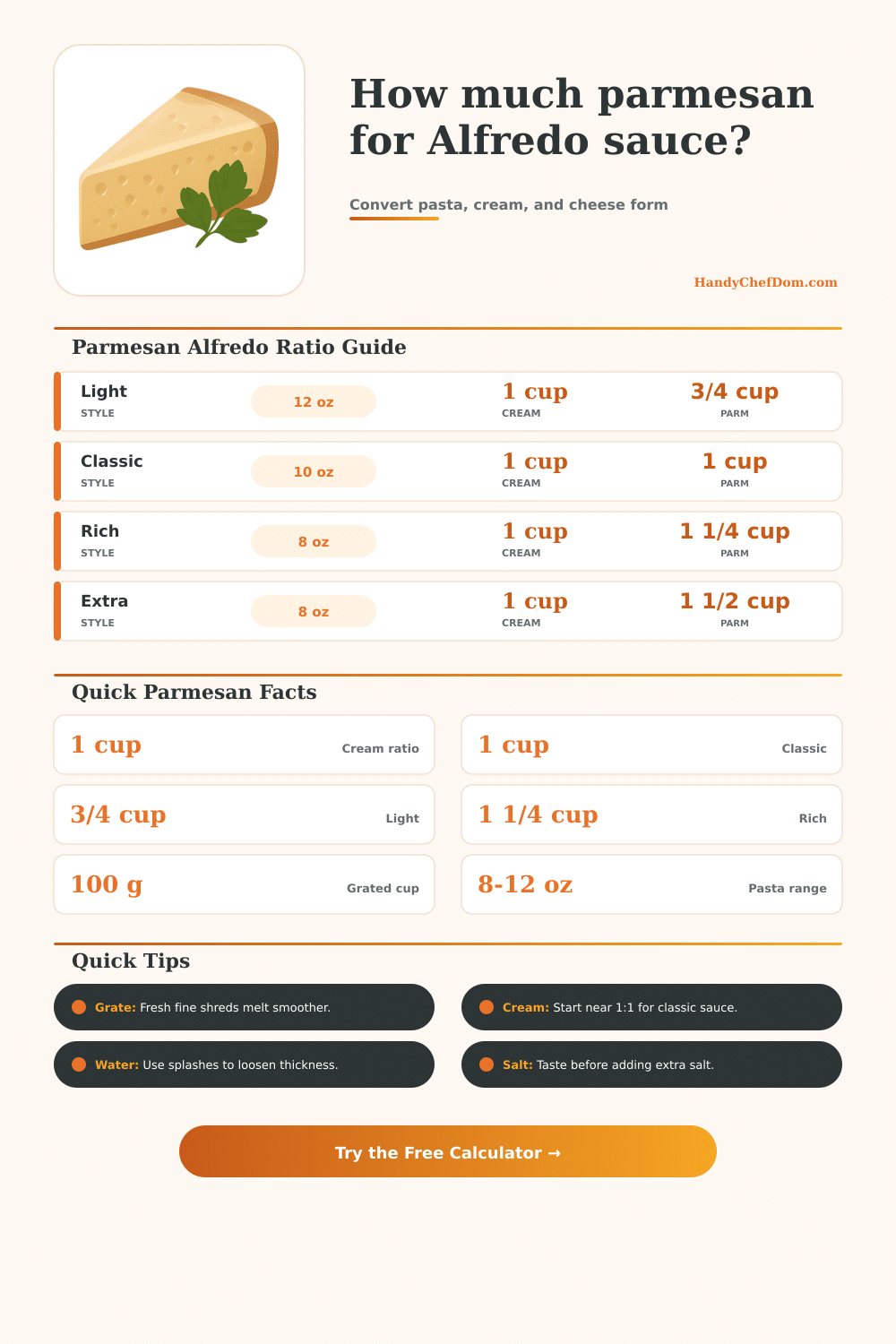
Classic Alfredo often starts near 1 cup finely grated Parmesan for 1 cup cream. The pasta-based reference is about 1 grated cup for every 8 to 12 ounces dry pasta depending on how cheesy and thick you want the sauce.
4Parmesan Style Comparison Grid
Best when cream is the lead and Parmesan is a gentle salty finish.
Matches the familiar 1 cup grated Parmesan per 1 cup cream starting point.
Uses more cheese for a thicker, more restaurant-style sauce coating.
Allows extra cheese because pasta absorbs sauce while the dish rests.
5Parmesan Forms Table
| Parmesan form | Approx cup weight | Best calculator use | Melting and sauce note |
|---|---|---|---|
| Finely grated Parmesan | About 100 g per cup | Default for most Alfredo sauce math | Melts quickly when added off direct high heat. |
| Shredded Parmesan | About 80 g per cup | Good when measuring loose shreds by cup | Needs a little more stirring time than fine grated cheese. |
| Microplaned fresh block | About 70 g per cup | Useful when the cup looks fluffy and airy | Melts smoothly but a cup weighs less than packed grated cheese. |
| Block Parmesan weighed first | Weight is direct | Best accuracy when you have a kitchen scale | Grate after weighing so the calculator is not affected by fluffiness. |
| Packed grated cup | About 120 g per cup | Use when cheese is pressed firmly into the cup | Can make the sauce salty and thick faster than expected. |
| Pre-grated shelf-stable Parmesan | About 90 g per cup | Use when measuring a dry shaker-style product | May thicken differently because anti-caking ingredients vary. |
6Alfredo Sauce Ratios Table
| Sauce style | Parmesan per 1 cup cream | Parmesan per dry pasta | Thickness direction |
|---|---|---|---|
| Light silky Alfredo | 3/4 cup grated Parmesan | 1 cup per 12 oz pasta | Loose and glossy; good with extra pasta water. |
| Classic creamy Alfredo | 1 cup grated Parmesan | 1 cup per 10 oz pasta | Balanced coating for most fettuccine or penne portions. |
| Rich restaurant Alfredo | 1 1/4 cups grated Parmesan | 1 cup per 8 oz pasta | Thicker, cheesier, and more clingy on the pasta. |
| Baked or casserole Alfredo | 1 1/8 cups grated Parmesan | 1 cup per 9 oz pasta | Accounts for sauce absorption while resting or baking. |
| Glossy emulsified Alfredo | 7/8 to 1 cup grated Parmesan | 1 cup per 11 oz pasta | Relies on pasta water to keep the sauce fluid. |
7Pasta Servings Table
| Serving plan | Dry pasta amount | Classic Parmesan start | Per-serving cheese guide |
|---|---|---|---|
| Dinner for 2 | 8 oz dry pasta | About 0.8 cup grated Parmesan | About 40 to 50 g total, depending cream. |
| Dinner for 4 | 1 lb dry pasta | About 1.5 to 1.6 cups grated Parmesan | About 35 to 45 g per person. |
| Family for 6 | 1.5 lb dry pasta | About 2.3 to 2.4 cups grated Parmesan | About 35 to 45 g per person. |
| Party tray for 10 | 2.5 lb dry pasta | About 3.8 to 4 cups grated Parmesan | Use more pasta water for holding. |
| Light side portions | 2 to 3 oz per person | Trim the result by 10 to 20% | Works when Alfredo is one part of a larger meal. |
8Cheese Comparison Table
| Cheese | Flavor strength | Approx sodium per oz | Alfredo adjustment |
|---|---|---|---|
| Parmesan | Nutty, savory, medium-sharp | About 450 mg | Use the calculator result as written. |
| Parmigiano Reggiano | Deep, crystalline, very savory | About 430 to 480 mg | Use slightly less if finely aged and intense. |
| Pecorino Romano | Sharper, saltier, sheep milk bite | About 520 mg | Use 15 to 25% less and watch salt. |
| Grana Padano | Milder and slightly sweeter | About 380 to 430 mg | Use the same volume or a small extra pinch. |
| Asiago aged | Nutty with a tangy edge | About 450 mg | Use as a partial blend, not the full cheese base. |
9Two Practical Tips
Making Alfredo sauce require an understanding of the interaction of the sauce’s ingredient with one another. Making Alfredo sauce also require an understanding of how the amounts of each ingredient can change the outcome of the sauce. The amount of Parmesan cheese that the cook adds to the sauce will impact the thickness of the sauce, as well as the saltiness of the sauce.
The amount of Parmesan cheese that should be used in the sauce can be determined by the amount of pasta that is to be cooked, or by an amount of cream that will be used in the sauce. Because each of these sauce variable can change, it is essential to use a calculator to ensure that the sauce ingredients are measured correct. The calculator for determining the amount of Parmesan cheese that is required to make Alfredo sauce require that you input specific information into the calculator.
How to Measure Parmesan for Alfredo Sauce
You must enter the amount of pasta that will be used in the sauce, as well as the volume of cream that will be used. Additionally, you must also enter the form of the Parmesan cheese that will be used. Parmesan cheese may be available in different form, such as grated or shredded; different forms of Parmesan will have different weight.
For instance, one cup of finely grated Parmesan will contain more weight than a cup of shredded Parmesan. Finally, the cook must select the salt target that will be used in the sauce. The salt target will impact the amount of salt that are used in the sauce.
Based off the information that is entered into the calculator, the sauce maker will recieve specific outputs from the sauce ingredient calculator. One output will be the total amount of Parmesan cheese that will be needed. Second, the per-serving amount of Parmesan cheese will be provided.
Third, the amount of sodium that will be contained in the sauce will be displayed; this is an important measurement for those who must limit there sodium intake. Fourth, the sauce will display a reading of the thickness of the Alfredo sauce that will result from this recipe; this help the sauce maker to decide whether additional pasta water should be added to the sauce. The measurement for Parmesan cheese may not be consistent due to the different ways in which the Parmesan cheese can be grated.
A cup of finely grated Parmesan cheese will weigh more than a cup of shredded Parmesan cheese. These type of differences can be avoided by converting the measurements into grams. Grams are an important unit of measurement for the recipe because they are a repeatable unit of weight; using a repeatable unit of measurement will allow the sauce maker to prepare the sauce the same way each time.
In addition to the sauce ingredient calculator, the sauce recipe include reference tables that describe the different types of sauce that can be made. For instance, the tables indicate what ingredient ratio can be used to make a “light” sauce versus a “rich” sauce; the type of sauce that is prepared impacts the amount of Parmesan cheese that can dissolve into the cream. Additionally, another ingredient that can be added to the sauce is pasta water, which can be used to loosen the sauce if it becomes too thick during the cooking process.
Some of the common mistake that can be made when preparing the sauce are including all types of Parmesan cheese as the same type of Parmesan cheese. Additionally, another common mistake when preparing the sauce is to ignore the effects that heat can have on the Parmesan cheese; applying heat to the Parmesan cheese can cause the Parmesan cheese to clump together. Another common mistake is using insufficient amount of pasta water; not enough pasta water will result in the sauce becoming too thick when mixed with the pasta.
Finally, adding additional salt to the sauce after you have added the Parmesan cheese to the sauce will result in the sauce being more salty. All of these mistakes can be avoided by using the ingredient calculator to review the effect that each of these choice will have on the recipe prior to cooking. The sauce ingredient calculator can be used to review the effect that different ingredient will have on the preparation of Alfredo sauce.
For instance, the calculator can help to determine how the form of the Parmesan cheese will change the amount of Parmesan cheese that is required, and how the target salt level will impact the sodium content of the sauce. Each of these sauce variables can be reviewed in order to determine the specific type of Alfredo sauce that you would like to prepare.