🫘 Tofu Protein Calculator
Estimate protein, calories, fat, and calcium from tofu firmness, block weight, pressed yield, servings, and meal style.
Enter the tofu package weight and, when you know it, the drained or pressed weight. If pressed weight is blank, the calculator estimates usable tofu from firmness and use style.
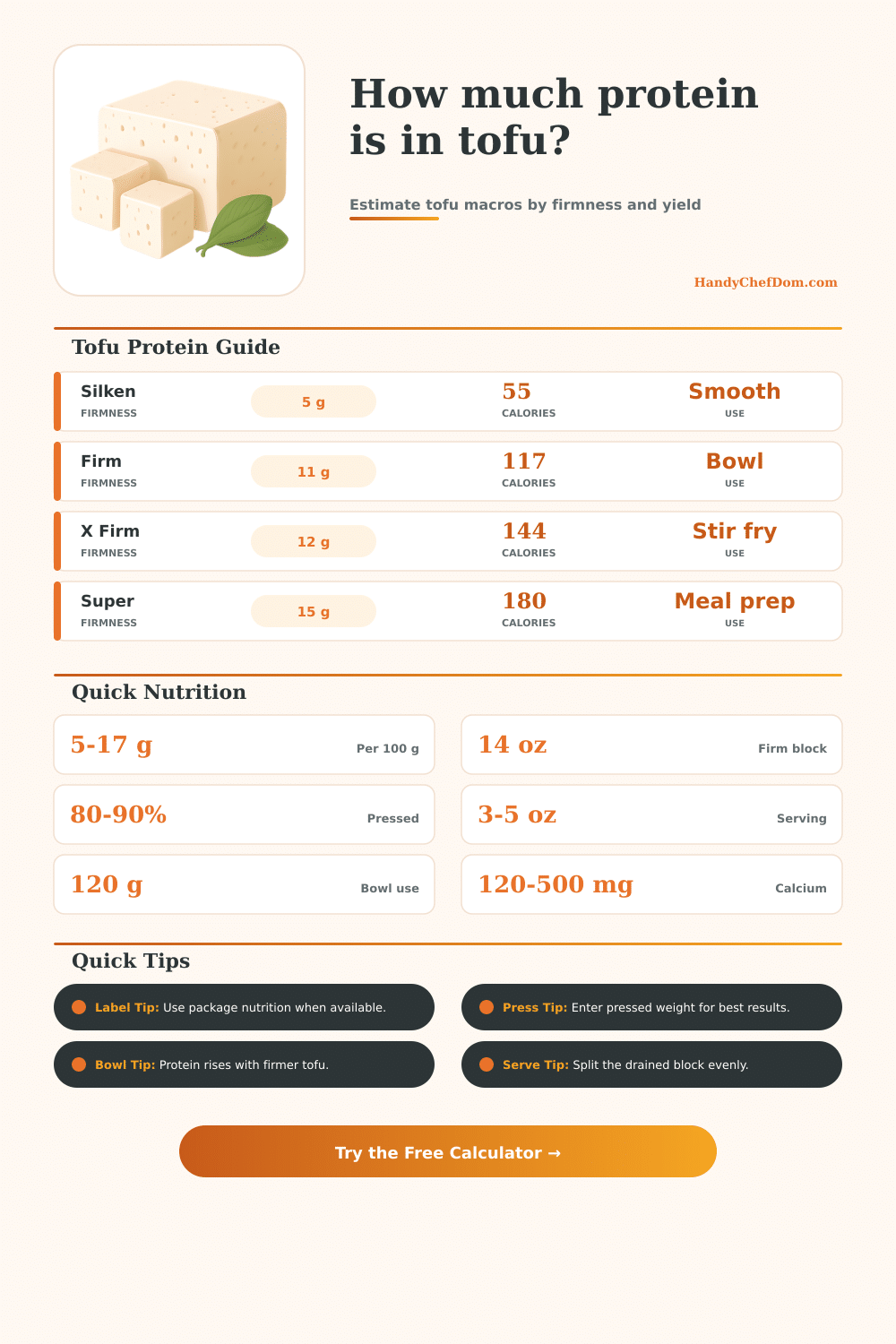
| Firmness | Protein / 100 g | Calories / 100 g | Fat / 100 g | Calcium / 100 g |
|---|---|---|---|---|
| Silken tofu | 5.3 g | 55 kcal | 2.7 g | 120 mg |
| Soft tofu | 7.0 g | 76 kcal | 4.8 g | 150 mg |
| Medium tofu | 8.0 g | 82 kcal | 5.0 g | 200 mg |
| Firm tofu | 10.9 g | 117 kcal | 7.0 g | 350 mg |
| Extra-firm tofu | 12.0 g | 144 kcal | 8.7 g | 410 mg |
| Super-firm tofu | 14.5 g | 180 kcal | 10.5 g | 500 mg |
| Sprouted firm tofu | 13.0 g | 150 kcal | 9.0 g | 300 mg |
| High-protein tofu | 17.0 g | 190 kcal | 11.0 g | 450 mg |
| Use Style | Target Serving | Best Firmness | Yield Note | Protein Aim |
|---|---|---|---|---|
| Stir-fry cubes | 125 g | Extra-firm | Press firm | 12-18 g |
| Grain bowl topping | 120 g | Firm | Drain well | 11-17 g |
| Tofu scramble | 140 g | Firm | Light press | 13-19 g |
| Soup or stew pieces | 100 g | Soft | Minimal press | 7-12 g |
| Cold salad cubes | 110 g | Super-firm | Pat dry | 12-18 g |
| Meal prep portions | 150 g | High-protein | Use dense | 20-26 g |
| Block Size | Metric Weight | Light Servings | Meal Servings | Hearty Servings |
|---|---|---|---|---|
| 10 oz block | 283 g | 3 | 2 | 2 |
| 12 oz block | 340 g | 3 | 3 | 2 |
| 14 oz block | 397 g | 4 | 3 | 2-3 |
| 16 oz block | 454 g | 4-5 | 3-4 | 3 |
| 20 oz block | 567 g | 5-6 | 4-5 | 3-4 |
| 2 x 14 oz | 794 g | 8 | 6 | 5 |
| Serving Weight | Firm Protein | Extra-Firm Protein | Super-Firm Protein | High-Protein Tofu |
|---|---|---|---|---|
| 75 g | 8.2 g | 9.0 g | 10.9 g | 12.8 g |
| 100 g | 10.9 g | 12.0 g | 14.5 g | 17.0 g |
| 125 g | 13.6 g | 15.0 g | 18.1 g | 21.3 g |
| 150 g | 16.4 g | 18.0 g | 21.8 g | 25.5 g |
| 175 g | 19.1 g | 21.0 g | 25.4 g | 29.8 g |
| 200 g | 21.8 g | 24.0 g | 29.0 g | 34.0 g |
That block of tofu you bought? Been sitting in the fridge for 3 days now. Seems fine. It’s just holding on to a gallon of water inside that spongy form.
You’re hungry. You might want to toss together some lunch, maybe stir-fry something up. Is this piece of soft white rubber going to give you enough protein to get you through the day?
Why You Should Squeeze Tofu Before Cooking
Meet the tofu calculator above. Plug in your tofu’s size and level of firmness and it’ll do the math for you. It spares you from having to guess at conversions and coefficients, and figuring out exactly what you have in that package.
Tofu’s nutritional problem lie in water. Tofu is just curdled soy milk, and amount of water it contains at the time it arrived on the shelf determines everything about the way it feels in your mouth. Silken tofu retains nearly all of its original water. This is ideal if you’re looking to make a creamy soup or add it to a smoothie, but it is also quite low in protein when measured by weight per gram.
On the other end of the spectrum, super-firm tofu has most of the water squeezed out of it and what remains are a solid mass of soy solids. And the contrast couldn’t be greater. Whereas a hundred grams of silken tofu may only contain five grams of protein, a hundred grams of extra-firm tofu can pack close to eleven or twelve grams. That’s a huge range in nutrient density for something that appears identical on your countertop.
Everyone measures by package weight, but this give you skewed numbers. There’s a bunch of water-weight in there that you’ll end up pouring out later. Log those calories and protein as if it were liquid you poured down the sink.
With the tool, you can enter weight after you’ve squeezed it/pressed it out. That slight change makes all the difference. Rather than seeing calories/protein for whatever was in the plastic wrap, you get a more realistic picture of how much actualy made its way onto your plate.
Turns out, squeezing the tofu isn’t just about texture. It’s about concentration. Squeezing the water out makes the nutrients more concentrated in a smaller package.
The other thing is firmness: what will the food do when cooked? Silken tofu will fall apart; you wouldn’t even think of trying to cube it up for a stir fry. Extra-firm tofu keeps its form under high heats, and has enough resistance to chew pleasingly… Closer to eating meat than any of the softer types.
As the tofu gets firmer, the calorie density go up along with the protein. See the reference tables on this page to see this tradeoff clearly. If it’s got more protein, does it matter that it’s higher in calories? Not only do you get more protein, but you get more calories per bite. Soy solids is dense in calories; there’s lots of fat and energy packed into each mouthful of high-protein tofu.
Are you looking for density, or volume, in your meal? Once you know those variables it makes portion sizing a whole lot easier. Three ounces are a normal serving size, except it appears very different as a firm block in a grain bowl versus as a soft block in a soup.
The calculator helps break down the total per serving so you don’t have to do any math in your head at dinnertime. It also lets you include seed or bean-based “boosts” to compare against the base of tofu. If you want to make a light snack-size portion one day or a heavy-duty athlete portion another, there is no problem. You can adjust inputs based off what you actually cook instead of being stuck trying to fit into strict categories.
Calcium is a concern of many home cooks, particularly those who replace dairy products with plant-based ones. In the case of tofu, there’s a huge range depending upon how it was produced. Some brands are heavily fortified; others have almost none. Knowing which brands do what goes a long way towards bridging that gap and using a label check feature will help out if you’re not sure.
You don’t necessarily need to eat tofu by itself for balanced nutrition, but you should of at least know what you are starting with. Take the guesswork out of your kitchen routine.
In short: Once you know what’s in there, you change how you treat it. All tofu isn’t equal; you pick and choose from different kinds for different jobs. The math of moisture applies to whether you’re making something light like a delicate scramble versus something denser like a meal-prep brick. Weigh the solids and drain the water. You will know exactly what you put in your body, turning a vague idea of being healthy into a clear daily practice.