🍛 Seitan Protein Calculator
Estimate seitan protein, calories, carbs, and sodium from package weight, homemade or store-bought style, cut shape, servings, and sodium level.
Enter the seitan weight you plan to serve, then match the closest nutrition label. The calculator scales the label values across slices, strips, chunks, or block portions.
| Seitan Label | Protein / 100 g | Calories / 100 g | Carbs / 100 g | Sodium / 100 g |
|---|---|---|---|---|
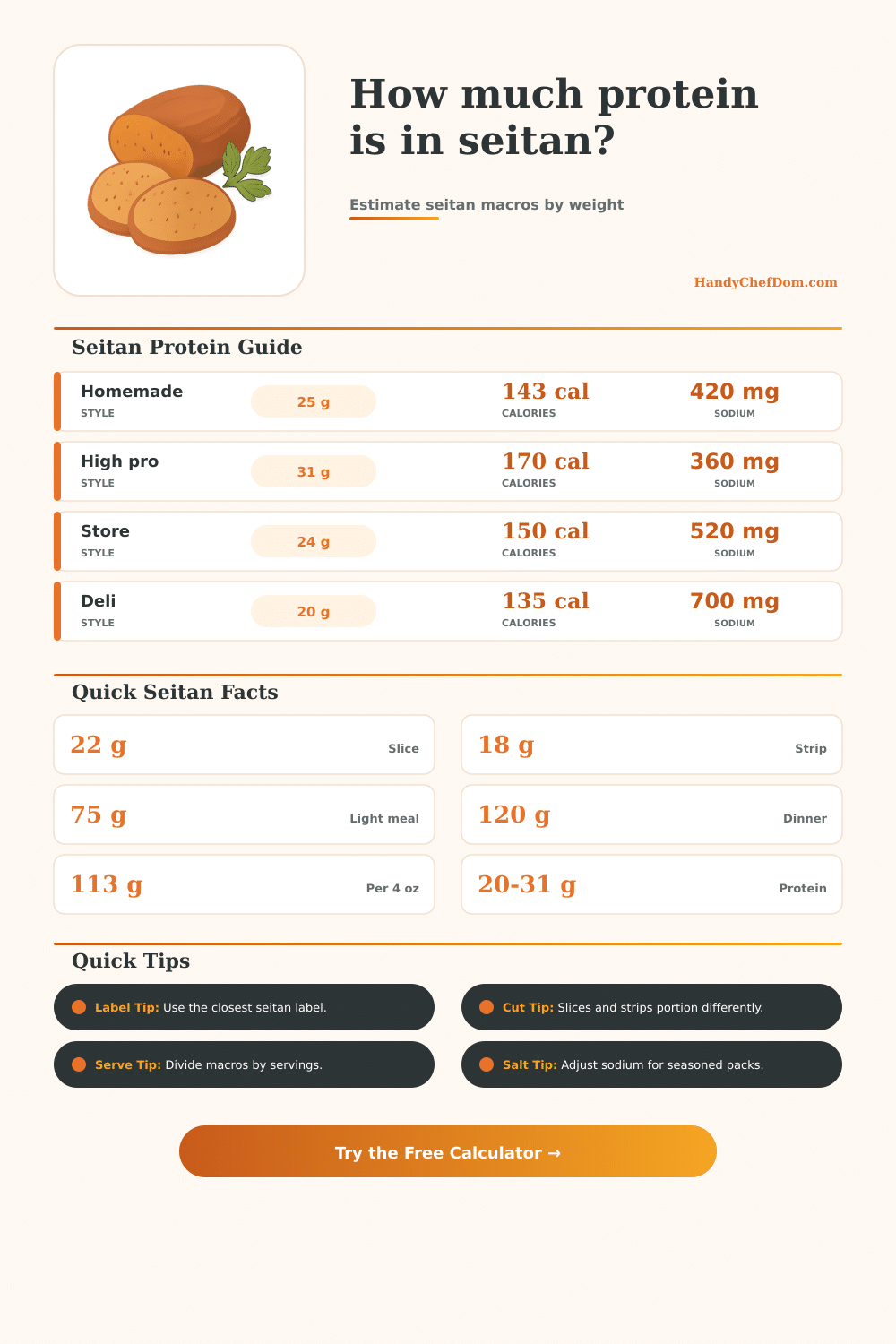
| Homemade simmered seitan | 25 g | 143 cal | 6 g | 420 mg |
| Homemade high-protein loaf | 31 g | 170 cal | 5 g | 360 mg |
| Homemade chickpea blend | 22 g | 165 cal | 12 g | 380 mg |
| Store-bought original | 24 g | 150 cal | 8 g | 520 mg |
| Store-bought seasoned strips | 23 g | 160 cal | 9 g | 600 mg |
| Store-bought deli slices | 20 g | 135 cal | 7 g | 700 mg |
| Teriyaki seitan pieces | 21 g | 170 cal | 12 g | 720 mg |
| Smoked wheat meat slices | 24 g | 155 cal | 7 g | 650 mg |
| Cut Style | Typical Piece | Standard Serving | Useful Count |
|---|---|---|---|
| Slices | 22 g each | 4 to 6 slices | Deli plates |
| Strips | 18 g each | 5 to 7 strips | Bowls |
| Chunks | 20 g each | 5 to 6 chunks | Skewers |
| Crumbles | 10 g scoop | 8 to 12 scoops | Rice bowls |
| Whole block | 100 g slice | 1 portion | Meal prep |
| Serving Plan | Servings | Light Weight | Standard Weight | High Protein |
|---|---|---|---|---|
| Solo prep | 2 | 150 g | 200 g | 300 g |
| Dinner for 4 | 4 | 300 g | 400 g | 600 g |
| Family of 6 | 6 | 450 g | 600 g | 900 g |
| Potluck tray | 12 | 900 g | 1200 g | 1800 g |
| Gathering | 25 | 1875 g | 2500 g | 3750 g |
| Sodium Setting | Multiplier | When To Use | Result Effect |
|---|---|---|---|
| Use label sodium | 1.00x | Standard label | No change |
| Reduced-sodium label | 0.70x | Lower salt pack | Less sodium |
| Extra seasoned pack | 1.25x | Glazed or sauced | More sodium |
| Drained or blotted pieces | 0.90x | Surface seasoning removed | Slightly less |
Plant-based proteins like seitan is all the rage these days, but not every package is created equal. If you go into two different grocery stores and purchase what appears to be an identical bag of seitan (wheat gluten meat), one may have 31 grams of protein per serving while the other has 20. Why? Some brands washes away different amounts of starch, and others use different amount of ingredients to flavor their product. If you’re serious about tracking macronutrients, you’ll quickly realize that reading the front-of-the-package isn’t always enough… Standard nutrition labels is deceiving.
Once you plug in how much weight you plan on making and what type of preparation you’re after, calculator will handle the rest. No more guessing about whether that batch is more like a salty deli slice or a lean homemade loaf. By understanding what goes into each input, you’ll be able to trust your output.
Why You Should Use a Seitan Calculator
After all, homemade seitan can get washed rigorously to strip away starch, leaving you with mostly protein and little carbohydrate. Conversely, store-bought options typically contains some sort of binder for texture or haven’t been washed at all to retain starch, significanty changing the macro- and calorie-nutrition of product.
Another consideration here is sodium. Sodium content in most store-bought foods can be much higher then what you would make at home because many items are already cured or otherwise pre-flavored. Even infusing with smoke or adding a teriyaki glaze adds flavor… But also boosts sodium and sugar. By picking a reduced-sodium preset or adjusting the sodium multiplier yourself, you’re able to account for this. It’s a tiny little tweak in an interface that will stop you from accidentally going over your daily sodium allowance if you want just protein.
This brings me back to one of my favorite points: It’s easy for us to go wrong with portion size. How do we know how much to eat? Usually, we eyeball it, thinking in terms of “a few bites” or “two slices,” rather than considering the actual weight. You could of be underestimating how many grams of protein you’re getting. For example, a pile of six slice can look like a lot, but what if they were super-thin, airier slices? Then you might only get half as much protein as you thought.
You can enter the grand total weight and split it into servings. Or, you can enter an estimated number of pieces based off how you slice or cut them. This helps the calculator account for these differences. Knowing your gram count matter more than eyeballing it, since thick deli slices will usually have higher weights than strips.
When adding seitan to your meals, think about how else it will contribute to what you’re eating. For example: is it a large part of the dish, or is it being added on top? If you’re preparing a stir fry where there’s also sauce and veggies, then go lighter on the seitan. Use the range of grams listed in the reference table for smaller portions (on a light bowl) versus larger ones (heavy dinner plate). But if seitan constitutes most of your daily protein intake, opt for something closer to high end of the range instead.
The buffer percentage is intended to compensate for shrinkage while cooking, because yes, it happens. It always does. When wheat gluten cooks down, it shrink! So adding an additional ten percent leeway helps you know you’ll have enough to eat after you cook it.
It is more accurate than any broad average because it doesn’t rely on one. The standard general guidance, “seitan is around 25g protein/100g”; is meaningless unless you know which brand you’re eating (some are 20, others are 30). Anchoring your calculations to real-world details about weight and brand type creates a custom macro profile that matches your food, not industry norms.
You can play with presets such as family dinner or meal prep pack sizes and watch the total adjusts accordingly. If serious eating is serious business, then so is the serious ingredient seitan. It’s versatile stuff, but it demands careful care. Whether purchased as pre-sliced convenience strips or made at home from a chunk of dough, when you know precisely what goes into your meal, there are no surprises, no guessing games with mysteriously carby seasoned packages, no overestimating the protein content of lean loaves. The information is revealed and your food choices is purposeful instead of random.