🧁 Batter per Cupcake Calculator
Size cupcake batter by liner volume, fill percentage, batter density, pan cavities, dome target, overflow buffer, and recipe yield.
Enter your recipe yield in cups or grams, then match the liner size, fill level, dome style, and pan cavities to see batter per cupcake and full batch yield.
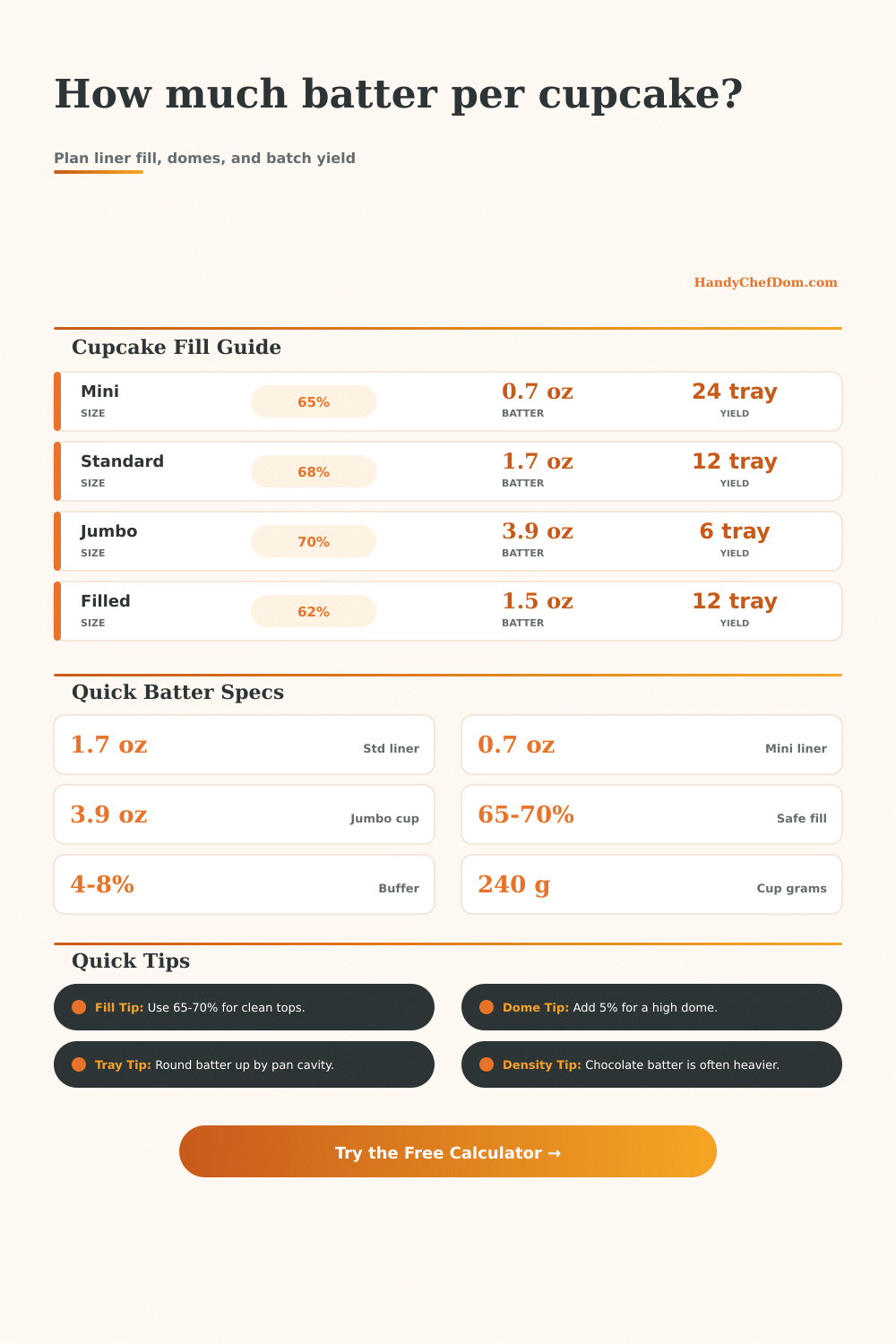
| Cupcake Size | Liner Capacity | Typical Fill | Approx Batter Each |
|---|---|---|---|
| Mini 1.25 inch | 1.05 fl oz | 62% to 68% | 0.65 to 0.72 oz |
| Standard 2 inch | 2.55 fl oz | 65% to 70% | 1.65 to 1.80 oz |
| Tall bakery liner | 3.10 fl oz | 62% to 68% | 1.92 to 2.11 oz |
| Jumbo 3 inch | 5.60 fl oz | 68% to 72% | 3.81 to 4.03 oz |
| Muffin cup liner | 4.20 fl oz | 65% to 72% | 2.73 to 3.02 oz |
| Wedding tasting liner | 1.65 fl oz | 60% to 66% | 0.99 to 1.09 oz |
| Batter Style | Density | Cups From 1200 g | Best Fill Cue |
|---|---|---|---|
| Vanilla butter batter | 240 g per cup | 5.00 cups | Level two thirds |
| Chocolate cocoa batter | 260 g per cup | 4.62 cups | Slightly lower fill |
| Red velvet batter | 250 g per cup | 4.80 cups | Medium dome |
| Gluten-free batter | 270 g per cup | 4.44 cups | Leave extra buffer |
| Light sponge batter | 215 g per cup | 5.58 cups | Do not overfill |
| Banana cupcake batter | 275 g per cup | 4.36 cups | Heavier scoop |
| Pan Setup | Cavities | Standard Batter | Mini Batter |
|---|---|---|---|
| Half dozen pan | 6 | 1.25 cups | 0.52 cups |
| Standard dozen pan | 12 | 2.50 cups | 1.05 cups |
| Double dozen event | 24 | 5.00 cups | 2.10 cups |
| Wedding rack | 48 | 10.00 cups | 4.20 cups |
| Party batch | 72 | 15.00 cups | 6.30 cups |
| Bakery sheet run | 96 | 20.00 cups | 8.40 cups |
| Dome Target | Added Batter | Overflow Buffer | Use When |
|---|---|---|---|
| Flat party top | 0% | 6% to 10% | Frosting swirl needs room |
| Low bakery dome | 4% | 4% to 8% | Standard cupcakes |
| High rounded dome | 8% | 5% to 10% | Visible bakery crown |
| Extra tall dome | 12% | 8% to 12% | Sturdy batters only |
| Filled cupcake base | -8% | 6% to 10% | Core will be removed |
| Gluten-free dome | 3% to 6% | 8% to 12% | Swelling is less even |
Why is it such a panic to find that half of your cupcakes overflow while the other half are flat? Why do you think of batter as water? Batter behave differently based off how much air there is and how heavy it is.
When mixing up something with a lot of air (sponge) vs. Something denser (chocolate), the physics of its rise get locked in at the moment batter go into the oven. So much so that you can’t compensate for less cake by turning down the temp, or add more cake by turning the heat up. It is all about amount.
How to Use the Cupcake Calculator
You input the specs for your liners and the total yield of the recipe (e.g., in cups or grams), then the calculator do the math for you. No more guesswork about the number of servings your bowl of batter can hold.
Of course, most folks begin with their go-to, generic recipe card that says “two dozen” cupcakes. This is as if they always get exactly two dozen, never accounting for how high or low you pack your liners or how much batter stick to the measuring cup and mixing bowl. The tool takes all those real world losses into account when you type in your true yield in grams or cups. You will know exactly how much batter is in each cup, and you will also see at a glance if you are an ounce or so short of finishing the last tray or if you will have leftovers.
What’s the problem? Compare filling a standard sized bakery cupcake vs. It is a mini cupcake. You want a nice rounded top, right? When baking minis in two-dozen cavity pans, being off by even a fraction of an ounce per cupcake will make the whole tray look lumpy. But with those huge jumbos, they requires much larger amounts of batter to look as full at eye-level as their tiny cousins. That’s why liner size is directly related to fill amount (see chart below). The jumbo can hold almost three times as much batter as a standard sized liner, so the amount of needed batter must also increase accordingly.
For the vast majority of home bakers, it’s the factor of density. Vanilla sponges contains less fat and fewer ingredients (such as cocoa) than a chocolate batter. Even though a cup of vanilla sponge might take up exactly the same amount of space in your measuring jug as a cup of chocolate batter, it won’t weigh as much so it will sit lower down inside the jug. If you use the same scoop size for both, the chocolate cupcakes will rise taller and potentially overflow, while the vanilla ones may fall flat. To bridge this volume/weight difference, you can enter the density of each batter in grams per cup into the calculator, and it’ll adjust accordingly. It’s key when converting from one system of measurement to another. Volume can change depending on air, but weight stays the same.
The other thing your preference affects: How high do you want the cake? Do you like a traditional tall dome, or would you rather have a flat top that’s easy to frost? For that case, you’ll need to fill your liner just a little bit more (which makes it even more comfortabley likely to spill over). And that’s where the tool comes in: You can define both your dome goal AND how much overflow you’re comfortable with. So if you’re after a tall dome, then the calculator will tell you to go a bit higher on your fill percentage, but it’ll tell you to add a bigger overflow buffer to allow for additional rise. It’s one input tweak… but it saves you from the frustration of having batter splash up against the sides of the pan, form those jaggedy crusts, and turn into a huge mess.
You should of seen how much was wasted. Precision in disguise: that’s what baking is all about. You want it to appear effortless. To achieve that look, you do the work upfront by accounting for wasted batter, liners, and density. This way, you never wonder how much batter is left for those last couple cup when you go to mix up another batch. And at the end, you’ll know how tall the muffins will be (not too far!). You’ll also know how many trays you’ll get from one batch (enough to satisfy your craving) and exactly how many muffins you’re getting (perfect!). The panic is gone, and quiet confidence has took its place.