🍓 Strawberry Carb Calculator
Estimate total carbs, net carbs, fiber, cups, grams, berry count, hulled trim, frozen weight changes, topping portions, and sweetener add-ins.
Use raw unsweetened strawberry data. Choose how you measured the berries, then adjust for hull trim, thawed frozen moisture, serving count, and any sweetener used for dessert topping.
| Strawberry form | Typical cup weight | Total carbs | Fiber | Net carbs |
|---|---|---|---|---|
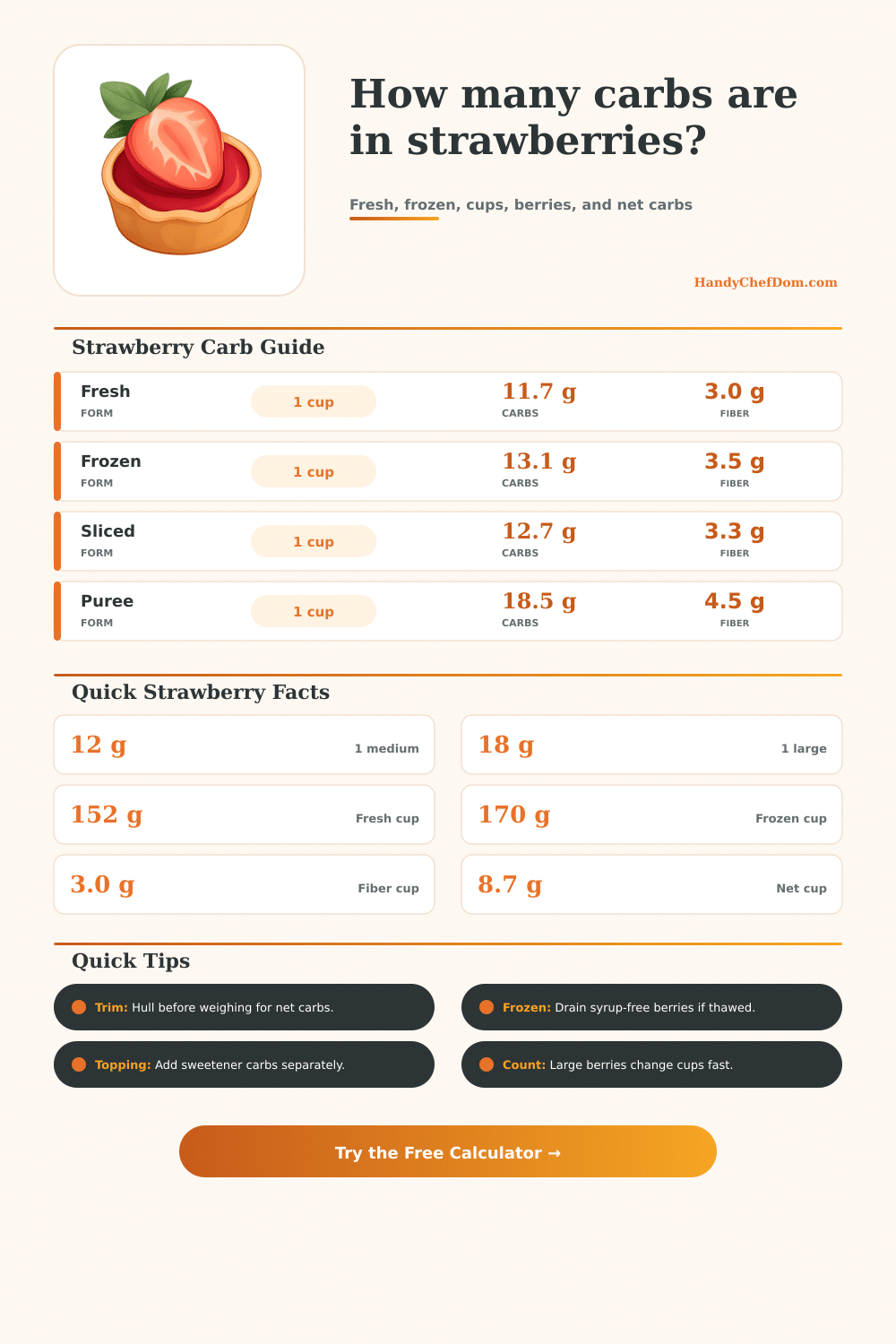
| Fresh whole | 152 g | 11.7 g | 3.0 g | 8.7 g |
| Fresh halved | 160 g | 12.3 g | 3.2 g | 9.1 g |
| Fresh sliced | 166 g | 12.7 g | 3.3 g | 9.4 g |
| Fresh diced | 170 g | 13.1 g | 3.4 g | 9.7 g |
| Frozen whole | 170 g | 13.1 g | 3.4 g | 9.7 g |
| Frozen sliced | 180 g | 13.9 g | 3.6 g | 10.3 g |
| Crushed fresh | 232 g | 17.9 g | 4.6 g | 13.3 g |
| Fresh puree | 240 g | 18.5 g | 4.8 g | 13.7 g |
| Berry size | Average weight | Carbs each | Fiber each | Cup estimate |
|---|---|---|---|---|
| Small | 7 g | 0.5 g | 0.1 g | 20 to 22 |
| Medium | 12 g | 0.9 g | 0.2 g | 12 to 13 |
| Large | 18 g | 1.4 g | 0.4 g | 8 to 9 |
| Extra large | 27 g | 2.1 g | 0.5 g | 5 to 6 |
| Serving use | Berry grams | Total carbs | Net carbs | Notes |
|---|---|---|---|---|
| Small garnish | 25 g | 1.9 g | 1.4 g | 2 tbsp |
| Dessert topping | 40 g | 3.1 g | 2.3 g | 3 tbsp |
| Snack side | 75 g | 5.8 g | 4.3 g | 1/2 cup |
| Standard cup | 152 g | 11.7 g | 8.7 g | 1 cup |
| Smoothie fruit | 170 g | 13.1 g | 9.7 g | Frozen cup |
| Party bowl | 600 g | 46.2 g | 34.2 g | 8 small |
| Add-in sweetener | Carbs per tsp | Use case | Net effect |
|---|---|---|---|
| None | 0 g | Plain berries | No change |
| Sugar | 4.2 g | Macerated topping | Raises net |
| Honey | 5.8 g | Drizzle bowl | Raises net |
| Maple syrup | 4.5 g | Brunch topping | Raises net |
| Agave syrup | 5.3 g | Smooth topping | Raises net |
| Zero-carb | 0 g | Low net bowl | No carb add |
A lot of people think “oh I know, one cup of strawberries is X number of grams of carbs,” but that’s not true at all. It depends on whether you measured your fruit with leafy greens chopped off or not. It also depends on if it was frozen as a whole, a cut-up block, or sliced first.
If you guessed what you ate most days, chances are you have no idea how many total carbs per day you’ve eaten. Berries is a fibrous, watery food with an irregular shape that can’t be weighed like a portion of chicken breast. Fruits call for more careful tracking when it comes to carb counts.
Why It Is Hard to Count Carbs in Berries
Once you have entered your prep style and measurement method, the calculator above do the rest. It takes out any guesswork about whether additional hulls significantly changed your scale weight. It also includes sweetener add-ins, form changes, and trim.
You can get more sliced berries into the same volume than whole berries, so a cup of the former contains less fruit (by mass). That means you are getting more actual plant matter per spoonful, which change the carbohydrate load noticeable. The difference isn’t huge, but if you’re counting carefully it adds up.
So, back to those strawberries: What’s in a pint bag? There are more little berries than big ones. Look at how much tighter those tiny berries pack into a pint bag. There are simply more pieces of fruit overall. Even though they appear to be as many berries in a bag when it’s full, because there’s more space (more exposed surface area) between them, you can easily macerate them and have even more sugar-exposed surface area to work with.
In comparison, fewer larger berry will get you to your desired number of servings before it’s time to stop chopping. Weight is best here, a gram is a gram, no matter how you’ve sliced or stuffed them into their bag. But if you do need to use cups, the tool adjusts for density based on whether you are using whole, halved, or diced fruit.
Another variable is introduced with frozen berries. For example, most unsweetened frozen strawberries are flash-frozen immediately after harvest. This means they don’t take on any extra sugar from syrup during freezing. However, once they thaw, they will release moisture and leave behind a concentrated pulp. They may also be denser (i.e., weigh more) than fresh when measured in a cup.
This means you’ll end up with less water weight if you strain out the liquid before blending or eating. But you’re still going to get the full fiber and carbs. And the tool lets you account for that so that your net carb count is correct even if you drain away some of the liquid.
That’s why we call it “net” carbs: It’s the total carbohydrates minus the fiber. Fiber doesn’t raise your blood sugar the way simple sugars do; instead, it basically just comes through your body mostly intact.
Most trackers go off the rails when it comes to adding sweeteners. One teaspoon of maple syrup or honey doesn’t sound like much, unless you multiply it by several teaspoons across a week! The calculator has a spot to enter your added liquid sweetener to account for all those small additions. It then calculates the effect on the grand total, which is crucial for things like yogurt parfaits or strawberry shortcakes.
Fruit itself is pretty low on the glycemic index, but once you add some sugared-up soaked topping, things spike fast. There’s also space to record zero-carb sweeteners, so you’ll get sweetness with no glucose hit.
There’s more fiber at play than you’d expect. Some of our favorite fruits (like strawberries) has some of the highest fiber content of all fruits. This keeps you full for longer and slows down how your body absorbs sugar. It breaks down your total carbs into two figures: fiber and net carbs. You will understand what percentage of each serving contributes toward your overall limit.
You can also keep track whether you are preparing meal prep containers or creating just one snack to hit your limit. Per-serving net carbs is especially useful because you won’t accidentally overdo it on a serving (whether that’s a big bowl or a small snack).
There’s no need to be perfect with tracking; this is about gaining awareness of what goes into your bowl, and how that translates inside your body. If you have a general idea of what ‘a portion’ looks like (and you consistently estimate) then you don’t necessarily need to weigh each individual berry. Tracking should create clarity, not cause anxiety.
Knowing the difference between a cup of whole berries and a cup of puree creates options, so you can choose according to your own goals instead of wondering ‘did I have too much?’ Choose your measuring method and let the tool do the conversion work for you. It takes the guesswork out of trim loss and density adjustments. You will learn how your sweetener choice and cut style impact your total in no time flat.
Now armed with the numbers, you’re ready to put together a meal that meets your desire for something sweet but won’t throw you off your macro game. The key is knowing what you’re actualy measuring, not looking at a heap of some red fruit and throwing up your hands and hoping for the best. With a bit of awareness, sticking to healthy habits isn’t as much of a math problem as it is looking at a pile of food and hoping for the best.