🍇 Grape Carb Calculator
Calculate total carbs, net carbs, fiber, serving carbs, cup conversions, gram weights, grape counts, frozen snack portions, and raisin equivalents.
Choose whether your grape portion is measured by cups, grams, or grape count. The calculator estimates total carbs, net carbs, fiber, and per-serving values using grape type, form, seed status, and serving count.
| Grape Type | Carbs / 100 g | Fiber / 100 g | Typical Note |
|---|---|---|---|
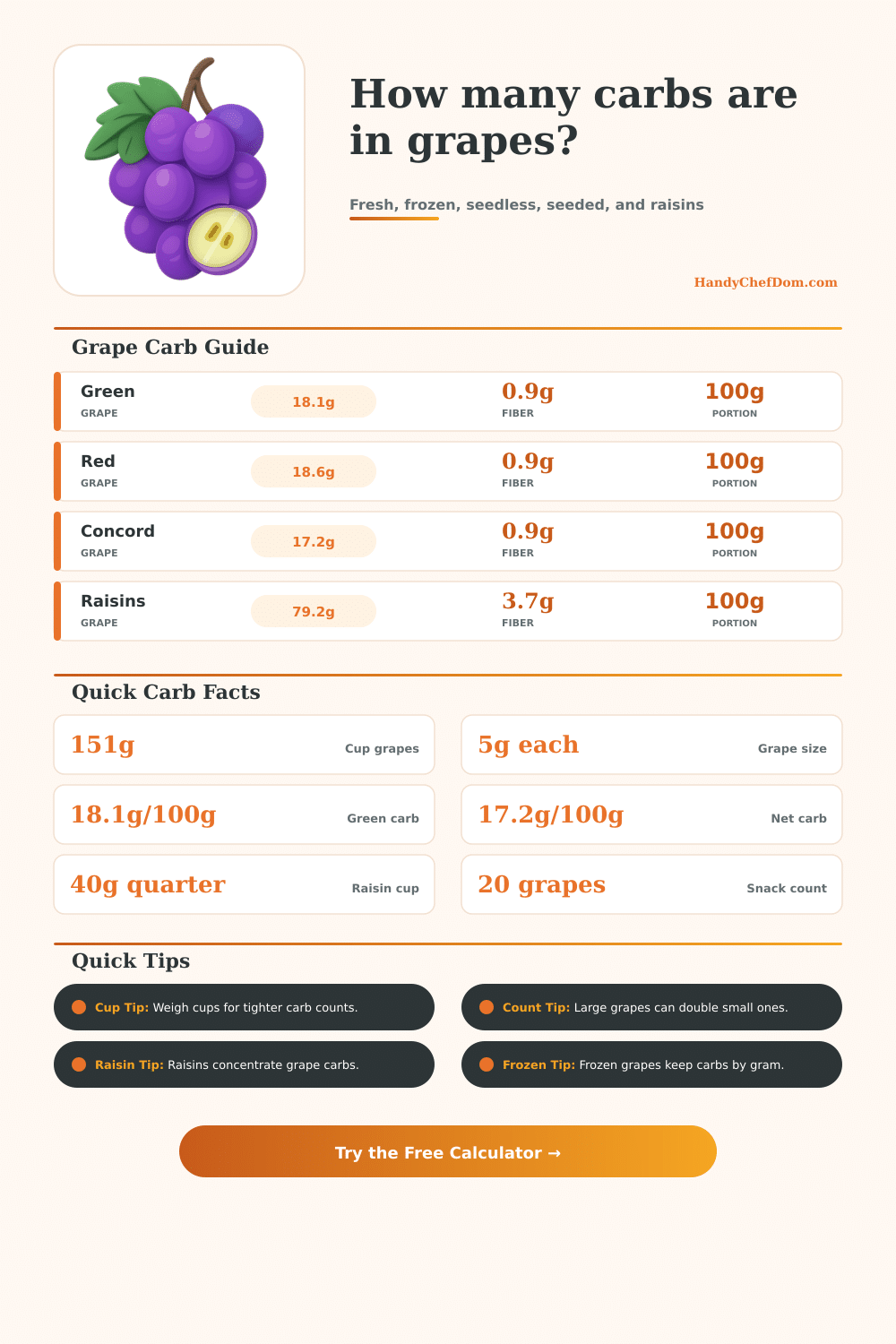
| Green seedless | 18.1 g | 0.9 g | Standard USDA-style table grape baseline. |
| Red seedless | 18.6 g | 0.9 g | Common snack grape with a small carb bump. |
| Black seedless | 18.2 g | 0.9 g | Similar carb range to green grapes. |
| Concord grapes | 17.2 g | 0.9 g | Often seeded, aromatic, and smaller. |
| Cotton candy grapes | 19.4 g | 0.8 g | Sweeter table grape estimate. |
| Muscadine grapes | 18.0 g | 3.9 g | Thicker skins raise the fiber estimate. |
| Champagne grapes | 18.1 g | 0.9 g | Tiny grapes; count estimates vary widely. |
| Seeded table grapes | 18.1 g | 1.0 g | Whole-weight servings include seed mass. |
| Form | Cup Weight | Carb Behavior | Calculator Note |
|---|---|---|---|
| Fresh grapes | 151 g/cup | Normal hydration | Best default for bowls and fruit trays. |
| Frozen grapes | 140 g/cup | Same by gram | Frozen scoop may weigh a little less. |
| Raisins | 160 g/cup | Concentrated | Use the raisin warning for equivalence. |
| Loose snack cup | 120 g/cup | Air gaps vary | Weigh if the cup is loosely filled. |
| Packed lunch cup | 150 g/cup | Fresh baseline | Often close to a measured cup. |
| Party tray scoop | 135 g/cup | Mixed sizes | Add buffer when people self-serve. |
| Portion | Approx Grams | Approx Carbs | Best Use |
|---|---|---|---|
| 10 grapes | 50 g | 9 g | Small snack or garnish. |
| 20 grapes | 100 g | 18 g | Countable carb portion. |
| 1/2 cup fresh | 76 g | 14 g | Lunch box side. |
| 1 cup fresh | 151 g | 27 g | Full fruit serving. |
| 1 cup frozen | 140 g | 25 g | Frozen snack bowl. |
| 1/4 cup raisins | 40 g | 32 g | Dried fruit portion check. |
| Serving Scenario | Suggested Portion | Serving Count | Carb Reminder |
|---|---|---|---|
| Kids lunch box | 1/2 cup | 1 | About 14 g carbs before type tweaks. |
| Frozen snack cup | 1 cup frozen | 1 | Carbs are based on frozen weight. |
| Meal prep cups | 3 cups fresh | 4 | Split total carbs across containers. |
| Shared fruit tray | 6 cups fresh | 8 | Add buffer for generous scoops. |
| Raisin topping | 2 tbsp | 1 | Small dried portions add carbs quickly. |
| Carb-counting snack | By grams | 1 | Scale weight is the most reliable input. |
What’s this? You’re in produce aisle, staring at red grapes. Will they count toward your carb allotment? It is an honest quandary, since nothing appears more innocently fruit-like than a fruit, until you read the label. Think of it: grapes are little bags of sugar encased in a delicate wrapping. Compared to something like melon or berries, they brings you more carbohydrate; portion control is essential when tracking them.
Once you input how you measure (above), the calculator do the math, and spares you guesswork about what constitutes a meal versus a snack. A cup is an intuitive measurement for things like grapes. It seems obvious. But for little round things with spaces in-between? Cups is inaccurate. One loosely filled cup will weigh less then another tightly packed one, and those extra grams adds up fast (they mess with your carb count).
How to Measure Grapes for Carbs
You can switch to measuring by gram weight instead (if you own a kitchen scale) and doing that will help you avoid accidental overeating. When you weigh something, the container’s fullness isn’t a factor anymore. It’s a minor change, but it make a difference when we’re talking about counting every gram.
If you want to count out each grape individually, the calculator takes into account that different-colored grapes vary in size. Twenty might sound like a lot of grapes, but a large Thompson variety weigh more than its tiny currant cousin; you’ll need to factor in that difference to make sure you’re counting right.
Nutritional information vary depending on the form of grape. Because fresh grapes consist primarily of water, their carb content stay low. Roughly 18 grams per every 100 grams of fruit.
Freeze them, and voilà: same sugar, different consistency. When a food freezes, its water become ice crystals, but the sugar just sits there, still as ever. It’s not uncommon for folks to think frozen treats must be lower-calorie; after all, those ice crystals feels lighter in the mouth and are slower to consume. But gram-for-gram, nutritionally speaking, they’re identical. As long as you weigh ’em pre-thaw (so they have time to expand a bit in volume), you’ll get your crunchy satisfaction with no stealthy carbs to worry about.
Then there is raisins. When you dry them out, all that leftover goodness gets packed into a little bit of nothingness. One quarter cup of raisins has about four times the amount of carbs as a full cup of grapes. And here’s where most people mess up: they look at small heap of dried fruit and think it’s a reasonable snack serving size. There’s zero bulk to stop you from eating so much, and since the water evaporated, its easy to overestimate the amount of sugar you’re consuming. Before you know it, you’ve eaten an entire bag of raisins, and that’s way more then what a single snack serving should of been.
There is one more level of complication: seeds. You’ll notice that some varieties (like Concord grapes) is not completely seedless; instead they’re merely “seeded.” Since those seeds occupy space and there’s less flesh by weight compared to an equivalent amount of non-seeded ones, the tool factors that in account too. A little detail, perhaps, though if you’re planning on purchasing your grapes by the pound for juice or jelly-making purposes, you want to know what percentage of that pound is carbohydrate-bearing grape flesh.
Speaking of grapes, muscadines are an odd category. They tend to be higher in fiber because they has thicker skins than typical table grapes. This makes them a slightly better option for managing blood sugar levels, even though their carbs are about the same.
The takeaway: Don’t fear the grape (or any other food), just don’t forget its density. Knowing which foods are heavy versus light eliminates guesswork. Light (a.k.a., knowing their weight vs. Knowing their volume eliminates guesswork. The tool’s reference tables provides baseline comparisons of fresh, frozen, dried. All side-by-side. When precision is required, go with grams; otherwise stick with cups if rough estimates will do.
Once you know exactly what goes onto your plate, you’ll be surprised at how fast it vanishes. Count those sugar bombs correctly, and they’ll hit you harder. But measure instead of guessing, and then enjoy those sugar bombs as much as ever.