Malted Barley Per Gallon Beer Calculator
Estimate malted barley amount from batch size, target original gravity, brewhouse efficiency, malt potential, beer style, adjunct share, grain loss, and unit system for technical brewing records.
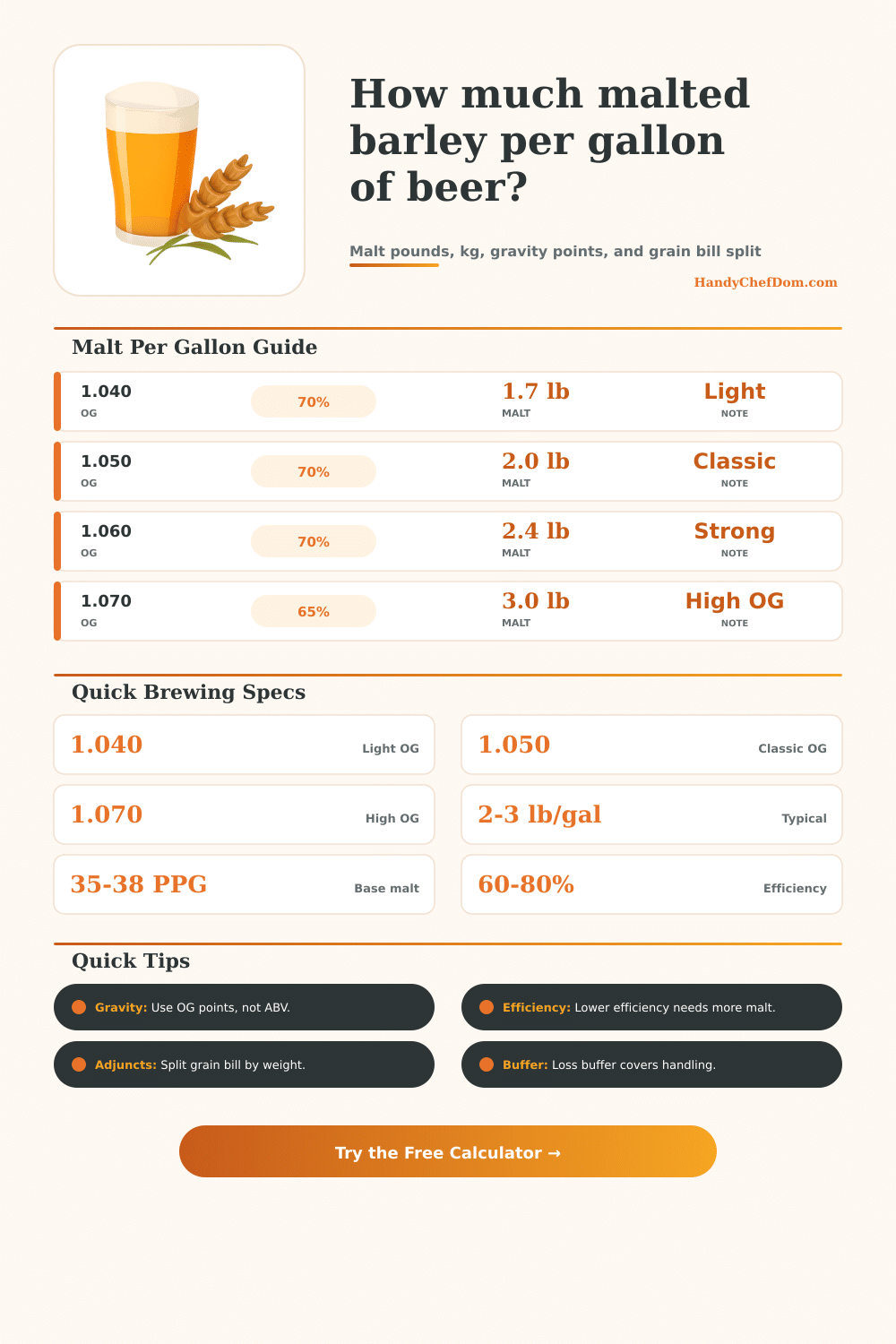
Reference range: many all-grain beer recipes land near 2 to 3 lb of malted grain per gallon, depending on target original gravity, brewhouse efficiency, malt potential, adjunct share, and handling loss.
Often fits session-strength recipes when efficiency is normal and the grain bill is mostly base malt.
Common planning zone for pale ales, lagers, wheat beers, stouts, and porters around mid-range OG.
Needed when OG rises, efficiency drops, or a larger adjunct percentage lowers average extract potential.
Moving from 75 percent to 60 percent efficiency can add a noticeable amount of required malt.
| Beer style | Typical OG range | Approx malt per gallon | Planning note |
|---|---|---|---|
| Session beer | 1.038 to 1.045 | About 1.5 to 2.0 lb per gallon | Lower gravity recipes need less grain when efficiency is steady. |
| Pilsner or lager | 1.044 to 1.056 | About 1.8 to 2.3 lb per gallon | Pilsner malt has good extract potential, so efficiency drives the final amount. |
| Pale ale | 1.045 to 1.060 | About 1.9 to 2.5 lb per gallon | A practical middle range for all-grain batch planning. |
| Stout or porter | 1.045 to 1.070 | About 2.0 to 2.8 lb per gallon | Specialty malts may have lower extract, so the base malt share matters. |
| High gravity ale | 1.080 to 1.110 | About 3.2 lb per gallon or more | Large grain bills can reduce efficiency, so use measured system data when available. |
| Malt type | Potential used | Flavor role | Calculator effect |
|---|---|---|---|
| US 2-row pale malt | 36 PPG | Clean base malt | Default balanced estimate for many all-grain recipes. |
| Maris Otter pale malt | 38 PPG | Richer biscuit base | Higher potential can slightly reduce required pounds. |
| Pilsner malt | 37 PPG | Light lager base | Similar to pale malt with a clean, high-extract planning value. |
| Munich malt | 35 PPG | Toasty malt depth | Slightly lower potential increases required pounds for the same OG. |
| Wheat malt | 38 PPG | Wheat beer base | High potential, but lautering efficiency may vary by system. |
| Rye malt | 29 PPG | Spicy grain character | Lower potential can raise total malt weight when used heavily. |
| Brewhouse efficiency | System description | Malt impact | Use in calculator |
|---|---|---|---|
| 55% to 60% | Low extraction or first brew day data | Needs a larger malt bill to hit the same OG. | Use if measured pre-boil and fermenter numbers run low. |
| 65% | Conservative homebrew planning | Often adds about 8% more malt than 70% efficiency. | Good safety estimate for unfamiliar equipment. |
| 70% | Common all-grain default | Matches many recipe assumptions and rough calculators. | Default value for this malted barley calculator. |
| 75% to 80% | Well-dialed mash and sparge process | Needs less malt for the same gravity target. | Use only when your records support the efficiency number. |
| 85%+ | Very high extraction | Can under-size malt if entered without proof. | Verify with repeated batches before planning around it. |
| Original gravity | Gravity points per gallon | 70% efficiency 36 PPG estimate | Interpretation |
|---|---|---|---|
| 1.035 | 35 points | About 1.39 lb malt per gallon | Very light gravity from an all-malt base estimate. |
| 1.045 | 45 points | About 1.79 lb malt per gallon | Light to moderate recipes before specialty adjustments. |
| 1.050 | 50 points | About 1.98 lb malt per gallon | Classic midpoint near the low end of the 2 to 3 lb range. |
| 1.060 | 60 points | About 2.38 lb malt per gallon | Moderately strong recipe planning zone. |
| 1.075 | 75 points | About 2.98 lb malt per gallon | High gravity planning, especially if efficiency falls. |
Malted barley form the primary ingredient in all-grain brewing. The amount of malted barley that you use will determine the final gravity of the beer that you produce. If you use too little malted barley, your beer will be thin.
However, if you use too many of the malted barley, your beer will have a heavy body or the beer will ferment slow than it should. To reach the target gravity of your beer, it is important for brewers to understand the relationship between the weight of the malted barley and the final gravity of the beer. Using a grain calculator will help you to determine the exact weight of the malted barley that is require for your batch of beer.
How to Calculate Malted Barley for Beer
The first variable that you must consider is the target original gravity of the beer that you would like to produce. The original gravity of the beer is a figure that shows the total extract in the kettle in the form of points per gallon. Each pound of base malt have a potential value in terms of it’s point value per gallon.
You can calculate the theoretical weight of the malted barley that you must use for brewing by multiplying the potential value of the malted barley by the batch size of the beer that you are producing, then dividing that number by the brewhouse efficiency of your brewing system. This calculation can be easily performed on a grain calculator, which will allow you to input the batch size of the beer that you will produce, your target original gravity, and the efficiency of your brewing system. The efficiency of your brewing system are a critical factor in producing beer at the right gravity.
The efficiency of your brewing system describes the amount of extract that you can get from your malted barley. Brewing systems typically have an efficiency of 70 percent when brewing at home. However, if you have an efficiency of 60 percent, you will need to use more malted barley to achieve your target gravity.
You can adjust the efficiency input on the grain calculator to ensure that the weight of the malted barley that is calculated for your recipe is accurate for your brewing system. If you do not adjust the efficiency of your brewing system as a variable in the grain calculator, you will end up with the incorrect amount of malted barley in your brewing system, which will prevent you from achieving your target gravity. The type of malted barley that you use will also impact the final gravity of your beer.
If you use different type of malted barley, each of which has a different potential extract value, you will need to adjust the amount of each type of malted barley that you use. A grain calculator will allow you to select each type of malted barley that you will use in your beer recipe. It will also allow you to input other adjunct ingredients that may impact the gravity of your beer.
Another variable that you should include in your brewing recipe is a loss buffer. During the brewing process, you will lose some of the malted barley during the weighing, milling, and brewing processes. A loss buffer of three or four percent will allow you to ensure that your malted barley wont run out during the brewing process.
The grain calculator will include a field for you to input a percentage loss buffer for your brewing system. The three specific pieces of information that the grain calculator will provide for your beer recipe are the total weight of the malted barley that is required for your batch, the amount of pound of malted barley that will be produced per gallon of the batch of beer, and the division between the base malt and adjunct ingredients for your recipe. The pounds per gallon of your beer can help you to verify that your recipe calculations is correct.
For all-grain beer recipes, the pounds of malted barley per gallon should be between two and three pound. If your calculated number of pounds per gallon is outside of this range, you should adjust the gravity target, efficiency, and adjunct ingredients percentages in your brewing system. The reference tables included in the grain calculator will provide information regarding the amount of malted barley that is typically used for different type of beer and malted barley.
These tables are not a replacement for the calculations, but they can help to show you if the amount of malted barley that you are calculating for your batch of beer is within the typical range for that type of beer. For instance, light session beers will require less malted barley then IPAs. These tables allow you to visualize the differences in different types of recipes.
These calculations should of been performed prior to your brewing day. Once you have begun brewing your beer, you cannot adjust the amount of malted barley that is used. Using the malted barley calculations ahead of time will allow you to purchase additional malted barley in the case that your brewing system efficiency is lower than you had estimated, or to adjust the brewing processes of your system to increase the efficiency of your malted barley.
Additionally, you can use the calculations to scale up or down the amount of beer that you would like to produce. If you change the batch size of your beer without performing the calculations, the gravity of your beer will change. The ultimate goal of using a grain calculator for brewing systems is to enable you to achieve consistency in the beer that you produce.
You want the weight of the malted barley that you measure in your brewing system to always produce the same specific gravity of beer. If you can achieve this goal, you will have more control over other aspects of your brewing system. For instance, you will have more control over the amount and timing of the hops that you use in your recipe.
You will have more control over the brewing temperature of your system. The consistency of the malted barley is the foundation for which all other aspect of brewing are built.