Graham Cracker Carb Calculator
Convert graham sheets, square halves, crumb cups, crust recipes, and s'mores into total carbs, net carbs, fiber, and per-serving numbers.
Your Graham Carb Breakdown
Usually two square halves for snacks or one classic s'more.
Half-sheet portions make small carb changes easier to count.
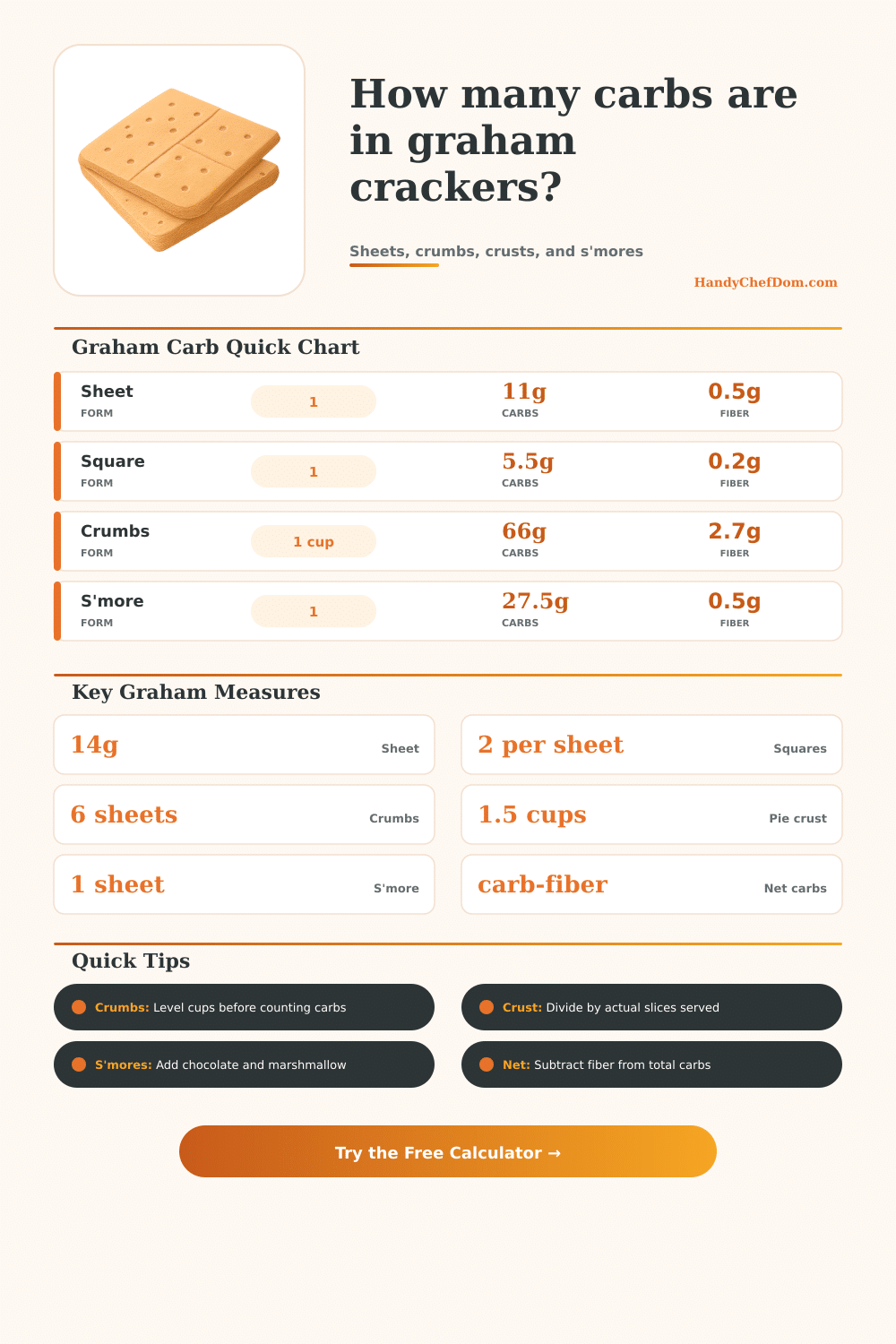
About six full sheets crush into one level cup of crumbs.
A standard 9-inch crust often starts with 1.5 cups crumbs.
| Graham Type | Carbs Per Sheet | Fiber Per Sheet | Best Calculator Use |
|---|---|---|---|
| Honey graham | 11.0g | 0.5g | Default snacks, crumbs, s'mores |
| Cinnamon graham | 11.4g | 0.5g | Snack trays and dessert layers |
| Chocolate graham | 11.8g | 0.6g | Chocolate crusts and parfaits |
| Whole wheat graham | 10.6g | 1.0g | Higher-fiber servings |
| Reduced sugar graham | 9.1g | 0.9g | Lower total carb snack counts |
| Gluten-free graham | 12.6g | 0.5g | Specialty crusts and crumbs |
| Mini graham bites | 10.8g | 0.4g | Measured snack cups |
| Form | Sheet Equivalent | Crumb Equivalent | Counting Note |
|---|---|---|---|
| 1 full sheet | 1 sheet | 0.17 cup crumbs | Two square halves |
| 1 square half | 0.5 sheet | 0.08 cup crumbs | Good for small servings |
| 1 cup crumbs | 6 sheets | 1 cup crumbs | Use level cups for crusts |
| 1 sleeve estimate | 9 sheets | 1.5 cups crumbs | Typical 9-inch pie base |
| 1 classic s'more | 1 sheet | Not crumbed | Add filling carbs if tracking |
| Recipe Format | Crumb Cups | Sheet Estimate | Suggested Servings |
|---|---|---|---|
| 9-inch pie crust | 1.5 cups | 9 sheets | 8 slices |
| 10-inch deep pie crust | 2 cups | 12 sheets | 10 slices |
| 8-inch cheesecake crust | 1.25 cups | 7.5 sheets | 8 slices |
| 9-inch cheesecake crust | 1.75 cups | 10.5 sheets | 12 slices |
| 9x13 bar crust | 3 cups | 18 sheets | 24 bars |
| 12 mini cups | 1 cup | 6 sheets | 12 minis |
| S'mores Count | Graham Sheets | Graham Carbs | Classic Total With Fillings |
|---|---|---|---|
| 2 s'mores | 2 sheets | 22g | 55g carbs |
| 4 s'mores | 4 sheets | 44g | 110g carbs |
| 8 s'mores | 8 sheets | 88g | 220g carbs |
| 12 s'mores | 12 sheets | 132g | 330g carbs |
| 24 s'mores | 24 sheets | 264g | 660g carbs |
You might associate Graham crackers with campfires and happy childhood memories, or with cheesecakes and other sweet treats. It’s hard to keep their carb count straight because they’re just so… Dual purpose!
A whole sheet doesn’t look like much (but it has two halves), each with a lot of carbs. When crushed into crumbs, you lose that visual clue about serving size. Six sheets’ worth of graham cracker carbs fit in one cup of crumbs. Changing shape confuse your estimates, which is why we need a converter.
Why You Need a Graham Cracker Carb Calculator
After choosing how many and what type of form you’re going to make, the calculator do the rest. You do not need to fiddle with fiber adjustments or fractional conversions. It connects those package labels to actual items.
Do you count whole sheets? Or do you want to count squares? Cups of crumbs, maybe? Finished s’more? It all makes a difference (crumbs is measured by volume while intact cracker is measured by weight). Level-packed crumbs has fewer carbs per portion than heavier packed ones, though both have slightly more carbs.
That’s a common baking detail that isn’t handled well on most labels. There’s a key distinction to make: Net Carbs vs Total Carbs. For most of your food logging, you want the latter (total carbs) minus Fiber. The reason? Graham crackers is notably low in fiber, often containing less than half a gram per sheet, so the gap between total and net carbs is minimal.
Fiber doesn’t have an impact on blood glucose levels, so why include it? Most graham cracker sheets has fewer than 0.5g of fiber. So the discrepancy between the two are small. It would of been nice if you could simply use the fiber to lower their carb impact like you can with Whole Grain Bread. However, it doesn’t work that way here.
When you choose the type, the site auto-calculates this for you. Depending on the variety, there will be subtle differences in its macronutrient breakdown. This matter because when you scale recipes for meal prep/party size, these details compound.
The complication with crust recipes is that they’re never made in round numbers. Nine inches is a typical size, but maybe that’s one-and-a-half cups of crumbs (which is about how many sheets you’d get). That means a 9-inch pie serves up a lot of carbs in its base, unless you cut it into ten thin slices different than eight. Then there are fewer carbs per serving.
Enter the number of servings you plan on having into the calculator, and the end result represent the actual number you’ll be eating. It also factors in any additional added sugar going into the crumb mixture. Those extra carbs gets added to the tally, so you know exactly what you’re paying for in terms of sweetness.
What about s’mores? S’mores are tricky since it’s not one ingredient, but several combined into one package. Yes, it is all about structure, which is the graham cracker. But when you add in marshmallows and chocolate bars, now you’re looking at a lot more sugar. That might double or triple your carbs compared to simply eating the crackers.
There are some pre-sets for several common s’more variations in the tool. You can get an idea of how much each filling contribute versus the whole base. It helps you determine if you want to stick with traditional ingredients or switch to lower-sugar versions while still tracking the total.
Common forms is listed out as reference tables at the bottom of the page, so you can look up numbers fast. It supports the same conversion ratio we use in our calculations. A visual reminder that six sheets are equivalent to one cup of crumbs helps strengthen the connection between whole and crushed forms.
Reminds you that just because it’s been crushed doesn’t make the cracker any less full of carbohydrates. It just alters how dense the food is and how easy it is to consume. This reminds you not to overeat! This is especially true when eating loose snacks or topping your yogurt with crumbs.
The point of being so precise with what you eat isn’t about being rigid; it’s about being aware. You shouldn’t obsess over crumbs landing on the countertop. But having a base line does help. Knowing how much is coming in helps whether you’re on a specialized diet or just interested.
When the guesswork goes out the window you know if and when that cookie fits into your plan for the day, and you can enjoy a pie crust (or s’more!) knowing precisely where all those carbs land. Once you have some solid tools and you get to know the math behind it all, you don’t have to stress anymore, just taste.
Now focus on flavor, and leave the worry of getting it wrong behind.