Spinach Fiber Calculator
Estimate spinach fiber from raw cups, grams, cooked cups, or frozen packs while accounting for baby versus mature leaves, shrinkage, servings, and your daily fiber goal.
Spinach fiber results
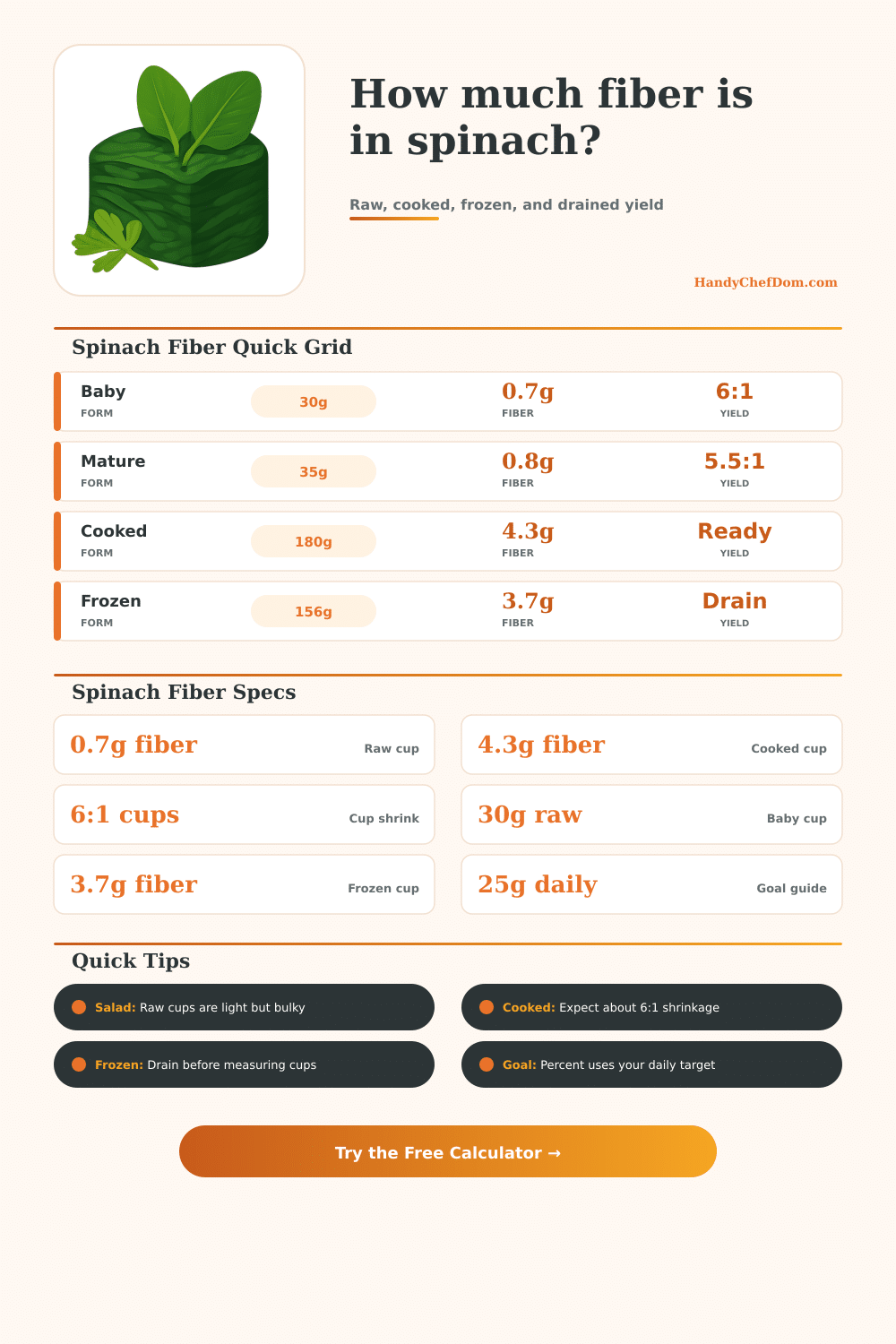
| Spinach form | Typical cup weight | Estimated fiber per cup | Cooked cup yield from raw cup |
|---|---|---|---|
| Baby spinach, fresh loose leaves | 30 g per raw cup | 0.7 g fiber | 0.17 cooked cup |
| Mature spinach, fresh leaves | 35 g per raw cup | 0.8 g fiber | 0.18 cooked cup |
| Fresh chopped spinach | 40 g per raw cup | 0.9 g fiber | 0.19 cooked cup |
| Packed fresh spinach for smoothies | 45 g per packed cup | 1.0 g fiber | 0.20 cooked cup |
| Cooked spinach, drained | 180 g per cooked cup | 4.3 g fiber | Ready as measured |
| Frozen chopped spinach, thawed | 156 g per drained cup | 3.7 g fiber | Ready after draining |
| Canned spinach, drained | 190 g per drained cup | 4.4 g fiber | Ready after draining |
| Starting fresh spinach | Cooked drained yield | Approx drained grams | Fiber stays about |
|---|---|---|---|
| 3 loose raw cups | About 1/2 cooked cup | 85 to 95 g | 2.0 to 2.4 g |
| 6 loose raw cups | About 1 cooked cup | 170 to 190 g | 4.0 to 4.8 g |
| 12 loose raw cups | About 2 cooked cups | 340 to 380 g | 8.0 to 9.6 g |
| 20 loose raw cups | About 3.3 cooked cups | 590 to 640 g | 13 to 16 g |
| Spinach use | Common serving volume | Fiber estimate | Share of 25 g goal |
|---|---|---|---|
| Fresh side salad | 2 loose raw cups | 1.3 to 1.6 g | 5 to 6 percent |
| Smoothie greens | 1 packed raw cup | 1.0 g | 4 percent |
| Cooked side | 1/2 cooked cup | 2.1 g | 8 percent |
| Spinach bowl add-in | 1 cooked cup | 4.3 g | 17 percent |
| Group size | Raw salad spinach | Cooked side spinach | Frozen drained equivalent |
|---|---|---|---|
| 2 servings | 4 raw cups | 1 cooked cup | 155 to 180 g |
| 4 servings | 8 raw cups | 2 cooked cups | 310 to 360 g |
| 8 servings | 16 raw cups | 4 cooked cups | 620 to 720 g |
| 12 servings | 24 raw cups | 6 cooked cups | 930 to 1080 g |
Cooked spinach shrivels up quite a bit, and many people fail to account for how much they’ll need when planning meals, so you end up with a bunch of raw spinach (you know, the giant mound staring at you from across the kitchen) and think “there’s no way this will fill my bowl.”
However, once water escapes the spinach plant matter, it reduces in size by a factor of six or greater. It’s not magic; its just a matter of losing moisture. Fiber doesn’t magically dissipate when you cook spinach. In fact, there is still a lot of structural carbohydrate in the spinach leaf even after cooking; it simply hasn’t changed form. Therefore, a cup of cooked spinach has far more fiber than a cup of raw spinach, as there is now more leaf itselt in that cup.
Why Spinach Shrinks When You Cook It
And then there’s the issue of density: A packed cup of cooked spinach (left) will probably be at least 17 times heavier than a loose cup of raw baby leaves (right), about thirty grams to nearly eighteen times that amount. If you’d rather not guesstimate which number corresponds to your daily requirement, simply plug it into calculator on this page.
According to general guidelines, most adults aims for between twenty-five and thirty-eight grams of fiber daily, which means when eating spinach, you must remember that though it looks like a lot of food, the raw leaves are actualy quite full of air. A typical side salad consisting of two loosely measured cup of baby spinach will yield just over one and a half grams of fiber. This is not bad for nutrition but it is hardly enough on its own to hit your daily goals.
To get up into the double-digits in fiber consumption, or even the higher end of the recommended range, aim to cook the greens or make bigger portions of them so as to improve your efficiency. Sauteeing changes how effective it is to eat spinach: When spinach is sauteed, it loses water and shrinks into a tighter mass of leaves. So one cup of cooked spinach contains more than four grams of fiber (close to three times what you’d get if you ate an equal portion raw), fitting more fiber per reasonable serving size.
The calculator on this page falls in between these two extremes, allowing you to enter how you plan to eat your spinach, as a smoothie ingredient? Fresh in a salad? As a warm side dish? It also calculates how much will be delivered based off the different water contents and densities of each approach.
There’s also a variable with frozen spinach: It come in bags that say they weigh X number of ounces or grams, but it’s primarily just ice inside. When you thaw and strain it, most of what you’re left with is… nothing, reducing its yield quite a bit. Unless you account for water weight lost during straining, you’ll overestimate the volume you have available.
This means you can’t plan things like creamed soups or lasagna fillings accurately without taking that into account. To help make those types of recipes easier to plan for, the calculator has an option to set whether you use frozen packs (and how many) to calculate the real amount of strained-out goodness you end up with.
Why? Because squeezing out all that water makes for a different weight/volume of final product and you can dial that in using this setting to adjust the output to fit your exact needs.
Most shoppers don’t know that baby spinach is milder and tender. But less dense by cupful than its tougher mature counterpart. To get the equivalent in fiber from any form of spinach, you require more baby leaves vs. Chopped or mature ones.
When you’re meal-prepping for the week, or serving a family, this may seem like just a small detail, but those details adds up. Knowing your way around them will help prevent you from underestimating your portion size. By using these figures as a guide, you remove the mystery from making healthy choices. You don’t have to second-guess whether that salad was healthy or not.
Now you know how every single thing in it would of helped you reach your goal for the day. It’s still pretty impressive how much it shrinks down, especially when you factor in the weight of those leaves. By the time you understand what all this greenery can do for you, the towering heap doesn’t seem so daunting.
It’s simply physics at work. It is a way to transform a giant pile of greens into a neat package of fiber-packed fuel for the rest of the day.