🫔 Dates Sugar Calculator
Convert Medjool, Deglet, chopped dates, and date paste into natural sugar, pitted yield, baking swaps, and snack portions.
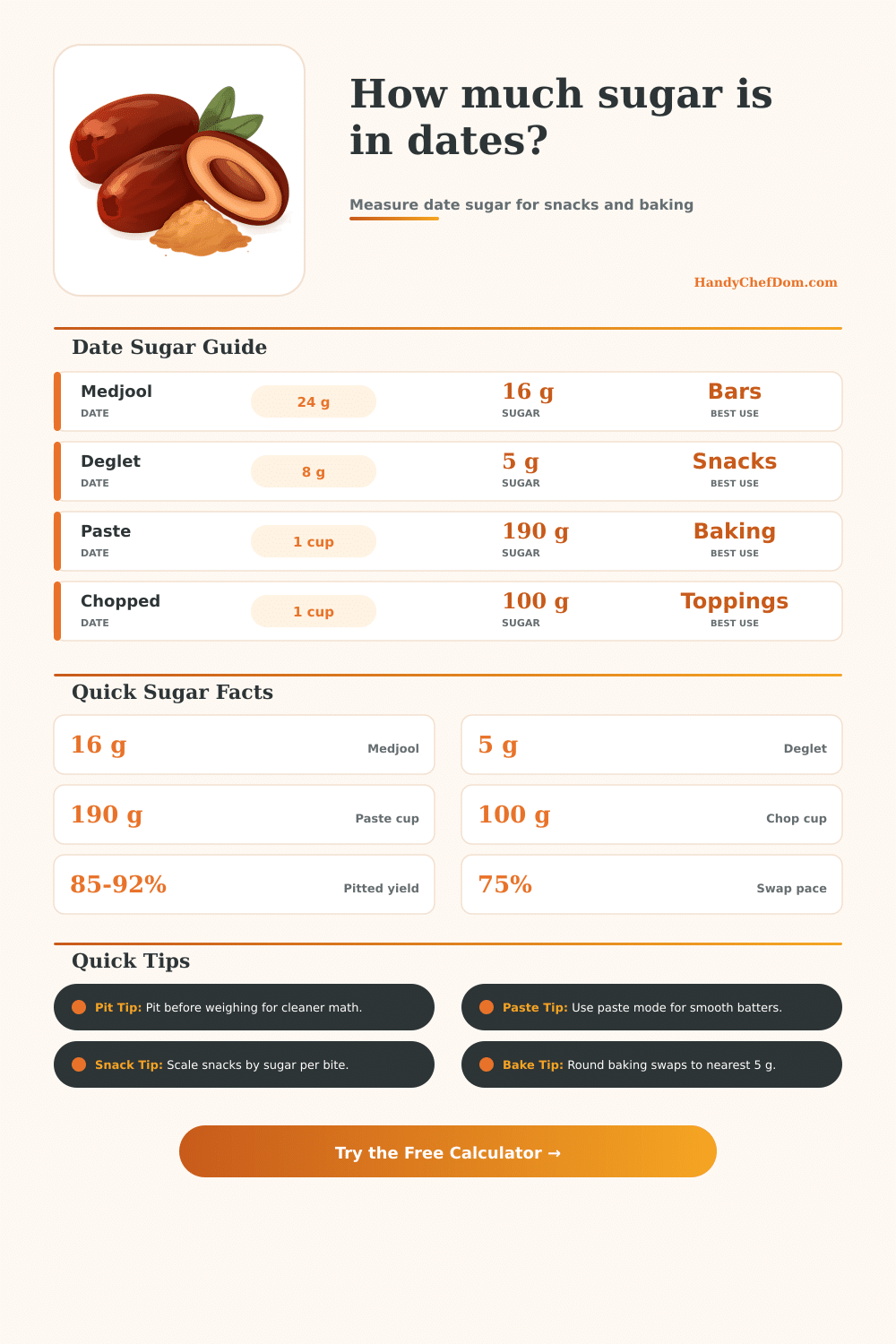
Choose the measurement that matches your kitchen notes. The calculator normalizes everything to pitted grams, then estimates natural sugar, chopped cup conversion, date paste conversion, servings, and snack or baking scale.
| Date variety | Typical whole date | Pitted yield | Natural sugar |
|---|---|---|---|
| Medjool, soft large dates | 24 g each | 90% | 66% of pitted weight |
| Deglet Noor, smaller dry dates | 8 g each | 88% | 63% of pitted weight |
| Barhi, tender caramel dates | 13 g each | 89% | 64% of pitted weight |
| Zahdi, firm baking dates | 10 g each | 87% | 62% of pitted weight |
| Mazafati, moist dark dates | 18 g each | 91% | 61% of pitted weight |
| Halawi, chewy golden dates | 11 g each | 88% | 65% of pitted weight |
| Packed chopped date mix | 1 cup measure | 100% | 64% of chopped weight |
| Smooth date paste | 1 cup measure | 100% | 59% of paste weight |
| Kitchen measure | Medjool equivalent | Deglet equivalent | Date paste equivalent |
|---|---|---|---|
| 1 whole Medjool | 24 g whole | 3 Deglet dates | 0.07 cup paste |
| 10 whole Medjool | 216 g pitted | 30 Deglet dates | 0.65 cup paste |
| 1 packed cup chopped dates | 160 g pitted | 150 g pitted | 0.49 cup paste |
| 1 cup date paste | 330 g paste | 310 g paste | 1 cup paste |
| 100 g pitted dates | 4.6 Medjool | 14.2 Deglet | 0.31 cup paste |
| 1 snack bite portion | 18 g pitted | 20 g pitted | 0.06 cup paste |
| Use case | Useful sugar target | Date form to measure | Scaling note |
|---|---|---|---|
| Snack boxes | 10 to 14 g per serving | Whole date count | Round to half dates for even boxes |
| Oat bars | 8 to 12 g per bar | Pitted grams | Divide total sugar by cut count |
| Muffin batter | 60 to 80% sugar credit | Date paste cups | Use paste for smoother sweetness |
| Smoothie prep | 8 to 16 g per cup | Pitted dates | Count dates before freezing packs |
| Stuffed dates | 12 to 18 g per piece | Whole date count | Track filling separately if needed |
| Topping mix | 5 to 9 g per bowl | Chopped cups | Pack cups lightly for chunky pieces |
| Ratio check | What it means | Snack planning cue | Baking planning cue |
|---|---|---|---|
| Under 8:1 | More fiber support | Works well for larger portions | Good for dense bars |
| 8:1 to 10:1 | Typical whole date range | Use normal serving math | Balanced for muffins |
| 10:1 to 12:1 | Sweeter date format | Cut portions slightly smaller | Reduce other sweeteners |
| Over 12:1 | Concentrated paste or dry fruit | Scale by sugar per bite | Use the sweetness credit field |
If you’ve ever had dates, you likely already know that they’re sweet; but what you may not know is just how much effort it takes to translate their sticky naturaly sugar into a number that makes sense to your oven. In our exact-age, recipes-as-law land, we expect nature to match our expectations, and Mother Nature doesn’t do that. Depending on when they were picked and whether they spent months sitting on a shelf before making there way to you, one variety of dates can be dry and chewy, while another may be plump and juicy. That’s when many home bakers stumble: We ask the fruit to replace sugar by the cup (or by weight), but we don’t account for all of its unique properties.
We must consider its moisture content, its fiber-rich pulp, and it’s space-occupying pit. It’s a gap between expectation and reality; and the calculator above will crunch those numbers for you. But to realy understand why those numbers change, we need to take a peek at the fruit itself.
Why You Should Use a Date Converter
Water is the biggest variable you’re fighting. Yes, dates are dried fruit, but they still has a lot of moisture relative to cane sugar. Think about what happens when you substitute chopped dates (or even better, date paste) for granulated white sugar: You’re adding water to your batter. Cookies, cakes, and bars reacts to this change in their structure. Just substituting one cup of sugar for one cup of blended dates isn’t going to work. The extra water won’t let them form a crumb as well, which means you’ll end up with a failed recipe.
Why? That’s where the baking sweetness credit field comes into play on the tool. Because chemically, sucrose doesn’t sweeten exactly the same way dates do during gluten development and leavening, it takes into account the fact that you can’t just adjust for sweetness; you also has to adjust for hydration at the same time.
Another frequent mistake is counting the pits as part of the fruit’s flesh. Since most store-bought Medjools are sold whole, you’ll find that a certain percentage of their weight is pit, rather than meaty flesh. If you don’t remove them before weighing your dates, you will overestimate amount of sugar. The difference between eight grams and twenty-four grams per date makes a big difference if you’re aiming for a recipe scaled to make a dozen servings. It multiplies fast when applied to a dozen muffins or bars.
That’s one reason the reference table on this page provides specific percentages of yields for different types. Because Medjools are larger and moister than Deglet Noors, they won’t react in exactly the same way in your mixing bowl. A Medjool coefficient won’t work in calculating with Deglets; you’ll end up with something under-sweetened.
They’re useful for more than just cooking. When I count dates for other tasks, like snacking or baking, it’s easy to use those same amounts (even if you don’t use exact ones) to track how much sugar you’re eating while avoiding the “Guilt Spiral.” Most of the sugars in dates are bound to fiber and absorbed slower then table sugar. However, your body does still absorb them. The “date to fiber” ratio determine whether that’s okay. Counting pieces instead of ounces makes sense; it becomes a real counting exercise rather than an abstract goal for healthy eating.
But it’s not just about dealing with the boring swap from a whole date to chopped to smooth paste, it accounts for how chopping up your dates alters their density (there are air pockets in the bowl). But if you blend them into a paste, you’re rid of the air pockets, which concentrates mass. So when you want one cup of sweetener, but you don’t know if that should be chopped-up dates, or blended into paste, you realize that a cup of paste contains much less water than a cup of chopped-up pieces, so you won’t accidentally make things too sweet in a dressing or sauce. It’s all about matching the sweetness you want to the texture you need.
In the end, date-cooking isn’t so much following directions as it is learning which direction your ingredients are going to go in. After you get a sense for what sweeteners do (and don’t) do in terms of moisture and fiber, you’ll find that measuring doesn’t really matter. You just adjust accordingly because you trust yourself. If you remove the math, the calculator takes care of it for you so that you can concentrate on the taste instead.
No need to cut the tension out of the measuring. Just measure twice.