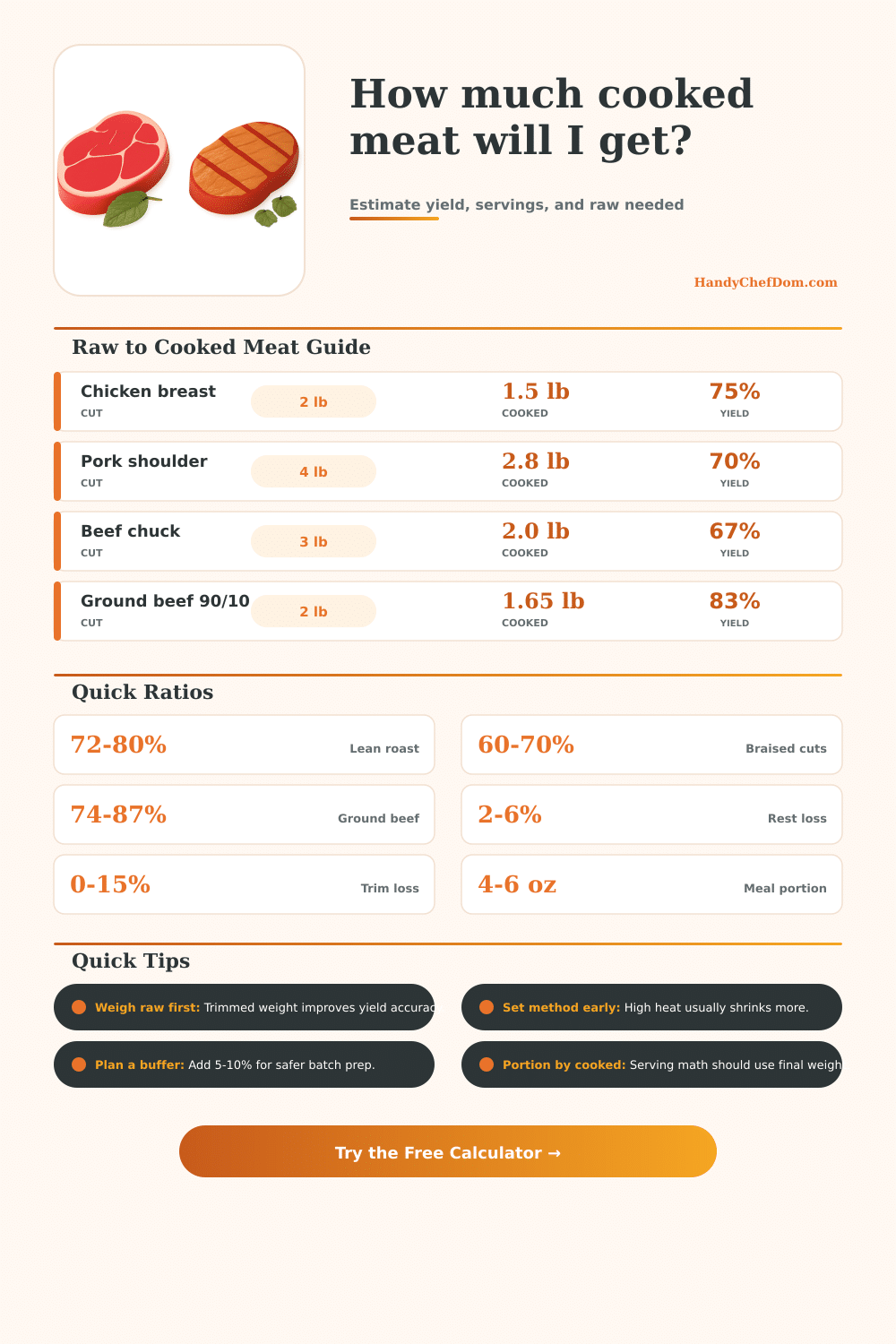
Raw to Cooked Meat Weight Calculator
Estimate cooked yield, raw purchase needs, servings, and cost-per-portion across meats, cuts, and cooking methods.
Quick Presets
Batch Setup
Choose your cut, method, and losses. The calculator builds an effective yield so you can move from raw input to cooked output or from cooked goal to raw purchase.
Yield Benchmarks
Reference Tables
| Cut | Base Yield | Typical Loss | Best Use |
|---|---|---|---|
| Chicken breast | 76% | 24% | Meal prep trays |
| Chicken thigh | 73% | 27% | Bowls and tacos |
| Pork shoulder | 68% | 32% | Pulled pork pans |
| Pork loin | 75% | 25% | Roast slices |
| Beef chuck | 66% | 34% | Braise and stew |
| Ground beef 90/10 | 83% | 17% | Burger and taco mix |
| Method | Factor | Shrink Shift | Note |
|---|---|---|---|
| Roast | 1.00 | Baseline | Stable oven yield |
| Bake | 0.99 | Slight down | Dry heat finish |
| Grill | 0.96 | Higher loss | Drip and flare loss |
| Skillet | 0.97 | Medium loss | Pan evaporation |
| Braise | 1.03 | Moist regain | Liquid retention |
| Sous vide + sear | 1.04 | Low shrink | High retention |
A raw to cooked meat weight calculator is a tool that will allow individuals to calculate the weight of the meat after it has been cooked. When individuals purchase meat, the weight of that meat will decrease during the cooking process. As a result of the meat losing weight during the cooking process, the amount of raw meat that is purchased isnt the same as the amount of meat that is to be served to individuals.
Thus, using a raw to cooked meat weight calculator will allow individuals to purchase the correct amount of raw meat to achieve the desired cooked meat weight. The raw to cooked meat weight calculator will require that individuals provides certain inputs to account for the different ways in which different cuts of meat will lose weight when cooked. For instance, chicken breast will lose less weight when cooked then pork shoulder due to the difference in fat and connective tissue content of each cut of meat.
How to Use a Raw to Cooked Meat Weight Calculator
Additionally, the method in which the meat is to be cooked will also impact the amount of weight that is lost by the meat. For instance, braised meat will lose less weight than meat that is grilled, as the grilled meat will drip of the pan into the fire and water will be lost. Additionally, the doneness of the meat will impact the weight of the cooked meat; juicy meat will lose less weight than meat that is cooked until it is shredded.
There are two types of weight loss that are accounted for in the meat weight calculator. The first type of weight loss is trim loss, which is the weight of the fat, silver skin, or bone that is removed prior to cooking the meat. The second type of weight loss is rest loss, which is the weight of the juice that is lost from the meat after it is removed from the heat source.
Trim loss occurs prior to cooking, but rest loss occurs after meat is cooked. The raw to cooked meat weight calculator accounts for the percentage of trim and rest loss to determine the effective yield of raw meat. The effective yield is the percentage of the original weight of the raw meat that will remain after trimming and cooking the meat.
There are two different ways to use this raw to cooked meat weight calculator. One way is to input the raw weight of the meat that will be purchased; the calculator will determine the resulting weight of the cooked meat. The second way to use the calculator is to input the target weight of the cooked meat; the calculator will determine the amount of raw meat that will be required to achieve that target weight of cooked meat.
This method can be used if the individual wants to determine how much raw meat that will be required to serve a certain number of individual a certain amount of raw meat each. Additionally, a buffer percentage can be added to the calculated amount to account for the fact that some of the meat may be lost during the meal that contains that cooked meat (due to meat being removed from the meal, sitting in a warmer, etc.). The raw to cooked meat weight calculator can be used to determine the portion sizes and the number of individuals that can be served with the amount of raw meat that will be purchased.
Additionally, the calculator can determine the raw weight of the meat that will need to be purchased in order to serve the number of individuals. A buffer percentage can be added to the calculated amount to account for the loss of meat that may occur during the meal. The raw to cooked meat weight calculator can also be used to determine the cost of the meat per serving.
Indviduals that purchase meat are typically within a certain budget. Thus, if the meat loses a significant amount of weight when cooked, the cost of that meat per serving will increase. The raw to cooked meat weight calculator will display to the individual the relationship between the weight of the meat and the cost per serving.
Certain types of meat will lose a certain percentage of their starting weight when cooked. For instance, lean roasts will lose less weight than cuts of meat that are higher in fat content. Additionally, the ground meat that is cooked will lose more or less weight depending upon the fat content of the ground meat and whether or not the fat is drained from the cooked ground meat.
Finally, cuts of meat that are slow cooked will lose some of their weight to steam but will gain in texture in a way that is suitable for cooking large batches of meat. These types of meat can be accounted for in the raw to cooked meat weight calculator with the use of reference tables. The raw to cooked meat weight calculator cannot account for each of the different variables that may impact the weight of the cooked meat.
For instance, the type of pan in which the meat is cooked, the temperature of the oven in which the meat is cooked, the amount of time that the meat rests prior to being served, the humidity in the kitchen in which the meat is cooked, and the starting temperature of the meat will all impact the weight that the meat will have after it is cooked. Thus, a buffer should of been incorporated into the raw to cooked meat weight calculation in order to account for these different variables. Indviduals should use this raw to cooked meat weight calculator prior to going into the store to purchase meat.
By using the calculator, individuals can determine the raw weight of the meat that will be required to achieve the desired cooked weight of the meat. Additionally, if that raw weight is provided with a buffer percentage to account for the different variables in the cooking of the meat, the individual will have a list of the amount of raw meat that will be required to serve each member of the meal’s table.