Carrot Sugar Calculator
Estimate natural carrot sugar, fiber-to-sugar balance, grated cup conversion, peeled yield, glaze add-ins, and scaled batches for baby carrots, whole carrots, or grated prep.
🥕Carrot Sugar Presets
⚖Carrot Batch Inputs
Carrot Sugar Results
🧮Current Batch Snapshot
📊Carrot Form, Method, and Sugar Grid
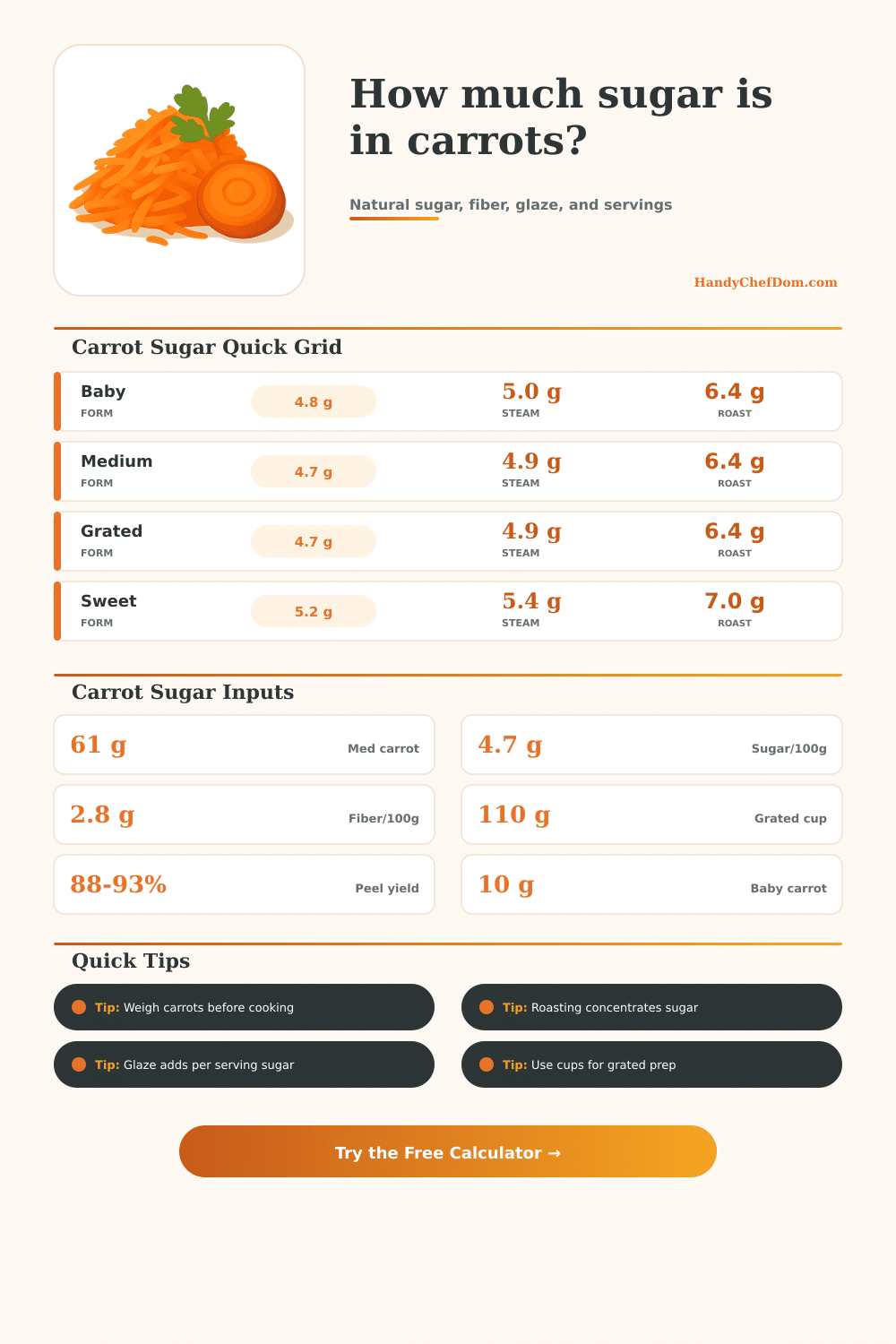
| Carrot form | Typical piece or cup | Raw sugar per 100 g | Steamed sugar per 100 g | Roasted sugar per 100 g |
|---|---|---|---|---|
| Whole medium carrots | 61 g each | 4.7 g | 4.9 g | 6.4 g |
| Whole large carrots | 72 g each | 4.7 g | 4.9 g | 6.4 g |
| Baby-cut carrots | 10 g each | 4.8 g | 5.0 g | 6.4 g |
| Fresh grated carrots | 110 g per cup | 4.7 g | 4.9 g | 6.4 g |
| Sweet heirloom carrots | 65 g each | 5.2 g | 5.4 g | 7.0 g |
| Purple carrots | 60 g each | 4.3 g | 4.5 g | 5.8 g |
🥣Grated Cup and Peeled Yield Conversions
| Prep form | Count estimate | Grated cup estimate | Standard peeled yield | Best input mode |
|---|---|---|---|---|
| Medium whole carrots | About 2 per cup | 110 g per cup | 90% | Count or weight |
| Large whole carrots | About 1.5 per cup | 112 g per cup | 90% | Count or weight |
| Baby-cut carrots | 10 to 11 per cup | 104 g per cup | 98% | Count |
| Fresh grated carrots | Measure by cup | 110 g per cup | 96% | Grated cups |
| Sweet heirloom carrots | About 2 per cup | 112 g per cup | 88% | Weight |
| Purple carrots | About 2 per cup | 108 g per cup | 89% | Weight |
🍯Glaze Add-In Sugar Scenarios
| Glaze scenario | Added sugar per serving | Added sugar for 8 servings | When it matters most |
|---|---|---|---|
| No glaze | 0 g | 0 g | Raw sticks, plain steamed sides |
| Orange juice splash | 2.5 g | 20 g | Light citrus finish |
| Light maple glaze | 4.2 g | 33.6 g | Roasted carrot coins |
| Honey-butter glaze | 5.7 g | 45.6 g | Holiday carrot dishes |
| Brown sugar glaze | 6.2 g | 49.6 g | Sweeter potluck trays |
👥Serving and Batch Scaling Reference
| Serving plan | Raw carrot target | Natural sugar range | Grated cup range | Good preset match |
|---|---|---|---|---|
| Snack cups for 4 | 240 to 320 g | 11 to 15 g | 2 to 3 cups | Baby Carrot Snack Cups |
| Family side for 6 | 600 to 800 g | 28 to 38 g | 5 to 7 cups | Steamed Family Side |
| Holiday side for 12 | 1.4 to 1.8 kg | 65 to 86 g | 13 to 16 cups | Holiday Honey Glaze |
| Potluck tray for 20 | 2.2 to 3.0 kg | 103 to 142 g | 20 to 27 cups | Big Batch Carrot Coins |
💡Carrot Sugar Calculation Tips
How much sugar is in a carrot? Check it out using calculator up top.
It’s actualy more complex then a simple label on a package, carrots contain significant amounts of both natural glucose and sucrose. They also has fiber, which alters how that sugar gets processed by your body. If you’re making holiday sides or planning meals for the week, it’s important to understand that balance. The tool can converts between raw weight, cooked yield and grated volume so you don’t have to guess around.
Why Use the Carrot Sugar Calculator?
How precise this number is depend on how you entered it. Did you enter as “weight” (e.g., “I have 2 pounds of carrots”) or “count” (e.g., “I have 6 baby carrot”)? Either way, that carrot is neither all flesh nor all water. Every type of root, in every shape and size, contain slightly varying amounts of each. How do we know? We don’t; the tool does.
It knows that baby carrots retain most of their center (sugar) after being mechanically peeled and shaped, which strips away some outer fiber, while whole carrots retains more surface nutrients when they’re simply scrubbed clean (and thus affect the yield ratio). The tool also take into account changes in the vegetable’s weight during chopping, peeling, or any other process you use. Your sugar results are based off the amount that will actualy end up on your plate.
Sugar content vary heavily based on cooking methods. The water inside raw carrots dilute it, and steaming preserves much of that water, resulting in a mild increase in perceived sweetness. Roasting removes lots of water weight, concentrating those natural sugars into more dense form. A cooked carrot will taste sweeter then an uncooked one not because extra sugar has been introduced, but because some of the water has leached out of the vegetable. That’s where the concentration effect comes in: the calculator accounts for it when comparing your food’s before-and-after nutritional profiles.
Glazes adds different amounts of extra sugar. For example, adding just a little maple syrup as a drizzle won’t add much; whereas, drenching in butter and honey would almost double the per-serving amount of sugar. When looking only at the veggie itself, it’s easy to forget the extra impact glaze can have. The interface makes it simple to trace the source of sweetness, the natural sugars of carrots versus anything added with the glaze. Knowing this lets you plan your portions more wisely (whether you’re trying to limit sugar intake or regulate your blood sugar).
Batch scaling adds another layer of practical utility. Preparing food for two person is much different than making dinner for a crowd. Surface area changes when things roast, and you can’t just multiply all the ingredients by X because of how the glazes spread. You can multiply same base recipe up or down, and adjust amounts accordingly for sugar and fiber. It will even estimate equivalent amount of grating (a cup) based on how hard you’re packing the grater. Firmly pressing will yield more than loosely packing.
Sugar has its counterweight: Fiber. And carrots is a good source of it. Dietary fiber delay digestion and avoids the quick rise in blood glucose you get from other sources of sugar. As the proportion of fiber to sugar increases on a plate or pan, you’re less likely to experience an insulin spike… And that’s where the fiber-to-sugar ratio comes into play. Even though roasting decreases weight, it doesn’t discard the fiber; so even while increasing the sugar content per mass, the roast also boost the fiber-to-sugar ratio. This all explains why roasted carrots aren’t simply sugar bombs; they’re balanced meals of both nutrition and energy.
With carrots, the things you can control are measured. Pick the form (roasted?); pick the heat (to what temperature?); pick the finish (when?). Everything else is basic arithmetic. Knowing what’s going into it means that you eliminate kitchen guessing and you’re sure about what winds up on the dinner table. Whether raw or roasted, eaten as a snack or served as part of a feast, having the numbers on hand makes your simple vegetable side a thoughtful addition to your meal plan.
You should of used this tool earlier!