🥩 Rib Roast Cooking Time Calculator
Estimate bone-in rib roast timing from rib count, raw weight, oven style, target temperature, sear plan, rest time, guest count, appetite, slice style, and carved meat yield.
Choose a preset or enter your own roast details. Timing is an estimate; the pull temperature and carved yield help you plan the serving window.
Longest estimate, gentle edge-to-center color, and the best match for a hot final sear.
Still slow, but trims time for medium-size rib roasts while keeping a generous rest.
Faster schedule with more edge cooking, useful when the roast starts later.
Moving air shortens the estimate, so the calculator starts the check window earlier.
| Rib bones | Typical raw weight | Classic guest range | Carving note |
|---|---|---|---|
| 2 ribs | 4 to 5.5 lb | 4 to 5 guests | Compact roast; check center early. |
| 3 ribs | 6 to 7.5 lb | 6 to 8 guests | Popular small holiday roast size. |
| 4 ribs | 8 to 10 lb | 8 to 10 guests | Balanced shape for even carving. |
| 5 ribs | 10 to 12.5 lb | 10 to 13 guests | Plan a longer rest and wide window. |
| 6 to 7 ribs | 12 to 16 lb | 12 to 18 guests | Large roast; probe more than one spot. |
| Oven style | Reference temp | Approx min/lb | Best fit |
|---|---|---|---|
| Slow roast | 225°F / 107°C | 30 to 38 | Rosy center and final sear plans. |
| Low roast | 250°F / 121°C | 24 to 31 | Medium-size roasts with less waiting. |
| Classic roast | 325°F / 163°C | 15 to 20 | Traditional oven schedule. |
| High-start roast | 450°F then 325°F | 14 to 19 | Early browning with classic finish. |
| Convection roast | 300°F / 149°C | 15 to 19 | Faster air movement and even browning. |
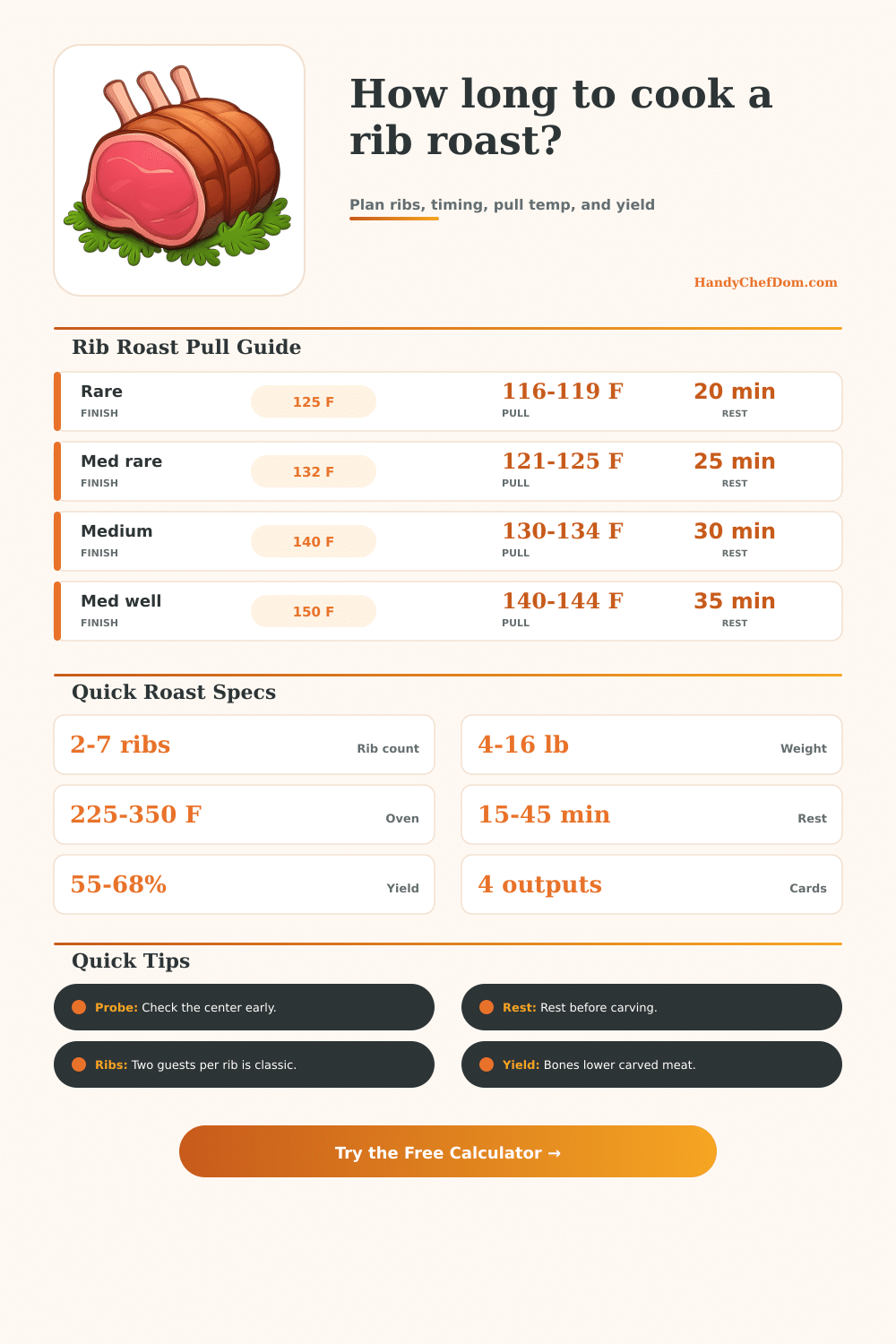
| Finish target | Final center temp | Typical pull range | Rest range |
|---|---|---|---|
| Rare | 120°F to 125°F | 112°F to 119°F | 15 to 25 minutes |
| Medium rare | 130°F to 135°F | 121°F to 126°F | 20 to 30 minutes |
| Medium | 138°F to 145°F | 129°F to 136°F | 25 to 35 minutes |
| Medium well | 148°F to 155°F | 139°F to 146°F | 30 to 45 minutes |
| Carving style | Cooked meat yield | Slice estimate | Guest planning use |
|---|---|---|---|
| Thin buffet slices | 55% to 65% | 3 to 4 oz each | Stretches the roast for a larger spread. |
| Standard dinner slices | 58% to 66% | 5 to 6 oz each | Best all-purpose plated serving. |
| Thick platter slices | 58% to 65% | 7 to 9 oz each | Generous holiday carving style. |
| Rib steak portions | 55% to 62% | 10 to 14 oz each | Use when carving around each bone. |
A rib roast is a type of meat cut that are often featured during holiday meals. Rib roast cuts contains bones and fat. The bones provide structure to the meat, while the fat help to keep the meat moist during the cooking process.
Cooking a rib roast can be difficult due to the fact that the time needed to properly cook the roast is not immediate obvious to those who attempt to cook the roast. Factors that influence the time that it take to properly cook the roast include the weight of the roast cut, the cooking temperature, the number of bones within the roast, and whether or not the cook is to sear the roast at the end of the cooking process. The weight of the roast will influence the starting time for cooking, but will not influence the time needed to cook the roast to completion.
How Long to Cook a Rib Roast
For instance, a four-rib roast that weighs nine pounds will cook different than a four-rib roast that weighs eleven pounds; the greater weight of the larger roast will cause the center of the roast to be further from the surface of the roast. A calculator can be used to mathematically determine the time needed for the roast to reach the appropriate cooking temperatures. Recipes that use a 225-degree oven will require more cooking time than recipes that use a 325-degree oven; the higher temperature will shorten the cooking time for the roast.
Each recipe will also differ in the amount of the roast that is cooked to each of the centers of the roast; the higher temperatures will cook the edges of the roast more complete than the temperatures that use slow cooking to reach the desired results. The pull temperature for the roast is the temperature of the roast that is removed from the oven. Pull temperature does not necessarily indicate the temperature of the roast that will be achieve with the eating of the roast.
After the cook removes the roast from the oven, the roast will reach higher temperature at its center; this is known as carryover heat. Additionally, searing the roast after it has been cooked will increase the temperature of the roast. The cooking calculator accounts for these rising temperatures by automatically subtract the estimated amount of heat that the roast will gain while resting and being seared from the target temperature for the roast.
This ensures that the roast will not become gray throughout the center of the roast while it is being rest. The time that the roast requires to rest before it is carved is also essential in the cooking of the roast. During the resting period, the juices will naturally settle within the roast, and the temperature of the roast will rise without the use of the oven.
A resting period of twenty-five minutes is required for most rib roast, but roasts that weigh more than nine pounds may require up to forty-five minutes of resting. The cooking time calculator accounts for resting time in the overall time for which the roast will be cooked. The amount of meat that will be yielded from the roast is another calculation that may occur prior to roasting the roast.
Due to the fact that the roast will lose weight due to the bones, the fat trim of the roast, and the loss of moisture while roasting, the roast will contain less meat than the weight of the roast. The calculator will estimate the amount of carved meat that will result from roasting the roast based on the selected carving style for the roast. This amount may then be compared to the number of guests that will be attending the meal, and the amount of meat that each guest will eat.
For example, thin slice of roast will allow for the roast to provide more servings than thick portion of meat. The type of oven in which the roast is cooked may impact the cooking process. Convection ovens move hot air across the roast, which may shorten the cooking time of the roast, and ensure that the roast is seared more even.
However, the use of a convection oven may reduce the margin for error when searing the roast. Smokers or ovens that reach low temperatures to cook the roast will allow for the roast to reach the interior of the roast at a slower rate. This allows cooks to monitor the roast at various time during the cooking of the roast.
Reference tables exist for the amount of time that a roast will take to reach the center of the roast to the surface of the roast at different oven styles. Rib roasts may be prepared in ways that is similar to those required for cooking steak. For example, placing the roast in an oven that reaches high temperature will cook the outer inch of the roast more than the interior of the roast.
Additionally, removing the roast from the oven at the temperature that is desired for the roast will result in the roast reaching higher temperature at the center of the roast while it is resting; this is known as carryover heat. These issue can be avoided by using the cooking time calculator to determine the time at which the roast should of been removed from the oven. The way in which the bones are prepared will impact the amount of roast that is yielded.
Leaving the bones within the roast will protect the interior of the roast, and add visual interest to the plated roast. However, the presence of the bones will result in less roast that is yielded. Removing the bones from the roast prior to roasting the roast will allow for an increase in the yielded amount of roast.
The cooking time calculator allows for the selection of either removing the bones from the roast or leaving the bones within the roast. The appetite of the guests will also impact the amount of roast that is needed. For holiday dinners, eight ounce of roast may be desired for each guest.
For lunch or dinner that is lighter in content, six ounces of roast may be provided for each guest. If the roast is to contain second helpings for the guests, or if it is to be the only protein served for the meal, more roast will be required. Temperature probe may be utilized while roasting the roast to ensure that the roast reaches the proper temperature.
A single temperature reading will be taken within the thickest part of the roast. However, roasts that are prepared using this method may contain hot spot near the bones within the roast, as well as cool spots in areas that are not near the bones. Taking two temperature probes to the roast will provide a better understanding of how hot or cold each portion of the roast is.
The cooking time calculator will provide a range of temperatures for the roast rather than the time that is required to prepare the roast to the center. Cooking success will be achieved if each of these factor is considered and accounted for in the preparation of the roast. Time, temperature, rest periods, and amount of roast that will be yielded must all be considered prior to cooking.
The time for which the roast is cooked will be obtained. The pull temperature will be set to account for carryover heat. The rest time will be determined to ensure that the roast is complete.
Additionally, the amount of roast that is prepared will allow for each guest to be served a portion of meat. These factor will ensure success with the preparation of the roast. Additionally, the roast will be rested and carved.
Each decision that was made prior to cooking will become visible in the roast when carved. The edges will be browned from the sear, the center of the roast will be the correct color, and the juices will be retained within the roast rather than drip from the roast onto the plate.