Wine Sugar Calculator
Estimate sugar in a single glass, a bottle lineup, or a whole event from wine style, residual sugar in g/L, bottle size, pour size, and guest scaling.
1Choose a wine moment
2Enter bottle, glass, and event details
This calculator estimates residual sugar only. Alcohol calories, acidity, and sweetness perception are separate from the grams of residual sugar.
Wine sugar breakdown
3At-a-glance pour math
4Wine sugar reference tables
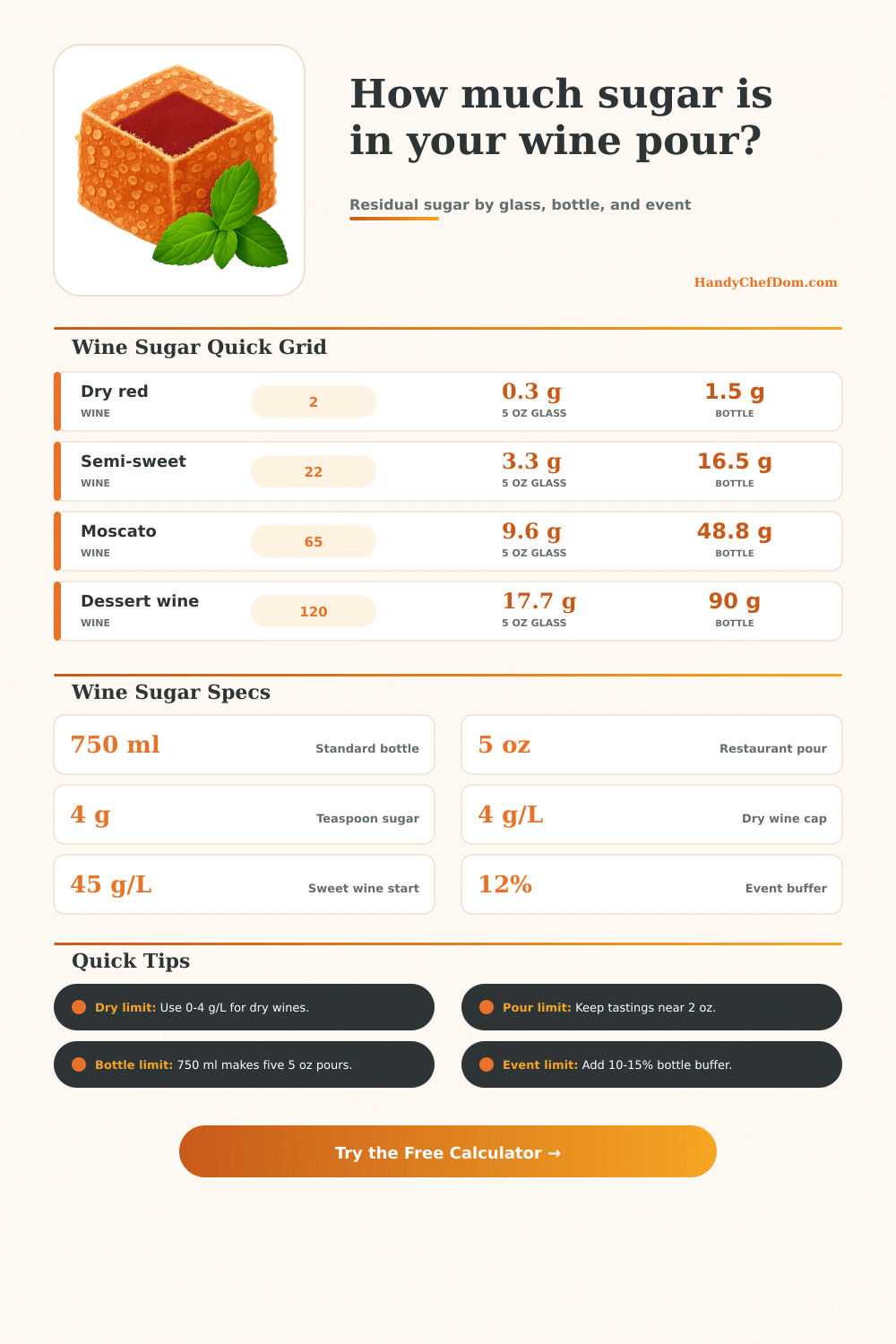
| Wine style | Typical residual sugar | Sugar in 5 oz glass | Sugar in 750 ml bottle | Best calculator use |
|---|---|---|---|---|
| Bone-dry red or white | 0-2 g/L | 0-0.3 g | 0-1.5 g | Use when the wine tastes crisp, lean, and not sweet. |
| Dry table wine | 2-4 g/L | 0.3-0.6 g | 1.5-3 g | Good default for dry Cabernet, Pinot Grigio, Chardonnay, and similar wines. |
| Brut sparkling | 6-12 g/L | 0.9-1.8 g | 4.5-9 g | Use for many brut Champagne, Cava, and sparkling wines. |
| Off-dry rose | 8-18 g/L | 1.2-2.7 g | 6-13.5 g | Useful when the wine has a soft fruity finish. |
| Semi-sweet white | 18-45 g/L | 2.7-6.7 g | 13.5-33.8 g | Use for noticeable sweetness, often Riesling or Gewurztraminer. |
| Sweet Moscato | 45-90 g/L | 6.7-13.3 g | 33.8-67.5 g | Best for sweet, low-alcohol party wines and dessert pairings. |
| Dessert wine | 90-160 g/L | 13.3-23.7 g | 67.5-120 g | Use smaller pours and label g/L when available. |
| Pour size | Milliliters | 5 oz equivalent | Best for | Serving note |
|---|---|---|---|---|
| 1.5 oz tasting splash | 44 ml | 0.30x | Wine flights | Good for comparing several bottles without full-glass sugar totals. |
| 2 oz dessert pour | 59 ml | 0.40x | Port, Sauternes, ice wine | Often enough for very sweet wines. |
| 3 oz half glass | 89 ml | 0.60x | Pairing courses | Useful when several wines are served with dinner. |
| 5 oz standard glass | 148 ml | 1.00x | Table wine | A 750 ml bottle gives about five pours. |
| 6 oz generous pour | 177 ml | 1.20x | Casual service | Sugar and bottle needs rise by about 20% versus 5 oz. |
| Residual sugar | 5 oz glass | 750 ml bottle | Case of 12 | Sweetness cue |
|---|---|---|---|---|
| 2 g/L | 0.3 g | 1.5 g | 18 g | Feels dry to most palates. |
| 8 g/L | 1.2 g | 6 g | 72 g | May taste round or fruity, not necessarily sweet. |
| 20 g/L | 3 g | 15 g | 180 g | Noticeably off-dry or semi-sweet. |
| 65 g/L | 9.6 g | 48.8 g | 585 g | Sweet wine territory. |
| 120 g/L | 17.7 g | 90 g | 1080 g | Dessert wine levels. |
| Event plan | Guests | Pours each | 5 oz pours | 750 ml bottles plus buffer |
|---|---|---|---|---|
| Small dinner | 8 | 2 | 16 | 4 bottles with 12% buffer |
| Brunch table | 14 | 1.5 | 21 | 5 bottles with 12% buffer |
| Reception toast | 35 | 1 | 35 | 8 bottles with 12% buffer |
| Patio party | 40 | 2.5 | 100 | 23 bottles with 12% buffer |
5Wine sugar tips
Residual sugar levels makes a difference, too: Have you ever noticed a huge diffrence between a sweet Riesling and a dry Chardonnay? Because there are still some grams of sugar left in the wine after fermentation finish, those leftovers impact your perception of the acidity and overall balance. They also can determines if this is a wine that will pair well with your food or clash with your dish. Knowing these numbers help you drink with purpose.
Maybe you’re tracking what you’re drinking for health reasons. Or maybe you just don’t wanna be surprised by wave of sweetness right before bedtime. Many drinkers believe if it’s not labeled “sweet,” it doesn’t have any sugar in it. And with few exception, that’s wrong. Crisp Sauvignon Blancs and bone-dry Cabernets still holds tiny amounts of fructose and glucose. Generally speaking, this doesn’t affect how they taste.
Why Sugar in Wine Matters for You
However, if you’re counting carbs rigorously, every little bit counts. The calculator translates those strange grams per liter into something more concrete: teaspoons or even entire bottles. It connects the dots between dry facts about winemaking practices and actualy drinking behavior.
The question is how many grams of sugar are in each liter (g/L). What does that even mean on my glass? It’s a concentration measure, not a measure of total volume. When it’s high, it means there is a lot of sugar in the same amount of liquid. However, you also has to consider pour size.
The industry norm is a five-ounce pour for most things, though many restaurants will give you more, and dessert wines are frequently poured in two-ounce servings. And this can dramaticly change how much you’re actualy getting. For example, if you’re sipping a sugary Moscato out of a tiny tasting glass you may end up consuming fewer total grams of sugar then the person who’s gulping down some off-dry Rosé from a big ol’ bowl. You can input your bottle format and pour size. The tool factors those details into its calculation so you get results based off your specific situation instead of an average guess.
But there’s another wrinkle here: You’re not only purchasing wine; you’re event planning, which means dealing with volume. And waste. If you have several different types on offer, most hosts greatly undervalue the rate at which they’ll get sucked dry. It’s customary to leave some space for enthusiastic guests, spilled drinks, and sediment. Typically, a 12% safety cushion will accommodate last-minute requests while preventing you from being left with half-drunk bottles in the back of your fridge next week.
The calculator takes all this into account by multiplying your number of pours per guest and then your total number of guests. It returns a practical shopping list complete with the extra buffer you specify, turning your fear of running out from an emotional issue into a math equation.
Most importantly: If a label provides info about residual sugar, go with what’s on the bottle. These days more and more producers is aware that their consumers want to know how dry (or sweet) their wines are, so you’ll find some bottlers printing the number right onto back label. This trumps any guesswork based of style. A “dry” could actualy be technically six grams per liter, depending on how the winemakers choose to make it. And an “off-dry” could be shockingly lean.
Having the option to add in these details manually ensures that you won’t accidentally fall into the trap of general categories that don’t always reflect each producer’s style. It is a little bit closer to precision drinking. Acidity affects how sweet a wine tastes. High acid wines can appears more fresh than they actually are due to high levels of sugar, and everyone perceives sweetness differently. But ultimately, look at the numbers as your baseline fact, and let your palate be last word.
Knowing the level of residual sugar in your wine will arm you to make smarter decisions in the store and on the table, whether you’re doing so out of curiosity or diet considerations. Use the facts first, and let your tongue tell you if the story matches up. You should of checked the label sooner.