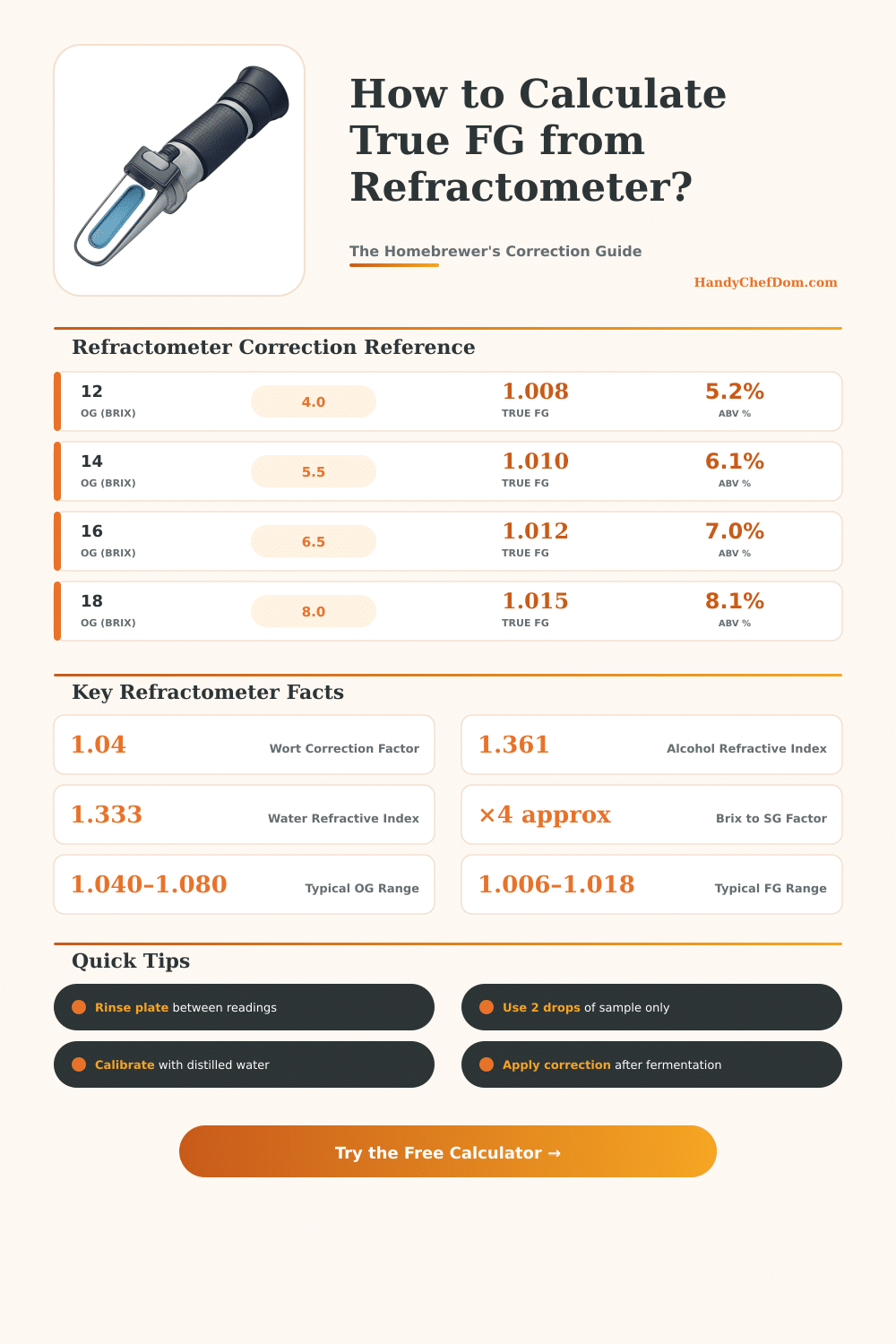
🍺 Refractometer Calculator After Fermentation
Convert post-fermentation Brix readings to true final gravity & ABV with alcohol correction
| Brix (°Bx) | Specific Gravity | Plato (°P) | Sugar g/L (approx) |
|---|---|---|---|
| 2.0 | 1.008 | 2.0 | 20 |
| 4.0 | 1.016 | 4.0 | 40 |
| 6.0 | 1.024 | 5.9 | 60 |
| 8.0 | 1.032 | 7.9 | 80 |
| 10.0 | 1.040 | 9.9 | 100 |
| 12.0 | 1.048 | 11.9 | 120 |
| 14.0 | 1.057 | 13.8 | 140 |
| 16.0 | 1.065 | 15.8 | 160 |
| 18.0 | 1.074 | 17.7 | 180 |
| 20.0 | 1.083 | 19.7 | 200 |
| 22.0 | 1.092 | 21.6 | 220 |
| 24.0 | 1.100 | 23.6 | 240 |
| 26.0 | 1.109 | 25.5 | 260 |
| 28.0 | 1.119 | 27.4 | 280 |
ℹ️ Formula: SG = 1 + (Brix / (258.6 - ((Brix / 258.2) x 227.1))). Values at 20°C / 68°F.
| Style | OG (SG) | FG (SG) | ABV % |
|---|---|---|---|
| Light Lager | 1.040 | 1.006 | 4.4% |
| American Ale | 1.050 | 1.010 | 5.2% |
| IPA | 1.060 | 1.012 | 6.3% |
| Stout | 1.065 | 1.016 | 6.4% |
| Saison | 1.058 | 1.008 | 6.6% |
| Double IPA | 1.080 | 1.014 | 8.7% |
| Belgian Triple | 1.085 | 1.010 | 9.9% |
| Hard Cider | 1.050 | 1.002 | 6.3% |
| Mead | 1.100 | 1.010 | 12.0% |
| Wine | 1.090 | 1.000 | 11.8% |
| WCF Value | Application | Effect |
|---|---|---|
| 1.00 | Distilled water | No correction |
| 1.02 | Low-adjunct wort | Minimal shift |
| 1.04 | Standard wort | Default (recommended) |
| 1.05 | High-adjunct wort | Slight increase |
| 1.06 | Honey / mead must | Moderate shift |
| 1.08 | Wine must | Larger correction |
ℹ️ Most homebrewers use 1.04. Adjust based on your refractometer calibration and wort composition.
Refractometer is a tool that one uses to estimate the refraction rate of anything. It works by checking how the light bends in direction when it goes through liquid or solid. The light bends when it touches liquid surroundings, and the grade of that bend depends on the properties of that liquid.
When the angle reaches a certain spot, the light no longer passes into the second material but becomes fully reflected. One calls that the critical angle, and exactly that the refractometer indeed estimates. Later one counts the refraction rate from the seen refraction angle helped by Snell’s law.
What a Refractometer Is and How It Works
Those devices help to identify species, check the cleaning and estimate the focus of solutions. One also can use them to find the water amount in liquids, because the refraction rate adjusts according to the moisture. A good way to imagine that is that refractometers estimate how much “something” is present in the water.
Refractometers come in analog and digital forms. The analog or digital manual models most commonly are light and easily carried. Some of them even are so little that one can lay them in a pocket.
That makes them practical for fast tests in breweries, wineries or automotive shops. Digital refractometers seem always more liked in factroies because of their regularity and simple usage.
One mainstream field, where refractometers genuinely shine, is the making of foods and drinks. They estimate the sugar amount in liquids according to Brix-scale. Wine growers apply them to check the sugar percentage in grape samples.
One uses them also in cheese making, sauce making and rating of solutions. Modern head chefs turn to refractometers to unite the focus of delicious soup. Some models estimate from zero until 32 percentages Brix.
Others reach even 80 percentages Brix. The flat, easily washed prism form simplifies the cleaning, even when dealing with sticky syrups.
Home brewers consider refractometers vary useful. Just some drops of liquid to start the test. Their toughness makes them safer than hydrometers, that commonly are fragile and easily break.
Even so, alcohol misleads the refractometer results, so one must correct them after the fermentation starts. Refractometers estimate the light refraction, and alcohol distorts that value.
Almost all refractometers, even the cheap, work quite well. They need occasional calibration, but usually they are almost accurate already from the box. Some types have high-quality sapphire optical parts, that is the second most hard material after diamond.
Temperature changes can affect the results, because they alter the density of the solution. Some devices have automatic temperature correction to settle that. There are also special versions for honey, saltwater andautomotive coolants.