🥦 Broccoli Potassium Calculator
Estimate potassium milligrams, per-serving potassium, daily value percent, fresh or frozen prep effects, stem mix, cup conversions, florets, grams, and meal prep scale.
🥦Broccoli Potassium Presets
🧮Broccoli Potassium Inputs
Choose cups for kitchen planning, florets for tray building, or grams for nutrition-style precision. The calculator focuses on potassium and serving scale, not broccoli fiber.
📊Potassium Snapshot Cards
🔍Broccoli Prep Context Cards
📘Broccoli Form, Prep, And Potassium Grid
| Broccoli form or prep | Typical measure | Weight used | Potassium density | Potassium estimate |
|---|---|---|---|---|
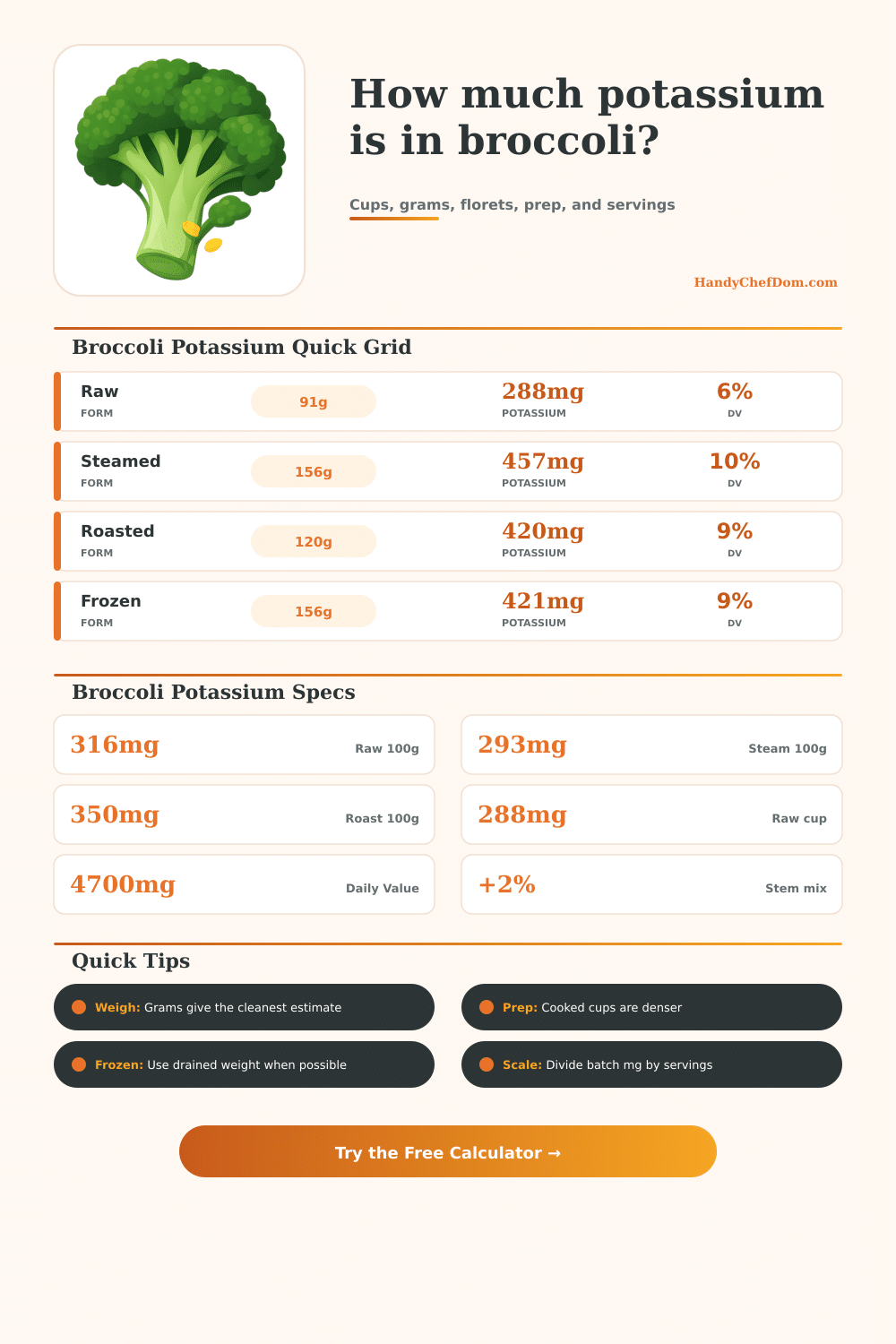
| Raw loose florets | 1 cup | 71 g | 316 mg per 100 g | 224 mg |
| Raw chopped broccoli | 1 cup | 91 g | 316 mg per 100 g | 288 mg |
| Steamed chopped broccoli | 1 cup | 156 g | 293 mg per 100 g | 457 mg |
| Roasted broccoli pieces | 1 cup | 120 g | 350 mg per 100 g | 420 mg |
| Frozen cooked broccoli | 1 cup | 156 g | 270 mg per 100 g | 421 mg |
| Shredded broccoli stem | 1 cup | 88 g | 322 mg per 100 g | 283 mg |
🧺Cups, Florets, And Weight Conversion Table
| Kitchen measure | Broccoli grams | Potassium if raw | Approximate florets | Best calculator mode |
|---|---|---|---|---|
| 1/2 cup raw chopped | 46 g | 145 mg | 4 to 5 medium | Cups |
| 1 cup raw chopped | 91 g | 288 mg | 9 medium | Cups |
| 2 cups raw chopped | 182 g | 575 mg | 18 medium | Cups |
| 10 medium florets | 100 g | 316 mg | 10 medium | Florets |
| 12 oz bag, edible | 340 g | 1074 mg | 34 medium | Bag or head |
| 1 lb prepped florets | 454 g | 1435 mg | 45 medium | Bag or head |
❄Fresh, Frozen, Stem, And Prep Factor Table
| Adjustment | Potassium factor | Weight or cup effect | Use when | Calculator note |
|---|---|---|---|---|
| Fresh broccoli | 1.00x | Reference baseline | Fresh crowns or florets | Default source |
| Frozen drained | 0.92x | May lose soluble minerals | Cooked and drained bags | Lower density |
| Frozen steam bag | 0.95x | Less draining loss | Microwave steam bags | Small reduction |
| Roasted prep | 1.11x | Water loss concentrates | Finished roasted weight | Higher mg per 100 g |
| Stem-heavy mix | 1.03x | Cups can pack denser | Peeled stems included | Small boost |
| Boiled and drained | 0.84x | Liquid discarded | Boiled broccoli sides | Draining loss |
📦Serving And Meal Prep Scaling Table
| Planning target | Broccoli amount | Raw potassium estimate | Typical servings | Scaling rule |
|---|---|---|---|---|
| Light side | 1/2 cup raw | 145 mg | 1 | Use half-cup target |
| Standard side | 1 cup raw | 288 mg | 1 | Use cup target |
| Meal prep box | 150 g raw | 474 mg | 1 | Multiply by boxes |
| Family dinner | 4 cups raw | 1150 mg | 4 | Divide by plates |
| Five-day prep | 750 g raw | 2370 mg | 5 | One 150 g box daily |
| Party tray | 12 cups raw | 3451 mg | 12 | Use snack portions |
💡Broccoli Potassium Tips
A big head of broccoli costs next to nothing, and properly prepared will last three or four meals. Weight isn’t the only way to think about volume, especially with something like water. Raw florets is light and fluffy; they look like a cup but aren’t. Steamed, that same cup are now dense and heavy. Though the vegetable hasn’t changed, the density has, and so has its nutrient count per serving.
Anyone wanting to reach their daily goals without guesswork, or those monitoring potassium: this counts. Once you decide on a measurement style, the calculator does math for you. No need to manually convert grams to cups each time. Many kitchen scales don’t account for floret size and meal plans require specific weights. Want to calculate potassium for a lunch box? You need to know how much is in each floret to estimate total amount eaten. Because a big piece from the crown weigh more than a tiny garnish, the tool factors that in; accounting for variation.
Easy Ways to Measure Broccoli
You won’t need to weigh every bite, but knowing where things fit into the mix can help you get a handle on what’s going into your container. The impact is substantial: Water is both a preserver and a diluter. Depending on what you do with it when removing water from a food. For example, if you boil broccoli, draining away the water, some of those soluble minerals will have leached out of the vegetable. Less remain, and that less is more dense than per gram of edible food.
Roasting does not add any water; instead, it removes moisture. So the remaining solid mass concentrates the nutrients.) A roasted broccoli will frequently contain more minerals by weight then one that was steamed or boiled. Different methods shifts things up or down, and this becomes clear from the reference table.
Some people say frozen veggies aren’t as good for you, especially broccoli. It’s true that most frozen foods undergo some sort of process (often blanching) prior to packaging to stop enzyme activity. At the time of freezing they are just as nutritious as fresh food. The exception? It depends on how well you pat-dry your food after thawing or after cooking. If you eat it still-wet (like if you steam in the bag), you’ll retain more weight. A few more grams of water might decrease the per-gram readout, but not by enough to change big picture: That serving size contains significant amounts of potassium.
The calculator factors in this difference in sources, which means that when it’s a hectic night, frozen shouldn’t be counted against you. The stems typically get tossed out, yet add volume to a dish at no additional cost (they’re high in potassium). Once trimmed of their thick skin (which is fibrous), the inner core are tender and can be prepared with or instead of the floret part of the plant. Because stem tissue is particularly good at retaining minerals, adding the stems to the dish increases its mineral content while changing the texture. With this tool you can ensure an even mix of stems.
That’s realistic for what happens in the kitchen, where we don’t throw away 30% of the veggie head. It’s also a way to increase nutritional value per dollar spent on food. Instead of thinking about serving sizes, think in batches (which is what meal prep is all about). How many days worth of food are you cooking? How much total potassium does that batch contains? Does it match your daily plan? Nutritional density doesn’t scale when you double or triple a recipe, but the portioning logistics do.
Try to maintain consistency from one container to the next so you can evenly track your intake all week long. Use the calculator’s meal prep scale to see your total amount and compare it to your planned portions. Broccoli is rich in potassium, is an all-purpose food (you can do anything with it), is bargain-priced, and can be prepared in countless ways. When steamed as a soft vegetable side or roasted into crunchy bits, its nutritional value remains intact as long as you don’t boil it into oblivion.
Measuring 101 means that a cup of raw broccoli florets isn’t the same as a cup of cooked broccoli. Knowing your measuring units, weight versus volume, is key to making wiser meal-planning choices without getting hung up on counting every bite. How about that? Stems aren’t just for stumps… They’re edible, too. The calculator will figure it out; you supply the game plan.