Raisins Potassium Calculator
Estimate potassium in raisins by mini boxes, tablespoons, cups, grams, golden or dark type, serving count, trail mix share, baking scale, daily value percent, and potassium-to-sugar ratio.
1Raisin Potassium Presets
2Raisin Type, Measure, Use Case, and Batch Inputs
Choose the raisin measure you actually have, then set servings and batch scale. For trail mix, the raisin share converts the full mix amount into raisin grams before estimating potassium.
Raisin potassium estimate
Choose a preset or enter your raisin details.
3Live Raisin Potassium Snapshot
4Raisin Type, Form, and Potassium Grid
| Raisin type or form | Potassium per 100 g | Sugar per 100 g | 1/4 cup estimate | Best use |
|---|---|---|---|---|
| Dark Thompson seedless raisins | 749 mg | 59 g | About 300 mg potassium | Classic snacks, oatmeal, lunchboxes. |
| Golden raisins | 746 mg | 60 g | About 284 mg potassium | Pilaf, salads, lighter baking color. |
| Flame raisins | 760 mg | 60 g | About 304 mg potassium | Bold snack mixes and granola. |
| Sultana raisins | 742 mg | 60 g | About 297 mg potassium | Soft baking and breakfast bowls. |
| Zante currants | 892 mg | 67 g | About 357 mg potassium | Tiny dried grapes, scones, and breads. |
| Chopped baking raisins | 735 mg | 58 g | About 276 mg potassium | Even distribution in cookies and muffins. |
5Mini Box, Tablespoon, Cup, and Gram Conversion Table
| Kitchen measure | Raisin grams used | Dark raisin potassium | Daily value | Kitchen note |
|---|---|---|---|---|
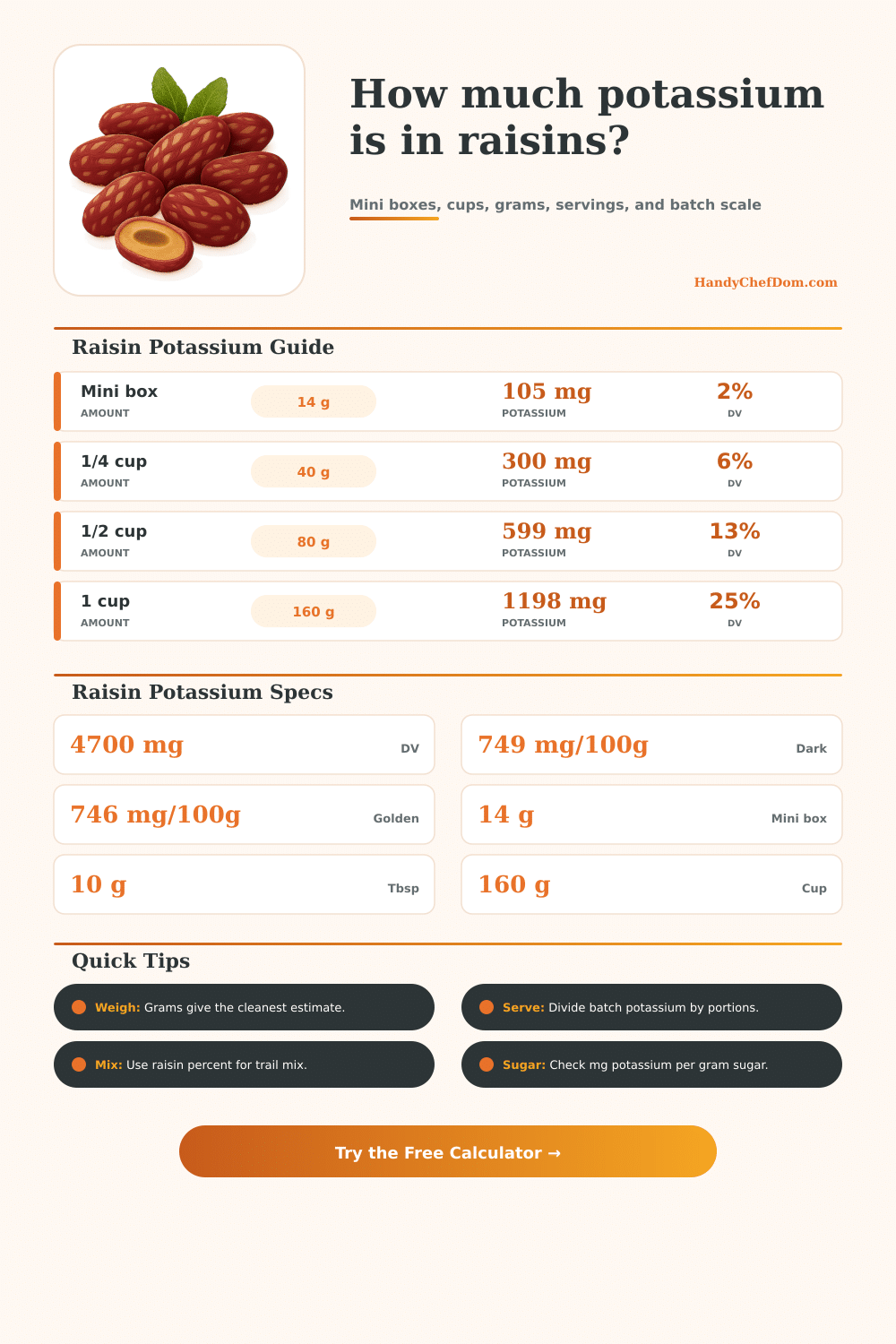
| 1 mini snack box | 14 g | About 105 mg | About 2% | Common lunchbox box size. |
| 1 tablespoon loose raisins | 10 g | About 75 mg | About 2% | Useful for oatmeal toppings. |
| 1/4 cup loose raisins | 40 g | About 300 mg | About 6% | Standard small raisin serving. |
| 1/2 cup loose raisins | 80 g | About 599 mg | About 13% | Large snack or recipe portion. |
| 1 cup loose raisins | 160 g | About 1198 mg | About 25% | Common baking batch input. |
| 100 g weighed raisins | 100 g | About 749 mg | About 16% | Best for precise nutrition math. |
6Serving, Trail Mix, and Baking Scale Table
| Scenario | Raisin amount | Servings | Potassium per serving | Scaling note |
|---|---|---|---|---|
| One mini box snack | 14 g | 1 | About 105 mg | Simple box-to-serving calculation. |
| Oatmeal topping for four | 4 tablespoons | 4 | About 75 mg | Each bowl gets about one tablespoon. |
| Trail mix with 30% raisins | 4 cups mix | 8 | About 135 mg | Only the raisin share counts toward raisin potassium. |
| Cookie batch with 1 cup raisins | 160 g | 24 cookies | About 50 mg | Divide by finished pieces. |
| Raisin bread with 1.5 cups | 240 g | 12 slices | About 150 mg | Potassium follows the raisin add-in. |
| Party bowl double batch | 2 cups scaled x2 | 16 | About 300 mg | Scale amount and servings together to keep portions stable. |
7Potassium-to-Sugar Ratio Reference
| Raisin choice | Potassium | Sugar estimate | Ratio | How to read it |
|---|---|---|---|---|
| Dark Thompson seedless | 749 mg/100 g | 59 g/100 g | 12.7 mg/g sugar | Balanced default for snacks and baking. |
| Golden raisins | 746 mg/100 g | 60 g/100 g | 12.4 mg/g sugar | Very similar potassium, slightly different texture. |
| Flame raisins | 760 mg/100 g | 60 g/100 g | 12.7 mg/g sugar | Good when you want a robust raisin flavor. |
| Zante currants | 892 mg/100 g | 67 g/100 g | 13.3 mg/g sugar | Higher mineral density but also very concentrated. |
| Moister raisins | Similar mg/100 g food | Lower per bite density | Ratio rises slightly | Use the moister adjustment if raisins are plump. |
| Very dry raisins | Similar mg/100 g food | Higher per bite density | Ratio falls slightly | Use the dry adjustment for old or baking-dry raisins. |
8Use-Case Interpretation Cards
Mini boxes and tablespoons are easiest when you want potassium per lunchbox or bowl topping.
Enter total mix cups and raisin percent so nuts, cereal, and chocolate are not counted as raisins.
Use cups or grams, then set servings to cookies, slices, muffins, or bars for per-piece potassium.
Scale the recipe and servings together when doubling a batch; change servings alone for larger portions.
9Raisin Potassium Tips
The wrinkly dried grape we call a raisin is sweet and rich in calories. It is very handy in the pantry when an immediate jolt of energy is needed, or it can be mixed into oatmeal where no one even thinks twice about what is in there. But a raisin’s tininess can fool us. And the nutrient potassium, in particular. Though raisins appear minute on the plate, their nutrition is compacted: because the water has been removed, the nutrients are concentrated. This is why a typical snack-sized serving of raisins can pack a big mineral punch you might not have known about. Knowing this raisin density will help you use it more wisely in recipes… Or with a focus on your health.
But most estimates from users (including myself) rely on eyeballing how many things fit into hands, or cups, leading to wildly varying accuracie. A full measuring cup of raisins packed tightly will weigh more than a cup of loose raisins. To get around this, the calculator above lets you choose the form and measure you used (grams, tablespoons, a mini snack box), and then runs the math for you. Since potassium depends on mass rather than volume, it first converts whatever volume you use into weight. Then, it uses the exact mineral profile of whichever kind of raisin you chose. Currants and both golden raisins and dark Thompson raisins is actualy a little bit different in density and nutrient content. If you don’t account for those, over time, those small differences add up, particularly when you track very closely what you eat day-to-day, or cook big batch.
Why You Should Count Raisins by Weight, Not Cups
But once you begin creating blends (for trails) or doubling recipes it becomes very useful. Knowing how much potassium there is in all of your trail mix is good, but knowing per serving is better. Same with baking big batches of cookies. How many calories are in each serving? Potassium/serving? How much sodium are in each serving? When you’re doing a batch like this, knowing what’s in 1 serving make more sense than knowing the sum of everything in the batch. With this tool, you can tell it what size batch you’re making so that it will adjust for the per-serving numbers for anything you scale up. It also takes care of the awkward math that happens with trail mixes, which include things like raisins as parts of a larger mixture. You can say “my trail mix has 20% raisins” and it will calculate exactly how many minerals was in just the raisin portion. Most folks miss this bit of detail when they try to guess at nutritional information for something mixed together.
Anyone who tracks nutrition, particularly athletes, watches potassium carefully; it’s critical to keeping water balanced as well as muscles functioning. Here’s how different raisin types stack up: The comparison chart on this page show how various forms of the same food compare, including their potassium content. Because of their mineral density, currants often pack slightly more potassium per gram than standard raisins, which, given their small size, makes sense.
Also helpful: Consider the ratio of potassium to sugar. Raisins are loaded with natural sugars, but they also contain many minerals. Looking at the ratio gives you an idea of what you’re gaining nutritionally versus the quick rush of sweetness. Very dry baking raisins may be more dense with sugar than moister kinds used in cooking. That changes the equation ever-so-sligthly.
The gold standard of accuracy when it comes to cooking is always going to be weighing out your ingredients. But for day-to-day cooking, who measures? Most of us use measuring cups or just guess by eye. If we can trust the embedded conversion factor, then we don’t even need a scale and can get really close to accurate using these preset amounts, such as one mini box or an amount typically used on oatmeal topping packages. Note: Each brand varies in moisture content; this affects its weight and its nutrient density per cup. For example, raisins may weigh less per cup, but they contain similar nutrients overall per gram of solids.
But all this oversimplification minimizes what raisins bring to the table. They are a concentrated source of minerals and quick energy in a portable form. By knowing the serving data for volume, weight, and batch size, you move from guessing to knowing. Now when you grab that bag of raisins you don’t just envision its sweetness but the precise nutritional content it’s contributing to your day. And that makes a simple snack become a calculated choice.
You should of known how much potassium is in there!