🍋 Lemons per Pound Calculator
Estimate lemon count, juice cups, zest teaspoons, and buying buffer from lemon size, average weight, recipe pounds, and prep shrink.
Choose a lemon size or enter a custom average weight. The calculator estimates usable lemon count after shrink, then rounds your purchase count for whole fruit.
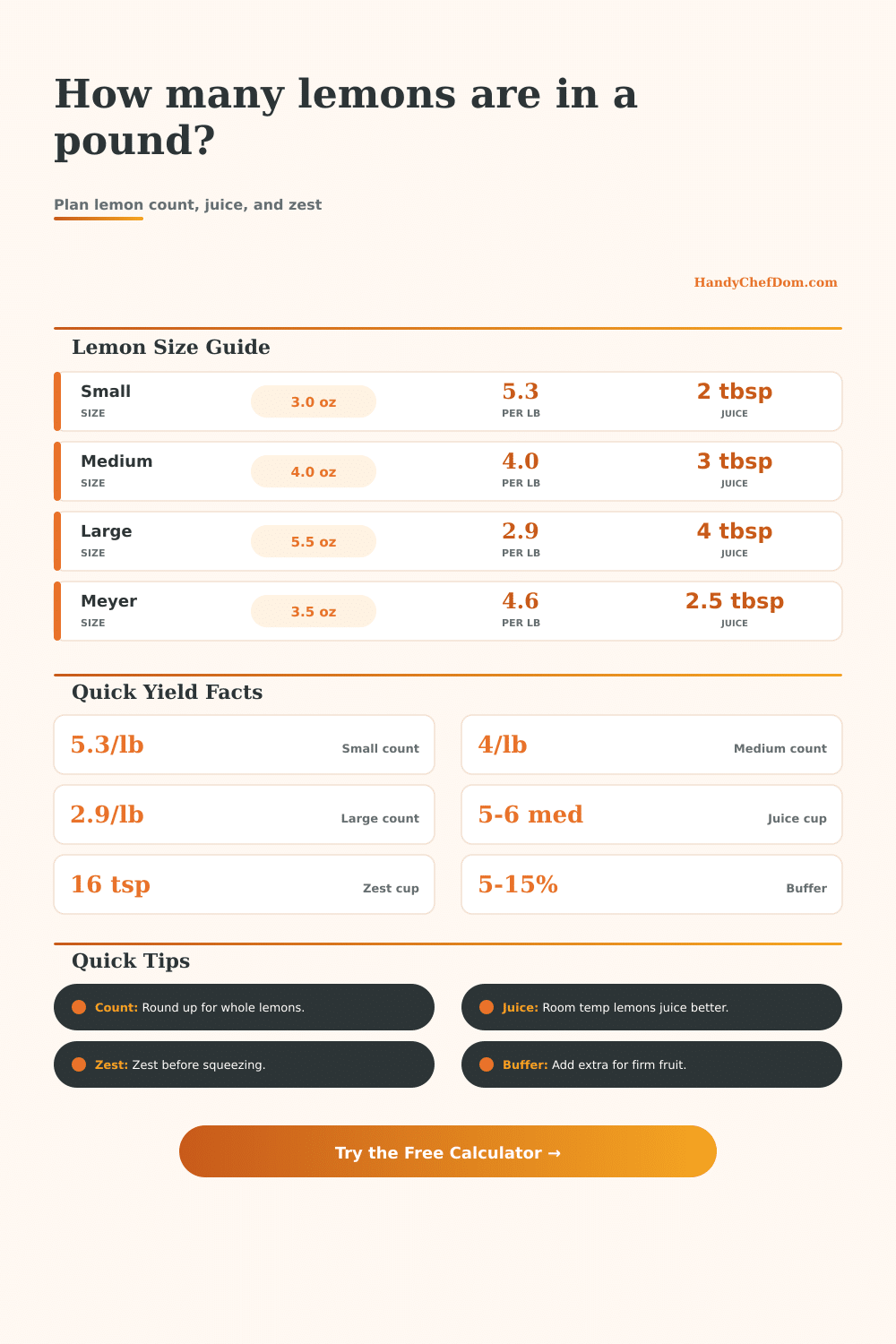
| Lemon Size | Avg Weight | Lemons/Lb | Best Use |
|---|---|---|---|
| Small | 3.0 oz | 5.3 | Bag prep |
| Medium | 4.0 oz | 4.0 | Recipes |
| Large | 5.5 oz | 2.9 | Juicing |
| Extra-large | 6.5 oz | 2.5 | Lemonade |
| Meyer | 3.5 oz | 4.6 | Baking |
| Mixed bag | 4.3 oz | 3.7 | Flexible |
| Size | Juice Each | Cups/Lb | Milliliters/Lb |
|---|---|---|---|
| Small | 2 tbsp | 0.66 | 156 ml |
| Medium | 3 tbsp | 0.75 | 177 ml |
| Large | 4 tbsp | 0.73 | 172 ml |
| Extra-large | 5 tbsp | 0.77 | 182 ml |
| Meyer | 2.5 tbsp | 0.71 | 168 ml |
| Mixed bag | 3.2 tbsp | 0.74 | 175 ml |
| Prep Goal | Count Rule | Buffer | Yield Focus |
|---|---|---|---|
| Recipe pound | By weight | 5-10% | Balanced |
| Juice batch | Round high | 10-15% | Liquid |
| Zest baking | Skin first | 15% | Zest |
| Garnishes | Even count | 8-12% | Slices |
| Lemonade | Large fruit | 12-18% | Juice |
| Market bag | Weigh bag | 10% | Mixed |
| Common Target | Small | Medium | Large |
|---|---|---|---|
| 0.5 lb | 3 lemons | 2 lemons | 2 lemons |
| 1 lb | 6 lemons | 4 lemons | 3 lemons |
| 2 lb | 11 lemons | 8 lemons | 6 lemons |
| 3 lb | 16 lemons | 12 lemons | 9 lemons |
| 5 lb | 27 lemons | 20 lemons | 15 lemons |
| 10 lb | 54 lemons | 40 lemons | 30 lemons |
The weight doesn’t reliably tell you how many lemons you have (since some is larger than others and not all are equally dense). Enter: this lemon calculator that turns pounds into practical numbers for whole fruit, zest, and juice, filling that gap between what your food weighs versus what it does for you, so you can prep more confidentely.
How does it work? It’s all about how much the average lemon weigh that you’re holding. If you weigh a standard grocery store lemon, it’ll be around 4 ounces. That’s roughly four lemons per pound. Convenient! Small, thin-skinned lemons will sometimes produce over five fruits per pound; larger-than-average ones might only have as little as two and a half. Plug your specific fruit profile into the calculator, and it do the math for you.
How the Lemon Calculator Works
There are no coefficients to memorize. Simply know what it is you’re purchasing. The correct size preset selection make all the difference, because it establishes the baseline for everything else. It also factors in prep. Lemons don’t give up 100% of their weight in liquid form. Some is lost in the rind. Some is lost in the pulp. Some is lost in the seeds. That’s why there’s an option called “shrink” (or waste) input that lets you take that loss into account.
This varies depending on if you’re juicing or making lemonade. If you’re juicing, you’ll want to set this higher since you toss away flesh. If you’re making lemonade, you care more about how much liquid you get. In that case, the calculator increase the total number of lemons to make sure you reach your desired volume goal. It’s a subtle change but it helps you avoid running out of juice before you finish mixing.
To give yourself some insurance against bad fruit, add a buffer: For example, adding a ten percent buffer allow you to account for that one mostly-rind lemon (or flat). You should of added more if they is small.
The calculator rounds your final count up or down; depending on whether you want to be generous or conservative. If rounding up means you’ll have a little extra, that’s good; it means you won’t run short. If you’re okay with slightly falling short, round to the next-nearest number which will save you a few bucks.
On the page, the reference tables helps explain the benchmarks. You’ll see that a pound of standard Eureka lemons will provide more juice and less aromatic zest than a pound of Meyer lemons, for instance. Knowing this gives you some context in deciding which variety will suit your project.
With Zest, it’s another story. Zest comes first: Peel then squeeze. If you need both, the sequence matter. In which case the order makes all the difference.
With zest, the calculator shows you the difference in yield between juice and zest so you’re able to visualize how much zest (how many teaspoons!) you’ll have if you start with a certain amount of fruit. That’s important when you’re making something like a cake that relies on a definite taste contribution from a single teaspoon of zest. Using less zest is not how you make an interesting curd or cake.
But that’s not what it really costs you. What it saves you is having to guess. No more picking up a bag and crossing your fingers. This time, you have a plan. You’ll know exactly how many lemons to set aside. You know exactly which lemons you’re going to keep.
You can play with lemon sizes (smaller for count flexibility or bigger for easy grabbing). You take something that was an annoying variable and turn it into a manageable input.
So what’s in it for you, realy? Squeeze and think: Aroma? Are you looking for juice? Weight? You want to know when to stop squeezing right? This is where the numbers comes into play. You’ll have precisely what you need (enough); and none more or less. Accuracy isn’t all that matters; it’s peace of mind.