🥬 Spinach Iron Calculator
Estimate spinach iron from raw cups, grams, cooked shrinkage, fresh or frozen form, serving count, daily value percent, vitamin C pairing, and realistic non-heme absorption context.
Spinach iron results
| Spinach form | Typical measure | Weight used | Iron estimate | Best calculator mode |
|---|---|---|---|---|
| Baby spinach, fresh loose leaves | 1 raw cup | 30 g | 0.75 mg | Raw cups or grams |
| Mature spinach, fresh leaves | 1 raw cup | 35 g | 0.95 mg | Raw cups or grams |
| Fresh chopped spinach | 1 chopped cup | 40 g | 1.08 mg | Raw cups or grams |
| Packed smoothie spinach | 1 packed cup | 45 g | 1.22 mg | Raw cups |
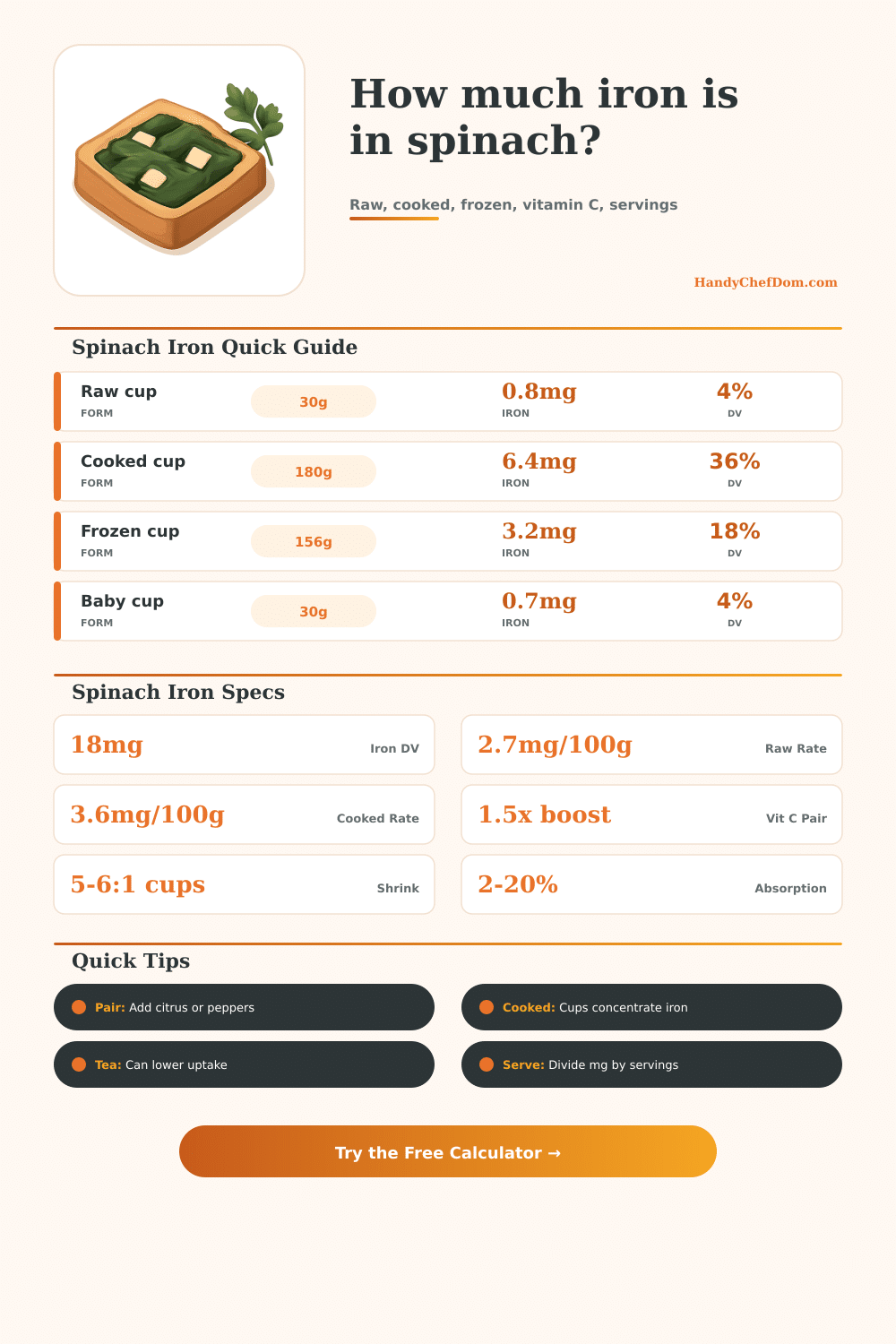
| Cooked spinach, drained | 1 cooked cup | 180 g | 6.43 mg | Cooked cups |
| Frozen chopped, thawed | 1 drained cup | 156 g | 3.21 mg | Frozen pack or grams |
| Frozen leaf, drained | 1 drained cup | 185 g | 4.07 mg | Cooked cups or grams |
| Canned spinach, drained | 1 drained cup | 190 g | 3.84 mg | Cooked cups or grams |
| Starting spinach | Cooked yield | Approx cooked grams | Total iron | Yield note |
|---|---|---|---|---|
| 3 raw cups | About 0.55 cooked cup | 90 to 100 g | 2.3 to 2.9 mg | Light side portion |
| 6 raw cups | About 1 cooked cup | 170 to 190 g | 4.6 to 5.8 mg | Common cooked serving batch |
| 12 raw cups | About 2 cooked cups | 340 to 380 g | 9.2 to 11.6 mg | Family cooked greens |
| 20 raw cups | About 3.5 cooked cups | 600 to 660 g | 15 to 19 mg | Meal prep batch |
| 280 g frozen pack | About 1.3 drained cups | 190 to 220 g | 3.9 to 4.6 mg | Depends on squeezing |
| Meal context | Pairing example | Context factor | Typical uptake estimate | Calculator meaning |
|---|---|---|---|---|
| Low enhancer meal | Plain spinach with tea | 0.65x to 1.0x | 2 to 5 percent | Lower absorption context |
| Light vitamin C pairing | Lemon splash or tomato | 1.25x | 5 to 10 percent | Small non-heme support |
| Good vitamin C pairing | Orange, kiwi, bell pepper | 1.5x | 8 to 15 percent | Useful meal pairing |
| Strong enhancer meal | Citrus plus peppers | 1.8x | 10 to 20 percent | Higher context estimate |
| Use case | Common spinach amount | Iron estimate | Typical servings | Scaling rule |
|---|---|---|---|---|
| Fresh side salad | 2 raw cups | 1.5 to 1.9 mg | 1 salad | Raw cups divided by 2 |
| Green smoothie pack | 1 packed raw cup | 1.2 mg | 1 smoothie | Packed cups divided by 1 |
| Cooked side portion | 0.5 cooked cup | 3.2 mg | 1 side | Cooked cups divided by 0.5 |
| Meal prep bowl add-in | 90 cooked g | 3.2 mg | 1 bowl | Cooked grams divided by 90 |
| Frozen spinach block | 280 g package | 4 to 5 mg | 3 to 4 servings | Package grams by drained yield |
| Reference target | Daily iron target | Cooked spinach cups for target | Raw cup equivalent | Use in calculator |
|---|---|---|---|---|
| FDA Daily Value | 18 mg | About 2.8 cooked cups | About 15 raw cups | Default label comparison |
| Adult men reference | 8 mg | About 1.25 cooked cups | About 7 raw cups | Lower daily target |
| Adult women reference | 18 mg | About 2.8 cooked cups | About 15 raw cups | Common adult comparison |
| Pregnancy reference | 27 mg | About 4.2 cooked cups | About 23 raw cups | Higher target comparison |
Iron: Spinach is one of those things that looks good and tastes okay on most restaurant menus (and also happens to be full of iron). But just because we know a particular type of food has minerals, it doesn’t mean our bodies retains all of them. And since most people think that filling up a large bowl equals meeting the day’s need for whatever it is, the math get slightly complicated.
You don’t have to guess if what you’re seeing is a cooked weight, or the raw volume (the calculator does it for you). Spinach iron requires mastering the vegetable’s properties, namely how much space it occupies compared to its actual mass. Compared to cooked, a cup of spinach (thirty grams) seem like a decent amount, but when those raw leaves are unfurled and wilted, they diminish to a fraction of their former size. Remove the water (the cooking process does this), and nutrients are concentrated, meaning you’ll get far more iron from a cup of cooked spinach than raw. Most recipes asks for thawed or sautéed greens. It is usually best to measure ingredients by the gram rather than by cups. Using grams will take into account how much spinach shrinks during cooking.
How to Get More Iron from Spinach
But here’s the other part: even if you dial it down to the perfect volume, iron (non-heme, from spinach) isn’t as easily absorbed by our bodies as the heme form of iron (from meat). In order to release those minerals well, our digestive system need assistance. And that’s when vitamin C comes into play. A couple slices of bell pepper or a squeeze of lemon on top of your greens will make big difference in how much iron you absorb. It does not add any iron to the dish; it just makes what is already there easier for your body to use.
And then there’s the fact that some meal combinations may not help with absorbing iron. For example, consuming spinach for dinner followed by a cup of coffee or tea will likely hinder absorption since coffee and tea contain tannins (which bind to the iron so it doesn’t absorbs into your bloodstream). By allowing you to account for iron inhibitors such as tannins or calcium, this tool provides a more realistic view of how much you could actualy absorb versus how much is just sitting on the leaf. That difference is important when you’re attempting to maintain healthy iron levels, or address an actual deficiency.
It’s easy to treat all spinach like it’s the same thing, which it isn’t. Darker, more mature leaves is denser in iron content, ounce for ounce, different than baby spinach (which is sweeter and more tender). Then there’s frozen spinach. Another source of confusion among cooks. A package may look large because it is packed tightly while frozen, but you get a lot less once you thaw and drain it. Have an idea what form you’re starting with to establish realistic expectations about the finished product.
It doesn’t have to be dead-on each time, either. It’s more about creating a plan that accommodates your lifestyle. Even if only a fraction gets absorbed. So what? Spinach, eaten regularly, will still add up substantialy to your mineral intake over time. Small increases can be multiplied when cooked correctly and paired thoughtfully.
To maximize your green consumption, you don’t have to turn into a nutritionist. This understanding also makes eating a side dish a planned nutritional decision. No more guessing when you plan out meals. You can feel confident in how you’re balancing out your plate for yourself (a smoothie!) or for a group (family dinner!). Knowing what to expect empowers you to plan. And knowing something empowers you because it takes away any fear and replaces it with understanding.
What separates an estimate from a wild guess? It only takes a few minutes of time. But where to begin? Look first to whatever you’ve already got in your fridge (or freezer). Is it cooked or raw? Fresh or frozen? And what about everything else on your plate: will eating all these things help or hinder your body’s ability to absorb nutrients? Making little changes like these adds up over time (weeks), then months. Tracking down the details doesn’t need to be tedious; it just becomes a natural part of how you cook well.
This is how you transform a humble vegetable into something dependable that gives you strength.