🌾 Buckwheat Seed Per Acre Calculator
Estimate buckwheat seeding rate by acres, field goal, method, germination, row spacing, soil condition, and field loss buffer.
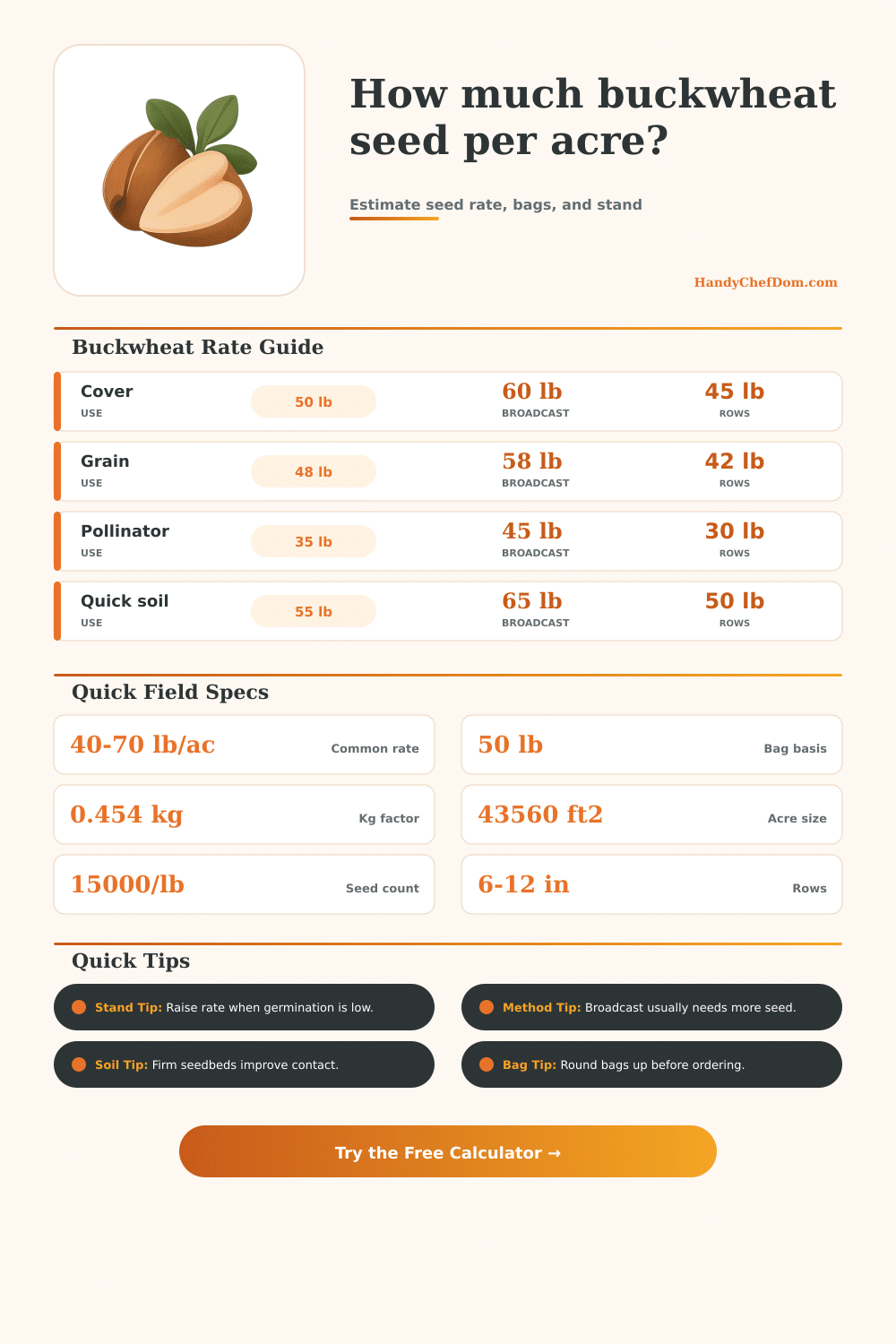
Common buckwheat seeding recommendations often land near 40-70 lb per acre, with broadcast and rougher seedbeds needing the higher side.
| Use Case | Typical Rate | Target Stand | Best Fit |
|---|---|---|---|
| Cover crop biomass | 50-60 lb/ac | Quick canopy | Soil cover, smothering, green manure |
| Grain or seed harvest | 40-55 lb/ac | Moderate stand | Better airflow and less lodging pressure |
| Pollinator strip | 30-45 lb/ac | Open bloom | Flowering strips, garden borders, wildlife lanes |
| Fast weed smothering | 60-70 lb/ac | Dense canopy | Short windows before a fall or summer crop |
| Garden bed scale | 1.0-1.6 lb/1000 ft2 | Even cover | Small plots converted from acre rates |
| Seeding Method | Rate Effect | Seed Contact | Calculator Logic |
|---|---|---|---|
| Grain drill | Baseline | Good depth control | Uses the entered rate before germination and loss adjustments |
| Broadcast then incorporate | Add about 12% | Good if lightly covered | Raises rate to cover uneven spread and placement |
| Surface broadcast only | Add about 22% | Variable contact | Raises rate more for surface exposure and bird loss |
| Precision or row planter | Reduce about 8% | Very controlled | Lowers rate when rows and depth are consistent |
| Area | Square Feet | At 50 lb/ac | At 65 lb/ac |
|---|---|---|---|
| 0.10 acre | 4,356 ft² | 5.0 lb | 6.5 lb |
| 0.25 acre | 10,890 ft² | 12.5 lb | 16.3 lb |
| 0.50 acre | 21,780 ft² | 25.0 lb | 32.5 lb |
| 1.00 acre | 43,560 ft² | 50.0 lb | 65.0 lb |
| 5.00 acres | 217,800 ft² | 250 lb | 325 lb |
| Cover Crop | Common Rate | Establish Speed | Stand Role |
|---|---|---|---|
| Buckwheat | 40-70 lb/ac | Very fast | Summer smother crop and pollinator bloom |
| Oats | 80-120 lb/ac | Fast | Cool-season cover and winter-kill biomass |
| Cereal rye | 60-120 lb/ac | Moderate | Winter cover and spring biomass |
| Field peas | 60-100 lb/ac | Moderate | Legume cover with broad leaves |
| Mustard | 8-15 lb/ac | Fast | Brassica canopy and biofumigation mixes |
Buckwheat seeding rates is essential to agriculture because the seeding rates will determine the amount of buckwheat biomass that a person can harvest from the planted buckwheat crop. If the buckwheat seeding rate are too low, the buckwheat plots will struggle to compete with the weeds growing in those plots. Alternatively, if the rate is too high, it will waste buckwheat seed and can damage the buckwheat plants due to buckwheat disease or buckwheat lodging.
The seeding rate has to be set to achieve the desired goal of the buckwheat crop, the seeding method for the buckwheat, and the conditions of the field in which the buckwheat will be planted. The standard seeding rate for buckwheat is between forty and seventy pound of seed per acre. However, the correct seeding rate for buckwheat will depend on the purpose for which the buckwheat will be grown.
How to Choose Buckwheat Seeding Rates
For instance, if the buckwheat is to be used as a pollinator strip for bee or other pollinators, the seeding rate will be less than if the buckwheat was to be used to smother weed in a crop rotation. Additionally, grain buckwheat will have a lower seeding rate then buckwheat cover crops because a higher seeding rate for buckwheat cover crops will help ensure that the buckwheat plants quickly cover the ground where they are planted. A buckwheat seeding calculator will determine the exact number of pounds of buckwheat seed that is required for setting.
The calculator will take into account the acreage of the field to be planted with buckwheat and the intended use of the buckwheat. The seeding method for buckwheat can impact the seeding rate for buckwheat. If a person use a grain drill to plant the buckwheat, the standard buckwheat seeding rate can be used.
However, if the buckwheat is to be seeded by broadcasting and light incorporation, more buckwheat seed will have to be used. Additionally, even more buckwheat seed will have to be used if the planting is to be done with pure surface broadcasting. This method of seeding can result in the buckwheat seeds not making proper contact with the soil.
Lastly, if a person use a precision planter to plant the buckwheat, slightly less buckwheat seed will have to be used to cover the field. Two factors that will influence the total amount of buckwheat seed that will have to be purchased are the germination percentage of the buckwheat seed and the potential loss of the buckwheat seed in the field. If the buckwheat seed has a lower germination percentage, there will be fewer seeds that will grow into buckwheat plants.
Thus, more buckwheat seed will have to be planted to achieve the desired number of buckwheat plants. A field loss buffer will also be necessary to account for situations in the field where the buckwheat seeds will not germinate or emerge from the soil. This could be due to dry soil conditions or rough seedbeds.
A buckwheat seeding calculator will include both germination percentage and field loss buffer to determine the total pounds of buckwheat seed that will be required before planting. Row spacing and soil conditions can also affect the buckwheat seeding rate. If narrow rows of buckwheat are to be planted, there will be more pressure from the buckwheat canopy to suppress the weeds in those rows.
However, if wider rows are planted for buckwheat, less buckwheat seed will have to be used because there is more room for weeds to grow in those wider plots. Additionally, the soil conditions will impact the amount of extra buckwheat seed that will be required to be spread in the field. If the soil conditions require a firm and fine seedbed, there will be less extra buckwheat seed that will have to be used.
However, if the seedbed is rough, more extra buckwheat seed will have to be used. Lastly, if the soil is dry, there will be more extra buckwheat seed that will have to be used because dry soil will result in poor contact between the buckwheat seeds and the soil. Calculating the buckwheat seeding rate allows a person to know for sure the exact amount of bags of buckwheat seed to purchase for a field.
Not only will a person know the number of bags of buckwheat seed that are necessary to plant in the field, but the person will also understand the reasons for purchasing that amount of buckwheat seed. Furthermore, the buckwheat seeding calculator allows a person to see the estimate of the number of seeds that will be planted per square foot of area that is to be planted with buckwheat. This information will allow a person to determine whether the buckwheat stand that will be planted will be open enough for the buckwheat to bloom or if it will be dense enough to smother weeds in those plots.
Overall, the buckwheat seeding rate that is determined before planting buckwheat is the critical part of establishing a buckwheat crop because the seeding rate will determine how much ground that the buckwheat will cover and how much of the buckwheat seed the grower of the buckwheat crop will have to order. Buckwheat seeding rates is essential to agriculture because the seeding rates will determine the amount of buckwheat biomass that a person can harvest from the planted buckwheat crop. If the buckwheat seeding rate are too low, the buckwheat plots will struggle to compete with the weeds growing in those plots.
Alternatively, if the rate is too high, it will waste buckwheat seed and can damage the buckwheat plants due to buckwheat disease or buckwheat lodging. The seeding rate has to be set to achieve the desired goal of the buckwheat crop, the seeding method for the buckwheat, and the conditions of the field in which the buckwheat will be planted. The standard seeding rate for buckwheat is between forty and seventy pound of seed per acre.
However, the correct seeding rate for buckwheat will depend on the purpose for which the buckwheat will be grown. For instance, if the buckwheat is to be used as a pollinator strip for bee or other pollinators, the seeding rate will be less than if the buckwheat was to be used to smother weed in a crop rotation. Additionally, grain buckwheat will have a lower seeding rate then buckwheat cover crops because a higher seeding rate for buckwheat cover crops will help ensure that the buckwheat plants quickly cover the ground where they are planted.
A buckwheat seeding calculator will determine the exact number of pounds of buckwheat seed that is required for setting. The calculator will take into account the acreage of the field to be planted with buckwheat and the intended use of the buckwheat. The seeding method for buckwheat can impact the seeding rate for buckwheat.
If a person use a grain drill to plant the buckwheat, the standard buckwheat seeding rate can be used. However, if the buckwheat is to be seeded by broadcasting and light incorporation, more buckwheat seed will have to be used. Additionally, even more buckwheat seed will have to be used if the planting is to be done with pure surface broadcasting.
This method of seeding can result in the buckwheat seeds not making proper contact with the soil. Lastly, if a person use a precision planter to plant the buckwheat, slightly less buckwheat seed will have to be used to cover the field. Two factors that will influence the total amount of buckwheat seed that will have to be purchased are the germination percentage of the buckwheat seed and the potential loss of the buckwheat seed in the field.
If the buckwheat seed has a lower germination percentage, there will be fewer seeds that will grow into buckwheat plants. Thus, more buckwheat seed will have to be planted to achieve the desired number of buckwheat plants. A field loss buffer will also be necessary to account for situations in the field where the buckwheat seeds will not germinate or emerge from the soil.
This could be due to dry soil conditions or rough seedbeds. A buckwheat seeding calculator will include both germination percentage and field loss buffer to determine the total pounds of buckwheat seed that will be required before planting. Row spacing and soil conditions can also affect the buckwheat seeding rate.
If narrow rows of buckwheat are to be planted, there will be more pressure from the buckwheat canopy to suppress the weeds in those rows. However, if wider rows are planted for buckwheat, less buckwheat seed will have to be used because there is more room for weeds to grow in those wider plots. Additionally, the soil conditions will impact the amount of extra buckwheat seed that will be required to be spread in the field.
If the soil conditions require a firm and fine seedbed, there will be less extra buckwheat seed that will have to be used. However, if the seedbed is rough, more extra buckwheat seed will have to be used. Lastly, if the soil is dry, there will be more extra buckwheat seed that will have to be used because dry soil will result in poor contact between the buckwheat seeds and the soil.
Calculating the buckwheat seeding rate allows a person to know for sure the exact amount of bags of buckwheat seed to purchase for a field. Not only will a person know the number of bags of buckwheat seed that are necessary to plant in the field, but the person will also understand the reasons for purchasing that amount of buckwheat seed. Furthermore, the buckwheat seeding calculator allows a person to see the estimate of the number of seeds that will be planted per square foot of area that is to be planted with buckwheat.
This information will allow a person to determine whether the buckwheat stand that will be planted will be open enough for the buckwheat to bloom or if it will be dense enough to smother weeds in those plots. Overall, the buckwheat seeding rate that is determined before planting buckwheat is the critical part of establishing a buckwheat crop because the seeding rate will determine how much ground that the buckwheat will cover and how much of the buckwheat seed the grower of the buckwheat crop will have to order. Buckwheat seeding rates is essential to agriculture because the seeding rates will determine the amount of buckwheat biomass that a person can harvest from the planted buckwheat crop.
If the buckwheat seeding rate are too low, the buckwheat plots will struggle to compete with the weeds growing in those plots. Alternatively, if the rate is too high, it will waste buckwheat seed and can damage the buckwheat plants due to buckwheat disease or buckwheat lodging. The seeding rate has to be set to achieve the desired goal of the buckwheat crop, the seeding method for the buckwheat, and the conditions of the field in which the buckwheat will be planted.
The standard seeding rate for buckwheat is between forty and seventy pound of seed per acre. However, the correct seeding rate for buckwheat will depend on the purpose for which the buckwheat will be grown. For instance, if the buckwheat is to be used as a pollinator strip for bee or other pollinators, the seeding rate will be less than if the buckwheat was to be used to smother weed in a crop rotation.
Additionally, grain buckwheat will have a lower seeding rate then buckwheat cover crops because a higher seeding rate for buckwheat cover crops will help ensure that the buckwheat plants quickly cover the ground where they are planted. A buckwheat seeding calculator will determine the exact number of pounds of buckwheat seed that is required for setting. The calculator will take into account the acreage of the field to be planted with buckwheat and the intended use of the buckwheat.
The seeding method for buckwheat can impact the seeding rate for buckwheat. If a person use a grain drill to plant the buckwheat, the standard buckwheat seeding rate can be used. However, if the buckwheat is to be seeded by broadcasting and light incorporation, more buckwheat seed will have to be used.
Additionally, even more buckwheat seed will have to be used if the planting is to be done with pure surface broadcasting. This method of seeding can result in the buckwheat seeds not making proper contact with the soil. Lastly, if a person use a precision planter to plant the buckwheat, slightly less buckwheat seed will have to be used to cover the field.
Two factors that will influence the total amount of buckwheat seed that will have to be purchased are the germination percentage of the buckwheat seed and the potential loss of the buckwheat seed in the field. If the buckwheat seed has a lower germination percentage, there will be fewer seeds that will grow into buckwheat plants. Thus, more buckwheat seed will have to be planted to achieve the desired number of buckwheat plants.
A field loss buffer will also be necessary to account for situations in the field where the buckwheat seeds will not germinate or emerge from the soil. This could be due to dry soil conditions or rough seedbeds. A buckwheat seeding calculator will include both germination percentage and field loss buffer to determine the total pounds of buckwheat seed that will be required before planting.
Row spacing and soil conditions can also affect the buckwheat seeding rate. If narrow rows of buckwheat are to be planted, there will be more pressure from the buckwheat canopy to suppress the weeds in those rows. However, if wider rows are planted for buckwheat, less buckwheat seed will have to be used because there is more room for weeds to grow in those wider plots.
Additionally, the soil conditions will impact the amount of extra buckwheat seed that will be required to be spread in the field. If the soil conditions require a firm and fine seedbed, there will be less extra buckwheat seed that will have to be used. However, if the seedbed is rough, more extra buckwheat seed will have to be used.
Lastly, if the soil is dry, there will be more extra buckwheat seed that will have to be used because dry soil will result in poor contact between the buckwheat seeds and the soil. Calculating the buckwheat seeding rate allows a person to know for sure the exact amount of bags of buckwheat seed to purchase for a field. Not only will a person know the number of bags of buckwheat seed that are necessary to plant in the field, but the person will also understand the reasons for purchasing that amount of buckwheat seed.
Furthermore, the buckwheat seeding calculator allows a person to see the estimate of the number of seeds that will be planted per square foot of area that is to be planted with buckwheat. This information will allow a person to determine whether the buckwheat stand that will be planted will be open enough for the buckwheat to bloom or if it will be dense enough to smother weeds in those plots. Overall, the buckwheat seeding rate that is determined before planting buckwheat is the critical part of establishing a buckwheat crop because the seeding rate will determine how much ground that the buckwheat will cover and how much of the buckwheat seed the grower of the buckwheat crop will have to order.
Buckwheat seeding rates is essential to agriculture because the seeding rates will determine the amount of buckwheat biomass that a person can harvest from the planted buckwheat crop. If the buckwheat seeding rate are too low, the buckwheat plots will struggle to compete with the weeds growing in those plots. Alternatively, if the rate is too high, it will waste buckwheat seed and can damage the buckwheat plants due to buckwheat disease or buckwheat lodging.
The seeding rate has to be set to achieve the desired goal of the buckwheat crop, the seeding method for the buckwheat, and the conditions of the field in which the buckwheat will be planted. The standard seeding rate for buckwheat is between forty and seventy pound of seed per acre. However, the correct seeding rate for buckwheat will depend on the purpose for which the buckwheat will be grown.
For instance, if the buckwheat is to be used as a pollinator strip for bee or other pollinators, the seeding rate will be less than if the buckwheat was to be used to smother weed in a crop rotation. Additionally, grain buckwheat will have a lower seeding rate then buckwheat cover crops because a higher seeding rate for buckwheat cover crops will help ensure that the buckwheat plants quickly cover the ground where they are planted. A buckwheat seeding calculator will determine the exact number of pounds of buckwheat seed that is required for setting.
The calculator will take into account the acreage of the field to be planted with buckwheat and the intended use of the buckwheat. The seeding method for buckwheat can impact the seeding rate for buckwheat. If a person use a grain drill to plant the buckwheat, the standard buckwheat seeding rate can be used.
However, if the buckwheat is to be seeded by broadcasting and light incorporation, more buckwheat seed will have to be used. Additionally, even more buckwheat seed will have to be used if the planting is to be done with pure surface broadcasting. This method of seeding can result in the buckwheat seeds not making proper contact with the soil.
Lastly, if a person use a precision planter to plant the buckwheat, slightly less buckwheat seed will have to be used to cover the field. Two factors that will influence the total amount of buckwheat seed that will have to be purchased are the germination percentage of the buckwheat seed and the potential loss of the buckwheat seed in the field. If the buckwheat seed has a lower germination percentage, there will be fewer seeds that will grow into buckwheat plants.
Thus, more buckwheat seed will have to be planted to achieve the desired number of buckwheat plants. A field loss buffer will also be necessary to account for situations in the field where the buckwheat seeds will not germinate or emerge from the soil. This could be due to dry soil conditions or rough seedbeds.
A buckwheat seeding calculator will include both germination percentage and field loss buffer to determine the total pounds of buckwheat seed that will be required before planting. Row spacing and soil conditions can also affect the buckwheat seeding rate. If narrow rows of buckwheat are to be planted, there will be more pressure from the buckwheat canopy to suppress the weeds in those rows.
However, if wider rows are planted for buckwheat, less buckwheat seed will have to be used because there is more room for weeds to grow in those wider plots. Additionally, the soil conditions will impact the amount of extra buckwheat seed that will be required to be spread in the field. If the soil conditions require a firm and fine seedbed, there will be less extra buckwheat seed that will have to be used.
However, if the seedbed is rough, more extra buckwheat seed will have to be used. Lastly, if the soil is dry, there will be more extra buckwheat seed that will have to be used because dry soil will result in poor contact between the buckwheat seeds and the soil. Calculating the buckwheat seeding rate allows a person to know for sure the exact amount of bags of buckwheat seed to purchase for a field.
Not only will a person know the number of bags of buckwheat seed that are necessary to plant in the field, but the person will also understand the reasons for purchasing that amount of buckwheat seed. Furthermore, the buckwheat seeding calculator allows a person to see the estimate of the number of seeds that will be planted per square foot of area that is to be planted with buckwheat. This information will allow a person to determine whether the buckwheat stand that will be planted will be open enough for the buckwheat to bloom or if it will be dense enough to smother weeds in those plots.
Overall, the buckwheat seeding rate that is determined before planting buckwheat is the critical part of establishing a buckwheat crop because the seeding rate will determine how much ground that the buckwheat will cover and how much of the buckwheat seed the grower of the buckwheat crop will have to order. Buckwheat seeding rates is essential to agriculture because the seeding rates will determine the amount of buckwheat biomass that a person can harvest from the planted buckwheat crop. If the buckwheat seeding rate are too low, the buckwheat plots will struggle to compete with the weeds growing in those plots.
Alternatively, if the rate is too high, it will waste buckwheat seed and can damage the buckwheat plants due to buckwheat disease or buckwheat lodging. The seeding rate has to be set to achieve the desired goal of the buckwheat crop, the seeding method for the buckwheat, and the conditions of the field in which the buckwheat will be planted. The standard seeding rate for buckwheat is between forty and seventy pound of seed per acre.
However, the correct seeding rate for buckwheat will depend on the purpose for which the buckwheat will be grown. For instance, if the buckwheat is to be used as a pollinator strip for bee or other pollinators, the seeding rate will be less than if the buckwheat was to be used to smother weed in a crop rotation. Additionally, grain buckwheat will have a lower seeding rate then buckwheat cover crops because a higher seeding rate for buckwheat cover crops will help ensure that the buckwheat plants quickly cover the ground where they are planted.
A buckwheat seeding calculator will determine the exact number of pounds of buckwheat seed that is required for setting. The calculator will take into account the acreage of the field to be planted with buckwheat and the intended use of the buckwheat. The seeding method for buckwheat can impact the seeding rate for buckwheat.
If a person use a grain drill to plant the buckwheat, the standard buckwheat seeding rate can be used. However, if the buckwheat is to be seeded by broadcasting and light incorporation, more buckwheat seed will have to be used. Additionally, even more buckwheat seed will have to be used if the planting is to be done with pure surface broadcasting.
This method of seeding can result in the buckwheat seeds not making proper contact with the soil. Lastly, if a person use a precision planter to plant the buckwheat, slightly less buckwheat seed will have to be used to cover the field. Two factors that will influence the total amount of buckwheat seed that will have to be purchased are the germination percentage of the buckwheat seed and the potential loss of the buckwheat seed in the field.
If the buckwheat seed has a lower germination percentage, there will be fewer seeds that will grow into buckwheat plants. Thus, more buckwheat seed will have to be planted to achieve the desired number of buckwheat plants. A field loss buffer will also be necessary to account for situations in the field where the buckwheat seeds will not germinate or emerge from the soil.
This could be due to dry soil conditions or rough seedbeds. A buckwheat seeding calculator will include both germination percentage and field loss buffer to determine the total pounds of buckwheat seed that will be required before planting. Row spacing and soil conditions can also affect the buckwheat seeding rate.
If narrow rows of buckwheat are to be planted, there will be more pressure from the buckwheat canopy to suppress the weeds in those rows. However, if wider rows are planted for buckwheat, less buckwheat seed will have to be used because there is more room for weeds to grow in those wider plots. Additionally, the soil conditions will impact the amount of extra buckwheat seed that will be required to be spread in the field.
If the soil conditions require a firm and fine seedbed, there will be less extra buckwheat seed that will have to be used. However, if the seedbed is rough, more extra buckwheat seed will have to be used. Lastly, if the soil is dry, there will be more extra buckwheat seed that will have to be used because dry soil will result in poor contact between the buckwheat seeds and the soil.
Calculating the buckwheat seeding rate allows a person to know for sure the exact amount of bags of buckwheat seed to purchase for a field. Not only will a person know the number of bags of buckwheat seed that are necessary to plant in the field, but the person will also understand the reasons for purchasing that amount of buckwheat seed. Furthermore, the buckwheat seeding calculator allows a person to see the estimate of the number of seeds that will be planted per square foot of area that is to be planted with buckwheat.
This information will allow a person to determine whether the buckwheat stand that will be planted will be open enough for the buckwheat to bloom or if it will be dense enough to smother weeds in those plots. Overall, the buckwheat seeding rate that is determined before planting buckwheat is the critical part of establishing a buckwheat crop because the seeding rate will determine how much ground that the buckwheat will cover and how much of the buckwheat seed the grower of the buckwheat crop will have to order. Buckwheat seeding rates is essential to agriculture because the seeding rates will determine the amount of buckwheat biomass that a person can harvest from the planted buckwheat crop.
If the buckwheat seeding rate are too low, the buckwheat plots will struggle to compete with the weeds growing in those plots. Alternatively, if the rate is too high, it will waste buckwheat seed and can damage the buckwheat plants due to buckwheat disease or buckwheat lodging. The seeding rate has to be set to achieve the desired goal of the buckwheat crop, the seeding method for the buckwheat, and the conditions of the field in which the buckwheat will be planted.
The standard seeding rate for buckwheat is between forty and seventy pound of seed per acre. However, the correct seeding rate for buckwheat will depend on the purpose for which the buckwheat will be grown. For instance, if the buckwheat is to be used as a pollinator strip for bee or other pollinators, the seeding rate will be less than if the buckwheat was to be used to smother weed in a crop rotation.
Additionally, grain buckwheat will have a lower seeding rate then buckwheat cover crops because a higher seeding rate for buckwheat cover crops will help ensure that the buckwheat plants quickly cover the ground where they are planted. A buckwheat seeding calculator will determine the exact number of pounds of buckwheat seed that is required for setting. The calculator will take into account the acreage of the field to be planted with buckwheat and the intended use of the buckwheat.
The seeding method for buckwheat can impact the seeding rate for buckwheat. If a person use a grain drill to plant the buckwheat, the standard buckwheat seeding rate can be used. However, if the buckwheat is to be seeded by broadcasting and light incorporation, more buckwheat seed will have to be used.
Additionally, even more buckwheat seed will have to be used if the planting is to be done with pure surface broadcasting. This method of seeding can result in the buckwheat seeds not making proper contact with the soil. Lastly, if a person use a precision planter to plant the buckwheat, slightly less buckwheat seed will have to be used to cover the field.
Two factors that will influence the total amount of buckwheat seed that will have to be purchased are the germination percentage of the buckwheat seed and the potential loss of the buckwheat seed in the field. If the buckwheat seed has a lower germination percentage, there will be fewer seeds that will grow into buckwheat plants. Thus, more buckwheat seed will have to be planted to achieve the desired number of buckwheat plants.
A field loss buffer will also be necessary to account for situations in the field where the buckwheat seeds will not germinate or emerge from the soil. This could be due to dry soil conditions or rough seedbeds. A buckwheat seeding calculator will include both germination percentage and field loss buffer to determine the total pounds of buckwheat seed that will be required before planting.
Row spacing and soil conditions can also affect the buckwheat seeding rate. If narrow rows of buckwheat are to be planted, there will be more pressure from the buckwheat canopy to suppress the weeds in those rows. However, if wider rows are planted for buckwheat, less buckwheat seed will have to be used because there is more room for weeds to grow in those wider plots.
Additionally, the soil conditions will impact the amount of extra buckwheat seed that will be required to be spread in the field. If the soil conditions require a firm and fine seedbed, there will be less extra buckwheat seed that will have to be used. However, if the seedbed is rough, more extra buckwheat seed will have to be used.
Lastly, if the soil is dry, there will be more extra buckwheat seed that will have to be used because dry soil will result in poor contact between the buckwheat seeds and the soil. Calculating the buckwheat seeding rate allows a person to know for sure the exact amount of bags of buckwheat seed to purchase for a field. Not only will a person know the number of bags of buckwheat seed that are necessary to plant in the field, but the person will also understand the reasons for purchasing that amount of buckwheat seed.
Furthermore, the buckwheat seeding calculator allows a person to see the estimate of the number of seeds that will be planted per square foot of area that is to be planted with buckwheat. This information will allow a person to determine whether the buckwheat stand that will be planted will be open enough for the buckwheat to bloom or if it will be dense enough to smother weeds in those plots. Overall, the buckwheat seeding rate that is determined before planting buckwheat is the critical part of establishing a buckwheat crop because the seeding rate will determine how much ground that the buckwheat will cover and how much of the buckwheat seed the grower of the buckwheat crop will have to order.
Buckwheat seeding rates is essential to agriculture because the seeding rates will determine the amount of buckwheat biomass that a person can harvest from the planted buckwheat crop. If the buckwheat seeding rate are too low, the buckwheat plots will struggle to compete with the weeds growing in those plots. Alternatively, if the rate is too high, it will waste buckwheat seed and can damage the buckwheat plants due to buckwheat disease or buckwheat lodging.
The seeding rate has to be set to achieve the desired goal of the buckwheat crop, the seeding method for the buckwheat, and the conditions of the field in which the buckwheat will be planted. The standard seeding rate for buckwheat is between forty and seventy pound of seed per acre. However, the correct seeding rate for buckwheat will depend on the purpose for which the buckwheat will be grown.
For instance, if the buckwheat is to be used as a pollinator strip for bee or other pollinators, the seeding rate will be less than if the buckwheat was to be used to smother weed in a crop rotation. Additionally, grain buckwheat will have a lower seeding rate then buckwheat cover crops because a higher seeding rate for buckwheat cover crops will help ensure that the buckwheat plants quickly cover the ground where they are planted. A buckwheat seeding calculator will determine the exact number of pounds of buckwheat seed that is required for setting.
The calculator will take into account the acreage of the field to be planted with buckwheat and the intended use of the buckwheat. The seeding method for buckwheat can impact the seeding rate for buckwheat. If a person use a grain drill to plant the buckwheat, the standard buckwheat seeding rate can be used.
However, if the buckwheat is to be seeded by broadcasting and light incorporation, more buckwheat seed will have to be used. Additionally, even more buckwheat seed will have to be used if the planting is to be done with pure surface broadcasting. This method of seeding can result in the buckwheat seeds not making proper contact with the soil.
Lastly, if a person use a precision planter to plant the buckwheat, slightly less buckwheat seed will have to be used to cover the field. Two factors that will influence the total amount of buckwheat seed that will have to be purchased are the germination percentage of the buckwheat seed and the potential loss of the buckwheat seed in the field. If the buckwheat seed has a lower germination percentage, there will be fewer seeds that will grow into buckwheat plants.
Thus, more buckwheat seed will have to be planted to achieve the desired number of buckwheat plants. A field loss buffer will also be necessary to account for situations in the field where the buckwheat seeds will not germinate or emerge from the soil. This could be due to dry soil conditions or rough seedbeds.
A buckwheat seeding calculator will include both germination percentage and field loss buffer to determine the total pounds of buckwheat seed that will be required before planting. Row spacing and soil conditions can also affect the buckwheat seeding rate. If narrow rows of buckwheat are to be planted, there will be more pressure from the buckwheat canopy to suppress the weeds in those rows.
However, if wider rows are planted for buckwheat, less buckwheat seed will have to be used because there is more room for weeds to grow in those wider plots. Additionally, the soil conditions will impact the amount of extra buckwheat seed that will be required to be spread in the field. If the soil conditions require a firm and fine seedbed, there will be less extra buckwheat seed that will have to be used.
However, if the seedbed is rough, more extra buckwheat seed will have to be used. Lastly, if the soil is dry, there will be more extra buckwheat seed that will have to be used because dry soil will result in poor contact between the buckwheat seeds and the soil. Calculating the buckwheat seeding rate allows a person to know for sure the exact amount of bags of buckwheat seed to purchase for a field.
Not only will a person know the number of bags of buckwheat seed that are necessary to plant in the field, but the person will also understand the reasons for purchasing that amount of buckwheat seed. Furthermore, the buckwheat seeding calculator allows a person to see the estimate of the number of seeds that will be planted per square foot of area that is to be planted with buckwheat. This information will allow a person to determine whether the buckwheat stand that will be planted will be open enough for the buckwheat to bloom or if it will be dense enough to smother weeds in those plots.
Overall, the buckwheat seeding rate that is determined before planting buckwheat is the critical part of establishing a buckwheat crop because the seeding rate will determine how much ground that the buckwheat will cover and how much of the buckwheat seed the grower of the buckwheat crop will have to order. Buckwheat seeding rates is essential to agriculture because the seeding rates will determine the amount of buckwheat biomass that a person can harvest from the planted buckwheat crop. If the buckwheat seeding rate are too low, the buckwheat plots will struggle to compete with the weeds growing in those plots.
Alternatively, if the rate is too high, it will waste buckwheat seed and can damage the buckwheat plants due to buckwheat disease or buckwheat lodging. The seeding rate has to be set to achieve the desired goal of the buckwheat crop, the seeding method for the buckwheat, and the conditions of the field in which the buckwheat will be planted. The standard seeding rate for buckwheat is between forty and seventy pound of seed per acre.
However, the correct seeding rate for buckwheat will depend on the purpose for which the buckwheat will be grown. For instance, if the buckwheat is to be used as a pollinator strip for bee or other pollinators, the seeding rate will be less than if the buckwheat was to be used to smother weed in a crop rotation. Additionally, grain buckwheat will have a lower seeding rate then buckwheat cover crops because a higher seeding rate for buckwheat cover crops will help ensure that the buckwheat plants quickly cover the ground where they are planted.
A buckwheat seeding calculator will determine the exact number of pounds of buckwheat seed that is required for setting. The calculator will take into account the acreage of the field to be planted with buckwheat and the intended use of the buckwheat. The seeding method for buckwheat can impact the seeding rate for buckwheat.
If a person use a grain drill to plant the buckwheat, the standard buckwheat seeding rate can be used. However, if the buckwheat is to be seeded by broadcasting and light incorporation, more buckwheat seed will have to be used. Additionally, even more buckwheat seed will have to be used if the planting is to be done with pure surface broadcasting.
This method of seeding can result in the buckwheat seeds not making proper contact with the soil. Lastly, if a person use a precision planter to plant the buckwheat, slightly less buckwheat seed will have to be used to cover the field. Two factors that will influence the total amount of buckwheat seed that will have to be purchased are the germination percentage of the buckwheat seed and the potential loss of the buckwheat seed in the field.
If the buckwheat seed has a lower germination percentage, there will be fewer seeds that will grow into buckwheat plants. Thus, more buckwheat seed will have to be planted to achieve the desired number of buckwheat plants. A field loss buffer will also be necessary to account for situations in the field where the buckwheat seeds will not germinate or emerge from the soil.
This could be due to dry soil conditions or rough seedbeds. A buckwheat seeding calculator will include both germination percentage and field loss buffer to determine the total pounds of buckwheat seed that will be required before planting. Row spacing and soil conditions can also affect the buckwheat seeding rate.
If narrow rows of buckwheat are to be planted, there will be more pressure from the buckwheat canopy to suppress the weeds in those rows. However, if wider rows are planted for buckwheat, less buckwheat seed will have to be used because there is more room for weeds to grow in those wider plots. Additionally, the soil conditions will impact the amount of extra buckwheat seed that will be required to be spread in the field.
If the soil conditions require a firm and fine seedbed, there will be less extra buckwheat seed that will have to be used. However, if the seedbed is rough, more extra buckwheat seed will have to be used. Lastly, if the soil is dry, there will be more extra buckwheat seed that will have to be used because dry soil will result in poor contact between the buckwheat seeds and the soil.
Calculating the buckwheat seeding rate allows a person to know for sure the exact amount of bags of buckwheat seed to purchase for a field. Not only will a person know the number of bags of buckwheat seed that are necessary to plant in the field, but the person will also understand the reasons for purchasing that amount of buckwheat seed. Furthermore, the buckwheat seeding calculator allows a person to see the estimate of the number of seeds that will be planted per square foot of area that is to be planted with buckwheat.
This information will allow a person to determine whether the buckwheat stand that will be planted will be open enough for the buckwheat to bloom or if it will be dense enough to smother weeds in those plots. Overall, the buckwheat seeding rate that is determined before planting buckwheat is the critical part of establishing a buckwheat crop because the seeding rate will determine how much ground that the buckwheat will cover and how much of the buckwheat seed the grower of the buckwheat crop will have to order. Buckwheat seeding rates is essential to agriculture because the seeding rates will determine the amount of buckwheat biomass that a person can harvest from the planted buckwheat crop.
If the buckwheat seeding rate are too low, the buckwheat plots will struggle to compete with the weeds growing in those plots. Alternatively, if the rate is too high, it will waste buckwheat seed and can damage the buckwheat plants due to buckwheat disease or buckwheat lodging. The seeding rate has to be set to achieve the desired goal of the buckwheat crop, the seeding method for the buckwheat, and the conditions of the field in which the buckwheat will be planted.
The standard seeding rate for buckwheat is between forty and seventy pound of seed per acre. However, the correct seeding rate for buckwheat will depend on the purpose for which the buckwheat will be grown. For instance, if the buckwheat is to be used as a pollinator strip for bee or other pollinators, the seeding rate will be less than if the buckwheat was to be used to smother weed in a crop rotation.
Additionally, grain buckwheat will have a lower seeding rate then buckwheat cover crops because a higher seeding rate for buckwheat cover crops will help ensure that the buckwheat plants quickly cover the ground where they are planted. A buckwheat seeding calculator will determine the exact number of pounds of buckwheat seed that is required for setting. The calculator will take into account the acreage of the field to be planted with buckwheat and the intended use of the buckwheat.
The seeding method for buckwheat can impact the seeding rate for buckwheat. If a person use a grain drill to plant the buckwheat, the standard buckwheat seeding rate can be used. However, if the buckwheat is to be seeded by broadcasting and light incorporation, more buckwheat seed will have to be used.
Additionally, even more buckwheat seed will have to be used if the planting is to be done with pure surface broadcasting. This method of seeding can result in the buckwheat seeds not making proper contact with the soil. Lastly, if a person use a precision planter to plant the buckwheat, slightly less buckwheat seed will have to be used to cover the field.
Two factors that will influence the total amount of buckwheat seed that will have to be purchased are the germination percentage of the buckwheat seed and the potential loss of the buckwheat seed in the field. If the buckwheat seed has a lower germination percentage, there will be fewer seeds that will grow into buckwheat plants. Thus, more buckwheat seed will have to be planted to achieve the desired number of buckwheat plants.
A field loss buffer will also be necessary to account for situations in the field where the buckwheat seeds will not germinate or emerge from the soil. This could be due to dry soil conditions or rough seedbeds. A buckwheat seeding calculator will include both germination percentage and field loss buffer to determine the total pounds of buckwheat seed that will be required before planting.
Row spacing and soil conditions can also affect the buckwheat seeding rate. If narrow rows of buckwheat are to be planted, there will be more pressure from the buckwheat canopy to suppress the weeds in those rows. However, if wider rows are planted for buckwheat, less buckwheat seed will have to be used because there is more room for weeds to grow in those wider plots.
Additionally, the soil conditions will impact the amount of extra buckwheat seed that will be required to be spread in the field. If the soil conditions require a firm and fine seedbed, there will be less extra buckwheat seed that will have to be used. However, if the seedbed is rough, more extra buckwheat seed will have to be used.
Lastly, if the soil is dry, there will be more extra buckwheat seed that will have to be used because dry soil will result in poor contact between the buckwheat seeds and the soil. Calculating the buckwheat seeding rate allows a person to know for sure the exact amount of bags of buckwheat seed to purchase for a field. Not only will a person know the number of bags of buckwheat seed that are necessary to plant in the field, but the person will also understand the reasons for purchasing that amount of buckwheat seed.
Furthermore, the buckwheat seeding calculator allows a person to see the estimate of the number of seeds that will be planted per square foot of area that is to be planted with buckwheat. This information will allow a person to determine whether the buckwheat stand that will be planted will be open enough for the buckwheat to bloom or if it will be dense enough to smother weeds in those plots. Overall, the buckwheat seeding rate that is determined before planting buckwheat is the critical part of establishing a buckwheat crop because the seeding rate will determine how much ground that the buckwheat will cover and how much of the buckwheat seed the grower of the buckwheat crop will have to order.
Buckwheat seeding rates is essential to agriculture because the seeding rates will determine the amount of buckwheat biomass that a person can harvest from the planted buckwheat crop. If the buckwheat seeding rate are too low, the buckwheat plots will struggle to compete with the weeds growing in those plots. Alternatively, if the rate is too high, it will waste buckwheat seed and can damage the buckwheat plants due to buckwheat disease or buckwheat lodging.
The seeding rate has to be set to achieve the desired goal of the buckwheat crop, the seeding method for the buckwheat, and the conditions of the field in which the buckwheat will be planted. The standard seeding rate for buckwheat is between forty and seventy pound of seed per acre. However, the correct seeding rate for buckwheat will depend on the purpose for which the buckwheat will be grown.
For instance, if the buckwheat is to be used as a pollinator strip for bee or other pollinators, the seeding rate will be less than if the buckwheat was to be used to smother weed in a crop rotation. Additionally, grain buckwheat will have a lower seeding rate then buckwheat cover crops because a higher seeding rate for buckwheat cover crops will help ensure that the buckwheat plants quickly cover the ground where they are planted. A buckwheat seeding calculator will determine the exact number of pounds of buckwheat seed that is required for setting.
The calculator will take into account the acreage of the field to be planted with buckwheat and the intended use of the buckwheat. The seeding method for buckwheat can impact the seeding rate for buckwheat. If a person use a grain drill to plant the buckwheat, the standard buckwheat seeding rate can be used.
However, if the buckwheat is to be seeded by broadcasting and light incorporation, more buckwheat seed will have to be used. Additionally, even more buckwheat seed will have to be used if the planting is to be done with pure surface broadcasting. This method of seeding can result in the buckwheat seeds not making proper contact with the soil.
Lastly, if a person use a precision planter to plant the buckwheat, slightly less buckwheat seed will have to be used to cover the field. Two factors that will influence the total amount of buckwheat seed that will have to be purchased are the germination percentage of the buckwheat seed and the potential loss of the buckwheat seed in the field. If the buckwheat seed has a lower germination percentage, there will be fewer seeds that will grow into buckwheat plants.
Thus, more buckwheat seed will have to be planted to achieve the desired number of buckwheat plants. A field loss buffer will also be necessary to account for situations in the field where the buckwheat seeds will not germinate or emerge from the soil. This could be due to dry soil conditions or rough seedbeds.
A buckwheat seeding calculator will include both germination percentage and field loss buffer to determine the total pounds of buckwheat seed that will be required before planting. Row spacing and soil conditions can also affect the buckwheat seeding rate. If narrow rows of buckwheat are to be planted, there will be more pressure from the buckwheat canopy to suppress the weeds in those rows.
However, if wider rows are planted for buckwheat, less buckwheat seed will have to be used because there is more room for weeds to grow in those wider plots. Additionally, the soil conditions will impact the amount of extra buckwheat seed that will be required to be spread in the field. If the soil conditions require a firm and fine seedbed, there will be less extra buckwheat seed that will have to be used.
However, if the seedbed is rough, more extra buckwheat seed will have to be used. Lastly, if the soil is dry, there will be more extra buckwheat seed that will have to be used because dry soil will result in poor contact between the buckwheat seeds and the soil. Calculating the buckwheat seeding rate allows a person to know for sure the exact amount of bags of buckwheat seed to purchase for a field.
Not only will a person know the number of bags of buckwheat seed that are necessary to plant in the field, but the person will also understand the reasons for purchasing that amount of buckwheat seed. Furthermore, the buckwheat seeding calculator allows a person to see the estimate of the number of seeds that will be planted per square foot of area that is to be planted with buckwheat. This information will allow a person to determine whether the buckwheat stand that will be planted will be open enough for the buckwheat to bloom or if it will be dense enough to smother weeds in those plots.
Overall, the buckwheat seeding rate that is determined before planting buckwheat is the critical part of establishing a buckwheat crop because the seeding rate will determine how much ground that the buckwheat will cover and how much of the buckwheat seed the grower of the buckwheat crop will have to order. Buckwheat seeding rates is essential to agriculture because the seeding rates will determine the amount of buckwheat biomass that a person can harvest from the planted buckwheat crop. If the buckwheat seeding rate are too low, the buckwheat plots will struggle to compete with the weeds growing in those plots.
Alternatively, if the rate is too high, it will waste buckwheat seed and can damage the buckwheat plants due to buckwheat disease or buckwheat lodging. The seeding rate has to be set to achieve the desired goal of the buckwheat crop, the seeding method for the buckwheat, and the conditions of the field in which the buckwheat will be planted. The standard seeding rate for buckwheat is between forty and seventy pound of seed per acre.
However, the correct seeding rate for buckwheat will depend on the purpose for which the buckwheat will be grown. For instance, if the buckwheat is to be used as a pollinator strip for bee or other pollinators, the seeding rate will be less than if the buckwheat was to be used to smother weed in a crop rotation. Additionally, grain buckwheat will have a lower seeding rate then buckwheat cover crops because a higher seeding rate for buckwheat cover crops will help ensure that the buckwheat plants quickly cover the ground where they are planted.
A buckwheat seeding calculator will determine the exact number of pounds of buckwheat seed that is required for setting. The calculator will take into account the acreage of the field to be planted with buckwheat and the intended use of the buckwheat. The seeding method for buckwheat can impact the seeding rate for buckwheat.
If a person use a grain drill to plant the buckwheat, the standard buckwheat seeding rate can be used. However, if the buckwheat is to be seeded by broadcasting and light incorporation, more buckwheat seed will have to be used. Additionally, even more buckwheat seed will have to be used if the planting is to be done with pure surface broadcasting.
This method of seeding can result in the buckwheat seeds not making proper contact with the soil. Lastly, if a person use a precision planter to plant the buckwheat, slightly less buckwheat seed will have to be used to cover the field. Two factors that will influence the total amount of buckwheat seed that will have to be purchased are the germination percentage of the buckwheat seed and the potential loss of the buckwheat seed in the field.
If the buckwheat seed has a lower germination percentage, there will be fewer seeds that will grow into buckwheat plants. Thus, more buckwheat seed will have to be planted to achieve the desired number of buckwheat plants. A field loss buffer will also be necessary to account for situations in the field where the buckwheat seeds will not germinate or emerge from the soil.
This could be due to dry soil conditions or rough seedbeds. A buckwheat seeding calculator will include both germination percentage and field loss buffer to determine the total pounds of buckwheat seed that will be required before planting. Row spacing and soil conditions can also affect the buckwheat seeding rate.
If narrow rows of buckwheat are to be planted, there will be more pressure from the buckwheat canopy to suppress the weeds in those rows. However, if wider rows are planted for buckwheat, less buckwheat seed will have to be used because there is more room for weeds to grow in those wider plots. Additionally, the soil conditions will impact the amount of extra buckwheat seed that will be required to be spread in the field.
If the soil conditions require a firm and fine seedbed, there will be less extra buckwheat seed that will have to be used. However, if the seedbed is rough, more extra buckwheat seed will have to be used. Lastly, if the soil is dry, there will be more extra buckwheat seed that will have to be used because dry soil will result in poor contact between the buckwheat seeds and the soil.
Calculating the buckwheat seeding rate allows a person to know for sure the exact amount of bags of buckwheat seed to purchase for a field. Not only will a person know the number of bags of buckwheat seed that are necessary to plant in the field, but the person will also understand the reasons for purchasing that amount of buckwheat seed. Furthermore, the buckwheat seeding calculator allows a person to see the estimate of the number of seeds that will be planted per square foot of area that is to be planted with buckwheat.
This information will allow a person to determine whether the buckwheat stand that will be planted will be open enough for the buckwheat to bloom or if it will be dense enough to smother weeds in those plots. Overall, the buckwheat seeding rate that is determined before planting buckwheat is the critical part of establishing a buckwheat crop because the seeding rate will determine how much ground that the buckwheat will cover and how much of the buckwheat seed the grower of the buckwheat crop will have to order. Buckwheat seeding rates is essential to agriculture because the seeding rates will determine the amount of buckwheat biomass that a person can harvest from the planted buckwheat crop.
If the buckwheat seeding rate are too low, the buckwheat plots will struggle to compete with the weeds growing in those plots. Alternatively, if the rate is too high, it will waste buckwheat seed and can damage the buckwheat plants due to buckwheat disease or buckwheat lodging. The seeding rate has to be set to achieve the desired goal of the buckwheat crop, the seeding method for the buckwheat, and the conditions of the field in which the buckwheat will be planted.
The standard seeding rate for buckwheat is between forty and seventy pound of seed per acre. However, the correct seeding rate for buckwheat will depend on the purpose for which the buckwheat will be grown. For instance, if the buckwheat is to be used as a pollinator strip for bee or other pollinators, the seeding rate will be less than if the buckwheat was to be used to smother weed in a crop rotation.
Additionally, grain buckwheat will have a lower seeding rate then buckwheat cover crops because a higher seeding rate for buckwheat cover crops will help ensure that the buckwheat plants quickly cover the ground where they are planted. A buckwheat seeding calculator will determine the exact number of pounds of buckwheat seed that is required for setting. The calculator will take into account the acreage of the field to be planted with buckwheat and the intended use of the buckwheat.
The seeding method for buckwheat can impact the seeding rate for buckwheat. If a person use a grain drill to plant the buckwheat, the standard buckwheat seeding rate can be used. However, if the buckwheat is to be seeded by broadcasting and light incorporation, more buckwheat seed will have to be used.
Additionally, even more buckwheat seed will have to be used if the planting is to be done with pure surface broadcasting. This method of seeding can result in the buckwheat seeds not making proper contact with the soil. Lastly, if a person use a precision planter to plant the buckwheat, slightly less buckwheat seed will have to be used to cover the field.
Two factors that will influence the total amount of buckwheat seed that will have to be purchased are the germination percentage of the buckwheat seed and the potential loss of the buckwheat seed in the field. If the buckwheat seed has a lower germination percentage, there will be fewer seeds that will grow into buckwheat plants. Thus, more buckwheat seed will have to be planted to achieve the desired number of buckwheat plants.
A field loss buffer will also be necessary to account for situations in the field where the buckwheat seeds will not germinate or emerge from the soil. This could be due to dry soil conditions or rough seedbeds. A buckwheat seeding calculator will include both germination percentage and field loss buffer to determine the total pounds of buckwheat seed that will be required before planting.
Row spacing and soil conditions can also affect the buckwheat seeding rate. If narrow rows of buckwheat are to be planted, there will be more pressure from the buckwheat canopy to suppress the weeds in those rows. However, if wider rows are planted for buckwheat, less buckwheat seed will have to be used because there is more room for weeds to grow in those wider plots.
Additionally, the soil conditions will impact the amount of extra buckwheat seed that will be required to be spread in the field. If the soil conditions require a firm and fine seedbed, there will be less extra buckwheat seed that will have to be used. However, if the seedbed is rough, more extra buckwheat seed will have to be used.
Lastly, if the soil is dry, there will be more extra buckwheat seed that will have to be used because dry soil will result in poor contact between the buckwheat seeds and the soil. Calculating the buckwheat seeding rate allows a person to know for sure the exact amount of bags of buckwheat seed to purchase for a field. Not only will a person know the number of bags of buckwheat seed that are necessary to plant in the field, but the person will also understand the reasons for purchasing that amount of buckwheat seed.
Furthermore, the buckwheat seeding calculator allows a person to see the estimate of the number of seeds that will be planted per square foot of area that is to be planted with buckwheat. This information will allow a person to determine whether the buckwheat stand that will be planted will be open enough for the buckwheat to bloom or if it will be dense enough to smother weeds in those plots. Overall, the buckwheat seeding rate that is determined before planting buckwheat is the critical part of establishing a buckwheat crop because the seeding rate will determine how much ground that the buckwheat will cover and how much of the buckwheat seed the grower of the buckwheat crop will have to order.
Buckwheat seeding rates is essential to agriculture because the seeding rates will determine the amount of buckwheat biomass that a person can harvest from the planted buckwheat crop. If the buckwheat seeding rate are too low, the buckwheat plots will struggle to compete with the weeds growing in those plots. Alternatively, if the rate is too high, it will waste buckwheat seed and can damage the buckwheat plants due to buckwheat disease or buckwheat lodging.
The seeding rate has to be set to achieve the desired goal of the buckwheat crop, the seeding method for the buckwheat, and the conditions of the field in which the buckwheat will be planted. The standard seeding rate for buckwheat is between forty and seventy pound of seed per acre. However, the correct seeding rate for buckwheat will depend on the purpose for which the buckwheat will be grown.
For instance, if the buckwheat is to be used as a pollinator strip for bee or other pollinators, the seeding rate will be less than if the buckwheat was to be used to smother weed in a crop rotation. Additionally, grain buckwheat will have a lower seeding rate then buckwheat cover crops because a higher seeding rate for buckwheat cover crops will help ensure that the buckwheat plants quickly cover the ground where they are planted. A buckwheat seeding calculator will determine the exact number of pounds of buckwheat seed that is required for setting.
The calculator will take into account the acreage of the field to be planted with buckwheat and the intended use of the buckwheat. The seeding method for buckwheat can impact the seeding rate for buckwheat. If a person use a grain drill to plant the buckwheat, the standard buckwheat seeding rate can be used.
However, if the buckwheat is to be seeded by broadcasting and light incorporation, more buckwheat seed will have to be used. Additionally, even more buckwheat seed will have to be used if the planting is to be done with pure surface broadcasting. This method of seeding can result in the buckwheat seeds not making proper contact with the soil.
Lastly, if a person use a precision planter to plant the buckwheat, slightly less buckwheat seed will have to be used to cover the field. Two factors that will influence the total amount of buckwheat seed that will have to be purchased are the germination percentage of the buckwheat seed and the potential loss of the buckwheat seed in the field. If the buckwheat seed has a lower germination percentage, there will be fewer seeds that will grow into buckwheat plants.
Thus, more buckwheat seed will have to be planted to achieve the desired number of buckwheat plants. A field loss buffer will also be necessary to account for situations in the field where the buckwheat seeds will not germinate or emerge from the soil. This could be due to dry soil conditions or rough seedbeds.
A buckwheat seeding calculator will include both germination percentage and field loss buffer to determine the total pounds of buckwheat seed that will be required before planting. Row spacing and soil conditions can also affect the buckwheat seeding rate. If narrow rows of buckwheat are to be planted, there will be more pressure from the buckwheat canopy to suppress the weeds in those rows.
However, if wider rows are planted for buckwheat, less buckwheat seed will have to be used because there is more room for weeds to grow in those wider plots. Additionally, the soil conditions will impact the amount of extra buckwheat seed that will be required to be spread in the field. If the soil conditions require a firm and fine seedbed, there will be less extra buckwheat seed that will have to be used.
However, if the seedbed is rough, more extra buckwheat seed will have to be used. Lastly, if the soil is dry, there will be more extra buckwheat seed that will have to be used because dry soil will result in poor contact between the buckwheat seeds and the soil. Calculating the buckwheat seeding rate allows a person to know for sure the exact amount of bags of buckwheat seed to purchase for a field.
Not only will a person know the number of bags of buckwheat seed that are necessary to plant in the field, but the person will also understand the reasons for purchasing that amount of buckwheat seed. Furthermore, the buckwheat seeding calculator allows a person to see the estimate of the number of seeds that will be planted per square foot of area that is to be planted with buckwheat. This information will allow a person to determine whether the buckwheat stand that will be planted will be open enough for the buckwheat to bloom or if it will be dense enough to smother weeds in those plots.
Overall, the buckwheat seeding rate that is determined before planting buckwheat is the critical part of establishing a buckwheat crop because the seeding rate will determine how much ground that the buckwheat will cover and how much of the buckwheat seed the grower of the buckwheat crop will have to order. Buckwheat seeding rates is essential to agriculture because the seeding rates will determine the amount of buckwheat biomass that a person can harvest from the planted buckwheat crop. If the buckwheat seeding rate are too low, the buckwheat plots will struggle to compete with the weeds growing in those plots.
Alternatively, if the rate is too high, it will waste buckwheat seed and can damage the buckwheat plants due to buckwheat disease or buckwheat lodging. The seeding rate has to be set to achieve the desired goal of the buckwheat crop, the seeding method for the buckwheat, and the conditions of the field in which the buckwheat will be planted. The standard seeding rate for buckwheat is between forty and seventy pound of seed per acre.
However, the correct seeding rate for buckwheat will depend on the purpose for which the buckwheat will be grown. For instance, if the buckwheat is to be used as a pollinator strip for bee or other pollinators, the seeding rate will be less than if the buckwheat was to be used to smother weed in a crop rotation. Additionally, grain buckwheat will have a lower seeding rate then buckwheat cover crops because a higher seeding rate for buckwheat cover crops will help ensure that the buckwheat plants quickly cover the ground where they are planted.
A buckwheat seeding calculator will determine the exact number of pounds of buckwheat seed that is required for setting. The calculator will take into account the acreage of the field to be planted with buckwheat and the intended use of the buckwheat. The seeding method for buckwheat can impact the seeding rate for buckwheat.
If a person use a grain drill to plant the buckwheat, the standard buckwheat seeding rate can be used. However, if the buckwheat is to be seeded by broadcasting and light incorporation, more buckwheat seed will have to be used. Additionally, even more buckwheat seed will have to be used if the planting is to be done with pure surface broadcasting.
This method of seeding can result in the buckwheat seeds not making proper contact with the soil. Lastly, if a person use a precision planter to plant the buckwheat, slightly less buckwheat seed will have to be used to cover the field. Two factors that will influence the total amount of buckwheat seed that will have to be purchased are the germination percentage of the buckwheat seed and the potential loss of the buckwheat seed in the field.
If the buckwheat seed has a lower germination percentage, there will be fewer seeds that will grow into buckwheat plants. Thus, more buckwheat seed will have to be planted to achieve the desired number of buckwheat plants. A field loss buffer will also be necessary to account for situations in the field where the buckwheat seeds will not germinate or emerge from the soil.
This could be due to dry soil conditions or rough seedbeds. A buckwheat seeding calculator will include both germination percentage and field loss buffer to determine the total pounds of buckwheat seed that will be required before planting. Row spacing and soil conditions can also affect the buckwheat seeding rate.
If narrow rows of buckwheat are to be planted, there will be more pressure from the buckwheat canopy to suppress the weeds in those rows. However, if wider rows are planted for buckwheat, less buckwheat seed will have to be used because there is more room for weeds to grow in those wider plots. Additionally, the soil conditions will impact the amount of extra buckwheat seed that will be required to be spread in the field.
If the soil conditions require a firm and fine seedbed, there will be less extra buckwheat seed that will have to be used. However, if the seedbed is rough, more extra buckwheat seed will have to be used. Lastly, if the soil is dry, there will be more extra buckwheat seed that will have to be used because dry soil will result in poor contact between the buckwheat seeds and the soil.
Calculating the buckwheat seeding rate allows a person to know for sure the exact amount of bags of buckwheat seed to purchase for a field. Not only will a person know the number of bags of buckwheat seed that are necessary to plant in the field, but the person will also understand the reasons for purchasing that amount of buckwheat seed. Furthermore, the buckwheat seeding calculator allows a person to see the estimate of the number of seeds that will be planted per square foot of area that is to be planted with buckwheat.
This information will allow a person to determine whether the buckwheat stand that will be planted will be open enough for the buckwheat to bloom or if it will be dense enough to smother weeds in those plots. Overall, the buckwheat seeding rate that is determined before planting buckwheat is the critical part of establishing a buckwheat crop because the seeding rate will determine how much ground that the buckwheat will cover and how much of the buckwheat seed the grower of the buckwheat crop will have to order. Buckwheat seeding rates is essential to agriculture because the seeding rates will determine the amount of buckwheat biomass that a person can harvest from the planted buckwheat crop.
If the buckwheat seeding rate are too low, the buckwheat plots will struggle to compete with the weeds growing in those plots. Alternatively, if the rate is too high, it will waste buckwheat seed and can damage the buckwheat plants due to buckwheat disease or buckwheat lodging. The seeding rate has to be set to achieve the desired goal of the buckwheat crop, the seeding method for the buckwheat, and the conditions of the field in which the buckwheat will be planted.
The standard seeding rate for buckwheat is between forty and seventy pound of seed per acre. However, the correct seeding rate for buckwheat will depend on the purpose for which the buckwheat will be grown. For instance, if the buckwheat is to be used as a pollinator strip for bee or other pollinators, the seeding rate will be less than if the buckwheat was to be used to smother weed in a crop rotation.
Additionally, grain buckwheat will have a lower seeding rate then buckwheat cover crops because a higher seeding rate for buckwheat cover crops will help ensure that the buckwheat plants quickly cover the ground where they are planted. A buckwheat seeding calculator will determine the exact number of pounds of buckwheat seed that is required for setting. The calculator will take into account the acreage of the field to be planted with buckwheat and the intended use of the buckwheat.
The seeding method for buckwheat can impact the seeding rate for buckwheat. If a person use a grain drill to plant the buckwheat, the standard buckwheat seeding rate can be used. However, if the buckwheat is to be seeded by broadcasting and light incorporation, more buckwheat seed will have to be used.
Additionally, even more buckwheat seed will have to be used if the planting is to be done with pure surface broadcasting. This method of seeding can result in the buckwheat seeds not making proper contact with the soil. Lastly, if a person use a precision planter to plant the buckwheat, slightly less buckwheat seed will have to be used to cover the field.
Two factors that will influence the total amount of buckwheat seed that will have to be purchased are the germination percentage of the buckwheat seed and the potential loss of the buckwheat seed in the field. If the buckwheat seed has a lower germination percentage, there will be fewer seeds that will grow into buckwheat plants. Thus, more buckwheat seed will have to be planted to achieve the desired number of buckwheat plants.
A field loss buffer will also be necessary to account for situations in the field where the buckwheat seeds will not germinate or emerge from the soil. This could be due to dry soil conditions or rough seedbeds. A buckwheat seeding calculator will include both germination percentage and field loss buffer to determine the total pounds of buckwheat seed that will be required before planting.
Row spacing and soil conditions can also affect the buckwheat seeding rate. If narrow rows of buckwheat are to be planted, there will be more pressure from the buckwheat canopy to suppress the weeds in those rows. However, if wider rows are planted for buckwheat, less buckwheat seed will have to be used because there is more room for weeds to grow in those wider plots.
Additionally, the soil conditions will impact the amount of extra buckwheat seed that will be required to be spread in the field. If the soil conditions require a firm and fine seedbed, there will be less extra buckwheat seed that will have to be used. However, if the seedbed is rough, more extra buckwheat seed will have to be used.
Lastly, if the soil is dry, there will be more extra buckwheat seed that will have to be used because dry soil will result in poor contact between the buckwheat seeds and the soil. Calculating the buckwheat seeding rate allows a person to know for sure the exact amount of bags of buckwheat seed to purchase for a field. Not only will a person know the number of bags of buckwheat seed that are necessary to plant in the field, but the person will also understand the reasons for purchasing that amount of buckwheat seed.
Furthermore, the buckwheat seeding calculator allows a person to see the estimate of the number of seeds that will be planted per square foot of area that is to be planted with buckwheat. This information will allow a person to determine whether the buckwheat stand that will be planted will be open enough for the buckwheat to bloom or if it will be dense enough to smother weeds in those plots. Overall, the buckwheat seeding rate that is determined before planting buckwheat is the critical part of establishing a buckwheat crop because the seeding rate will determine how much ground that the buckwheat will cover and how much of the buckwheat seed the grower of the buckwheat crop will have to order.
Buckwheat seeding rates is essential to agriculture because the seeding rates will determine the amount of buckwheat biomass that a person can harvest from the planted buckwheat crop. If the buckwheat seeding rate are too low, the buckwheat plots will struggle to compete with the weeds growing in those plots. Alternatively, if the rate is too high, it will waste buckwheat seed and can damage the buckwheat plants due to buckwheat disease or buckwheat lodging.
The seeding rate has to be set to achieve the desired goal of the buckwheat crop, the seeding method for the buckwheat, and the conditions of the field in which the buckwheat will be planted. The standard seeding rate for buckwheat is between forty and seventy pound of seed per acre. However, the correct seeding rate for buckwheat will depend on the purpose for which the buckwheat will be grown.
For instance, if the buckwheat is to be used as a pollinator strip for bee or other pollinators, the seeding rate will be less than if the buckwheat was to be used to smother weed in a crop rotation. Additionally, grain buckwheat will have a lower seeding rate then buckwheat cover crops because a higher seeding rate for buckwheat cover crops will help ensure that the buckwheat plants quickly cover the ground where they are planted. A buckwheat seeding calculator will determine the exact number of pounds of buckwheat seed that is required for setting.
The calculator will take into account the acreage of the field to be planted with buckwheat and the intended use of the buckwheat. The seeding method for buckwheat can impact the seeding rate for buckwheat. If a person use a grain drill to plant the buckwheat, the standard buckwheat seeding rate can be used.
However, if the buckwheat is to be seeded by broadcasting and light incorporation, more buckwheat seed will have to be used. Additionally, even more buckwheat seed will have to be used if the planting is to be done with pure surface broadcasting. This method of seeding can result in the buckwheat seeds not making proper contact with the soil.
Lastly, if a person use a precision planter to plant the buckwheat, slightly less buckwheat seed will have to be used to cover the field. Two factors that will influence the total amount of buckwheat seed that will have to be purchased are the germination percentage of the buckwheat seed and the potential loss of the buckwheat seed in the field. If the buckwheat seed has a lower germination percentage, there will be fewer seeds that will grow into buckwheat plants.
Thus, more buckwheat seed will have to be planted to achieve the desired number of buckwheat plants. A field loss buffer will also be necessary to account for situations in the field where the buckwheat seeds will not germinate or emerge from the soil. This could be due to dry soil conditions or rough seedbeds.
A buckwheat seeding calculator will include both germination percentage and field loss buffer to determine the total pounds of buckwheat seed that will be required before planting. Row spacing and soil conditions can also affect the buckwheat seeding rate. If narrow rows of buckwheat are to be planted, there will be more pressure from the buckwheat canopy to suppress the weeds in those rows.
However, if wider rows are planted for buckwheat, less buckwheat seed will have to be used because there is more room for weeds to grow in those wider plots. Additionally, the soil conditions will impact the amount of extra buckwheat seed that will be required to be spread in the field. If the soil conditions require a firm and fine seedbed, there will be less extra buckwheat seed that will have to be used.
However, if the seedbed is rough, more extra buckwheat seed will have to be used. Lastly, if the soil is dry, there will be more extra buckwheat seed that will have to be used because dry soil will result in poor contact between the buckwheat seeds and the soil. Calculating the buckwheat seeding rate allows a person to know for sure the exact amount of bags of buckwheat seed to purchase for a field.
Not only will a person know the number of bags of buckwheat seed that are necessary to plant in the field, but the person will also understand the reasons for purchasing that amount of buckwheat seed. Furthermore, the buckwheat seeding calculator allows a person to see the estimate of the number of seeds that will be planted per square foot of area that is to be planted with buckwheat. This information will allow a person to determine whether the buckwheat stand that will be planted will be open enough for the buckwheat to bloom or if it will be dense enough to smother weeds in those plots.
Overall, the buckwheat seeding rate that is determined before planting buckwheat is the critical part of establishing a buckwheat crop because the seeding rate will determine how much ground that the buckwheat will cover and how much of the buckwheat seed the grower of the buckwheat crop will have to order. Buckwheat seeding rates is essential to agriculture because the seeding rates will determine the amount of buckwheat biomass that a person can harvest from the planted buckwheat crop. If the buckwheat seeding rate are too low, the buckwheat plots will struggle to compete with the weeds growing in those plots.
Alternatively, if the rate is too high, it will waste buckwheat seed and can damage the buckwheat plants due to buckwheat disease or buckwheat lodging. The seeding rate has to be set to achieve the desired goal of the buckwheat crop, the seeding method for the buckwheat, and the conditions of the field in which the buckwheat will be planted. The standard seeding rate for buckwheat is between forty and seventy pound of seed per acre.
However, the correct seeding rate for buckwheat will depend on the purpose for which the buckwheat will be grown. For instance, if the buckwheat is to be used as a pollinator strip for bee or other pollinators, the seeding rate will be less than if the buckwheat was to be used to smother weed in a crop rotation. Additionally, grain buckwheat will have a lower seeding rate then buckwheat cover crops because a higher seeding rate for buckwheat cover crops will help ensure that the buckwheat plants quickly cover the ground where they are planted.
A buckwheat seeding calculator will determine the exact number of pounds of buckwheat seed that is required for setting. The calculator will take into account the acreage of the field to be planted with buckwheat and the intended use of the buckwheat. The seeding method for buckwheat can impact the seeding rate for buckwheat.
If a person use a grain drill to plant the buckwheat, the standard buckwheat seeding rate can be used. However, if the buckwheat is to be seeded by broadcasting and light incorporation, more buckwheat seed will have to be used. Additionally, even more buckwheat seed will have to be used if the planting is to be done with pure surface broadcasting.
This method of seeding can result in the buckwheat seeds not making proper contact with the soil. Lastly, if a person use a precision planter to plant the buckwheat, slightly less buckwheat seed will have to be used to cover the field. Two factors that will influence the total amount of buckwheat seed that will have to be purchased are the germination percentage of the buckwheat seed and the potential loss of the buckwheat seed in the field.
If the buckwheat seed has a lower germination percentage, there will be fewer seeds that will grow into buckwheat plants. Thus, more buckwheat seed will have to be planted to achieve the desired number of buckwheat plants. A field loss buffer will also be necessary to account for situations in the field where the buckwheat seeds will not germinate or emerge from the soil.
This could be due to dry soil conditions or rough seedbeds. A buckwheat seeding calculator will include both germination percentage and field loss buffer to determine the total pounds of buckwheat seed that will be required before planting. Row spacing and soil conditions can also affect the buckwheat seeding rate.
If narrow rows of buckwheat are to be planted, there will be more pressure from the buckwheat canopy to suppress the weeds in those rows. However, if wider rows are planted for buckwheat, less buckwheat seed will have to be used because there is more room for weeds to grow in those wider plots. Additionally, the soil conditions will impact the amount of extra buckwheat seed that will be required to be spread in the field.
If the soil conditions require a firm and fine seedbed, there will be less extra buckwheat seed that will have to be used. However, if the seedbed is rough, more extra buckwheat seed will have to be used. Lastly, if the soil is dry, there will be more extra buckwheat seed that will have to be used because dry soil will result in poor contact between the buckwheat seeds and the soil.
Calculating the buckwheat seeding rate allows a person to know for sure the exact amount of bags of buckwheat seed to purchase for a field. Not only will a person know the number of bags of buckwheat seed that are necessary to plant in the field, but the person will also understand the reasons for purchasing that amount of buckwheat seed. Furthermore, the buckwheat seeding calculator allows a person to see the estimate of the number of seeds that will be planted per square foot of area that is to be planted with buckwheat.
This information will allow a person to determine whether the buckwheat stand that will be planted will be open enough for the buckwheat to bloom or if it will be dense enough to smother weeds in those plots. Overall, the buckwheat seeding rate that is determined before planting buckwheat is the critical part of establishing a buckwheat crop because the seeding rate will determine how much ground that the buckwheat will cover and how much of the buckwheat seed the grower of the buckwheat crop will have to order. Buckwheat seeding rates is essential to agriculture because the seeding rates will determine the amount of buckwheat biomass that a person can harvest from the planted buckwheat crop.
If the buckwheat seeding rate are too low, the buckwheat plots will struggle to compete with the weeds growing in those plots. Alternatively, if the rate is too high, it will waste buckwheat seed and can damage the buckwheat plants due to buckwheat disease or buckwheat lodging. The seeding rate has to be set to achieve the desired goal of the buckwheat crop, the seeding method for the buckwheat, and the conditions of the field in which the buckwheat will be planted.
The standard seeding rate for buckwheat is between forty and seventy pound of seed per acre. However, the correct seeding rate for buckwheat will depend on the purpose for which the buckwheat will be grown. For instance, if the buckwheat is to be used as a pollinator strip for bee or other pollinators, the seeding rate will be less than if the buckwheat was to be used to smother weed in a crop rotation.
Additionally, grain buckwheat will have a lower seeding rate then buckwheat cover crops because a higher seeding rate for buckwheat cover crops will help ensure that the buckwheat plants quickly cover the ground where they are planted. A buckwheat seeding calculator will determine the exact number of pounds of buckwheat seed that is required for setting. The calculator will take into account the acreage of the field to be planted with buckwheat and the intended use of the buckwheat.
The seeding method for buckwheat can impact the seeding rate for buckwheat. If a person use a grain drill to plant the buckwheat, the standard buckwheat seeding rate can be used. However, if the buckwheat is to be seeded by broadcasting and light incorporation, more buckwheat seed will have to be used.
Additionally, even more buckwheat seed will have to be used if the planting is to be done with pure surface broadcasting. This method of seeding can result in the buckwheat seeds not making proper contact with the soil. Lastly, if a person use a precision planter to plant the buckwheat, slightly less buckwheat seed will have to be used to cover the field.
Two factors that will influence the total amount of buckwheat seed that will have to be purchased are the germination percentage of the buckwheat seed and the potential loss of the buckwheat seed in the field. If the buckwheat seed has a lower germination percentage, there will be fewer seeds that will grow into buckwheat plants. Thus, more buckwheat seed will have to be planted to achieve the desired number of buckwheat plants.
A field loss buffer will also be necessary to account for situations in the field where the buckwheat seeds will not germinate or emerge from the soil. This could be