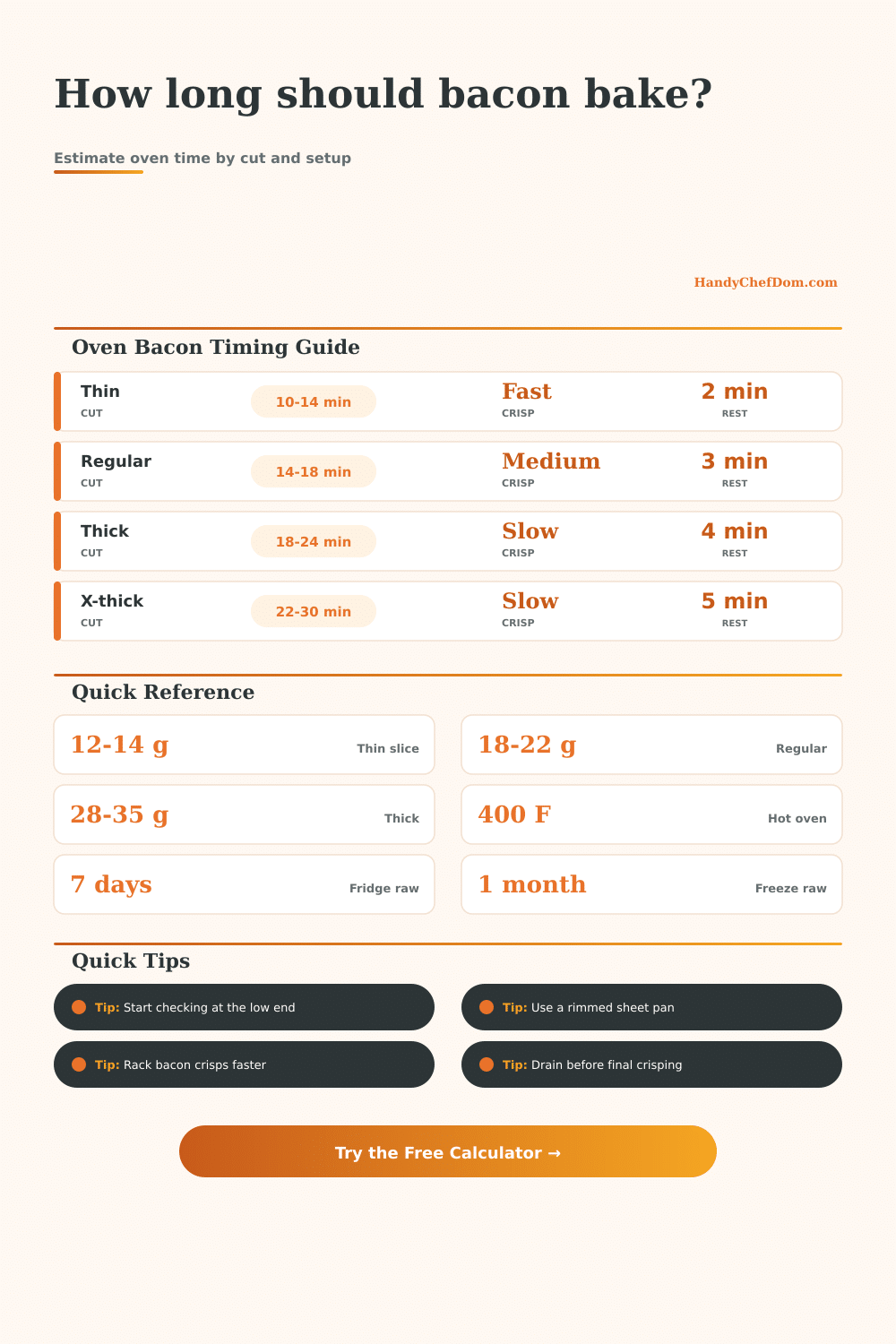
Bacon in Oven Cooking Time Calculator
Estimate oven bacon timing from thickness, oven temperature, rack or parchment setup, slice count, pan crowding, crispness target, convection, start temperature, and drain-rest time.
| Bacon / Setup | Slice Weight | 325°F | 350°F | 375°F | 400°F | 425°F | Best Check |
|---|
| Setup | Time Effect | Texture Tendency | Use When | Calculator Factor |
|---|---|---|---|---|
| Parchment-lined sheet pan | Baseline | Even render, slightly glossy | General oven bacon batches | x 1.00 |
| Foil-lined sheet pan | Near baseline | Similar to parchment, easy lift | Cleanup is the priority | x 0.99 |
| Wire rack over pan | Usually faster to crisp | Drier surface, crisp edges | Thick bacon or extra crispness | x 0.94 |
| Bare rimmed sheet pan | Can brown faster | More direct pan contact | Small batches with close checking | x 0.97 |
| Rack with parchment below | Slightly faster | Crisp top and easier cleanup | Balanced rack setup | x 0.96 |
| Target | Visual Cue | Remove From Oven | Drain Rest | Final Texture |
|---|---|---|---|---|
| Chewy and bendable | Edges browned, center flexible | Before fully stiff | 0-2 minutes | Soft bite |
| Tender-crisp | Mostly browned with slight flex | Low-middle of range | 2-3 minutes | Balanced bite |
| Crisp | Deep golden, bubbling slows | Middle-high of range | 3-5 minutes | Snappy edges |
| Extra-crisp | Dark golden, very little pale fat | High end with close checks | 5-8 minutes | Firm and brittle |
| Reference Point | Value | Metric | Applies To | Calculator Note |
|---|---|---|---|---|
| Refrigerator temperature | 40°F or below | 4°C or below | Raw or cooked bacon storage | Keep raw bacon cold before baking |
| Freezer temperature | 0°F or below | -18°C or below | Longer storage | Partly frozen edges add time |
| Raw bacon status | Cook before eating | Not ready-to-eat | Raw or partly cooked bacon | Use timing plus visual doneness |
| Opened raw bacon storage | About 7 days | Refrigerated | USDA/FSIS bacon guidance | Cook or freeze within that window |
| Raw bacon freezer quality | About 1 month | Frozen | FoodSafety.gov cold chart | Thaw safely before normal timing |
| Room-temperature limit | 2 hours | 1 hour above 90°F | Perishable food handling | Do not leave raw bacon out |
| Cooked leftovers | 3-4 days | Refrigerated | Cooked bacon storage | Cool and refrigerate promptly |
| Batch | Regular Slices | Raw Weight | Pan Layout | Timing Note |
|---|---|---|---|---|
| Breakfast for 2 | 6 slices | 4-5 oz / 113-142 g | Half pan or loose sheet | Check early |
| Family breakfast | 12 slices | 8-10 oz / 227-283 g | One rimmed sheet pan | Baseline timing |
| Brunch tray | 18 slices | 12-14 oz / 340-397 g | Full pan or two pans | Add rotation |
| Party batch | 24 slices | 1.1-1.3 lb / 499-590 g | Two pans | Add 1-3 minutes |
| Meal prep | 36 slices | 1.6-1.9 lb / 726-862 g | Two or three pans | Cook in waves if crowded |
Once you plug in your slice thickness and pan setup, the rest of the math are done by the calculator. You won’t have to guess which conversions or coefficients will work, so you won’t end up making bacon while feeling regretful. Bacon doesn’t cook like meat, so even though it’s a little thing, it counts. Bacon release fat. That makes all the difference in how long you have to wait to eat. The reason is bacon: it’s mostly fat surrounded by some lean meat. You don’t want to dry out the lean part while rendering the fat.
Bacon isn’t like steak where you can use a specific temperature and time combo. Instead, most folks just assumes bacon should of been done in a certain number of minutes. That’s wrong! Slices piled up will only steam and become limp. They need breathing room so heat can flow through them. So, the app takes into account how many slices is touching, and lets you choose between a crowded vs. Loose layout. In the former case, moisture will pool and make a sticky mess, as though it were cooked, yet rubbery. Air circulation is what you’re after with space, which is why the expected duration decreases different than the loose option.
How the Calculator Works
But also remember: thickness is important; much more so then most home cooks think. Thinner slices can go from raw to broken in an instant. Thicker-cut bacon need time to soften and get tender, making the fat translucent, and it has some staying power. Pulling out a piece of thick bacon “because it’s starting to look done” when it’s still mostly pink on top means it’ll still be cold and uncooked through middle. The calculator accounts for that with its extended window for thick-cuts… A reminder that relying on how something looks is unsafe if not placed within the proper context. Trust the process, not your eyeballs.
There’s also the matter of what you’re cooking the bacon on: Cooked on a rack? The bacon will sit above the pool of grease it renders, exposed to air on all sides. Normally that leads to crispier, less soggy bacon than swimming in its own fat in pan lined with parchment paper. How does one balance quicker clean up (parchment) against better texture (rack)? A little table at the bottom of the page sum it up. You’ll see that raising the bacon shortens your cook time.
Oven temperature is another factor where our gut instincts goes wrong. You’d think that hotter would mean quicker, and yes, hotter will burn the outside of bacon, but leave inside still pink. Usually, four-hundred degrees fahrenheit ends up being happy place for most home ovens. It is hot enough to get that fat rendering, yet not so hot as to turn the sugary component into ash before heat reaches deep into each slice. By normalizing based off your desired temperature, it’ll adjust your starting point accordingly (if you want it cooked more gently at a lower setting, or faster at a hotter one).
And finally…don’t skimp on the rest. As your bacon sits for those extra two or three minutes after being pulled off the wire rack (or paper towel) it will continue to crisp. Typically, if you pull it out when it’s perfect it’ll be over-cooked by the time it reaches your plate. By allowing it to cool for an additional couple minutes, the bacon have time to firm back up. A minor change but the difference between shattering bacon and snapping bacon. Who wants the latter? Make sure you include the resting time in your overall cooking window with the calculator. That way you can plan for the entire process, from oven to table.
Baking bacon doesn’t require exactness as much as it requires juggling variables: the amount of space, the temperature and the thickness. When you learn to make the three work together, there’s no need for panic. There’s no need to check the clock every second; just let things happen. It’s math, and the math adds up: So will your breakfast.