🥓 Bacon Protein Calculator
Estimate bacon protein from raw slices, cooked slices, crumbles, drained yield, servings, calories, fat, and sodium.
Choose the way you measured the bacon. The calculator converts raw slices, cooked slices, crumbles, or serving targets into cooked-slice equivalents before estimating protein and nutrition.
| Bacon style | Protein per regular cooked slice | Calories | Sodium |
|---|---|---|---|
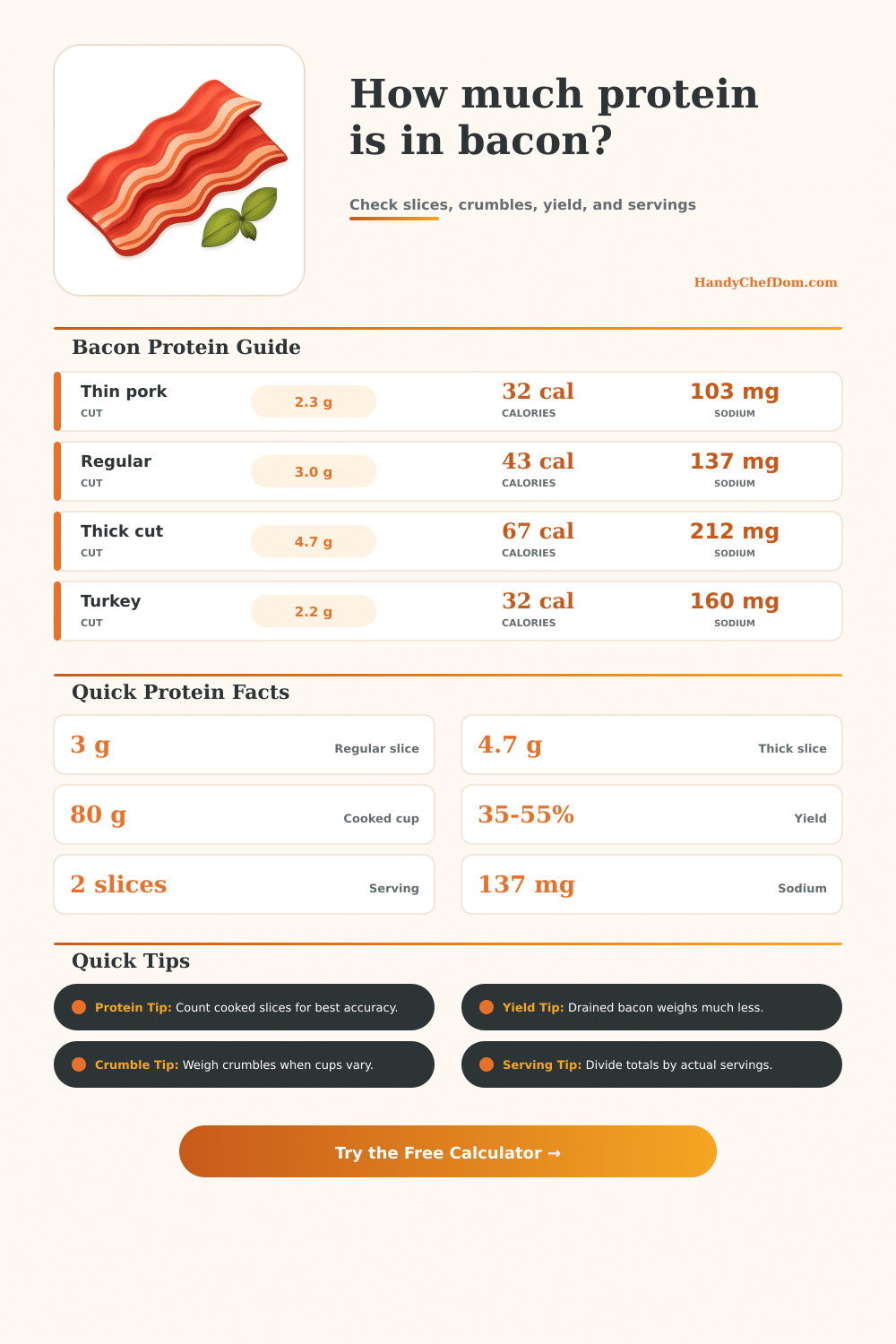
| Regular pork bacon | 3.0 g | 43 cal | 137 mg |
| Center-cut pork bacon | 3.2 g | 40 cal | 125 mg |
| Smoked pork bacon | 3.0 g | 45 cal | 145 mg |
| Peppered pork bacon | 3.1 g | 46 cal | 150 mg |
| Lower sodium pork bacon | 3.0 g | 42 cal | 90 mg |
| Turkey bacon | 2.2 g | 32 cal | 160 mg |
| Beef bacon | 3.8 g | 55 cal | 170 mg |
| Canadian bacon | 5.6 g | 45 cal | 360 mg |
| Slice thickness | Protein multiplier | Cooked weight | Best use in calculator |
|---|---|---|---|
| Thin slice | 0.75x | About 6 g | Sandwich layers |
| Regular slice | 1.00x | About 8 g | Breakfast plates |
| Thick cut | 1.55x | About 13 g | Brunch portions |
| Extra thick or slab | 2.20x | About 18 g | Protein-heavy plates |
| Measured amount | Cooked slice estimate | Protein estimate | Serving note |
|---|---|---|---|
| 2 regular cooked slices | 2 slices | 6 g | Light breakfast |
| 4 regular cooked slices | 4 slices | 12 g | Large breakfast |
| 1/4 cup crumbles | 2.5 slices | 7.5 g | Salad topping |
| 1/2 cup crumbles | 5 slices | 15 g | Potato topping |
| 1 cup crumbles | 10 slices | 30 g | Group garnish |
| 25 regular slices | 25 slices | 75 g | Party tray |
| Group size | Cooked slices | Total protein | Per serving |
|---|---|---|---|
| 2 people | 4 slices | 12 g | 6 g |
| 4 people | 8 slices | 24 g | 6 g |
| 6 people | 12 slices | 36 g | 6 g |
| 12 people | 24 slices | 72 g | 6 g |
| 25 people | 50 slices | 150 g | 6 g |
| 50 people | 100 slices | 300 g | 6 g |
It tastes good on pretty much everything, but bacon’s nutrition facts can be confusing because meat changes shape when you prepare it. When cooked, a lot of fat (and water) leeches out, leaving you with a smaller amount of food than expected. What appears as a giant heap of raw bacon is typically only half that when drained of grease, leaving a disconnect between what you buy and what you actualy eat.
To solve that problem, I made a tool (above) that first takes your entries and transforms them into equivalent slices of cooked bacon, then plugs those in the calculation. Why does that matter? Because most labels report raw weight of food, so unless you’re planning on eating it all right now as a burger patty, you’ll be off. Since meal prepping and tracking macros is about knowing final result in advance, that could throw you for a loop.
Why Cooking Changes Bacon Nutrition
By entering how many slice you began with, the calculator figures out yield based off how much fat cooks away. The lower the number here, the less bacon there will be at the end, so fewer total calories and grams of everything else, but a more concentrated nutrient profile. Chewier bacon will have a lower yield, since it doesn’t lose quite as much water/weight. Tweak this variable to get a correct idea of how much protein you’ll end up consuming (rather than some general-average number).
Another variable that significantly alter the numbers is thickness of the slices. If you’re using thick-cut bacon, then there’s more meat in each slice. It will contain more sodium, more protein, and more calories. I built multipliers into the calculator to account for this difference between standard, thick, and extra-thick cut slice. That way, if you pile on hefty slices for brunch, you won’t underestimate what you’ve consumed.
Also, if you’re scaling up recipe to serve a crowd, you don’t want to forget about that one little miscalculation per serving. It will add up fast when multiplied by two dozen.
Instead of eating bacon as slices, many home cooks prefer crumbled versions, which they add to baked potatoes or toss with salad ingredients. But it’s hard to measure by volume since a loosely-packed cup is different than one that’s very dense with crumbles. If you don’t have a scale, the tool will convert amount to dry measuring cups, but weighing your bacon crumbles ensures accuracy. Ten regular-size bacon slices has about the same amount of protein as a cup of packed crumbles. This conversion helps you think of crumbled bacon as a significant protein ingredient (not simply an embellishment), which help you serve up a nutritionally meaningful meal.
Finally, there is sodium. If you’re watching your sodium (or checking your blood pressure), this is something you’ll want to pay some mind. You can tweak this calculator to account for salty cures or a lower-sodium variety. Because, as we mentioned above, not all bacon is created equal; center cuts are often lower in fat and slightly different than their protein makeup when compared with more traditional streaky bacons. Knowing how to swap these will help you make informed choices without sacrificing flavor entirely. Note that swapping for turkey bacon will reduce calories, but it will also change the protein density per slice and overall texture.
How much protein in that? Knowing how much is going into any meal makes it easier to plan ahead. Whether you’re packing lunches or cooking up a big batch for a party tray. Knowing that your bacon add 12g of protein per serving can help you decide how much extra legumes and/or meat you’ll need to reach daily targets.
For a snapshot of typical meal balances, the page includes handy reference tables: everything from heavy brunch items to light breakfasts. These help take guesswork out of portion size.
Overall, cooking bacon is a balance between nutrition, taste, and texture. And while the app does the math for you (leaving you free to worry less about overestimated protein and secret sodium content, and more about getting that crisp edge just right), it translates an airy feeling of plenty into concrete information. From there, prepping and shopping for it becomes purposeful; now you’ll be able to see how thick, and how much, to go for. By the time they reaches the table, you’ll have a good idea of what those strips are bringing to the meal.