Potato Roasting Time Calculator
Estimate oven roasting time for potatoes by type, cut size, pan density, oven temperature, oil amount, convection, parboil step, and desired crispness.
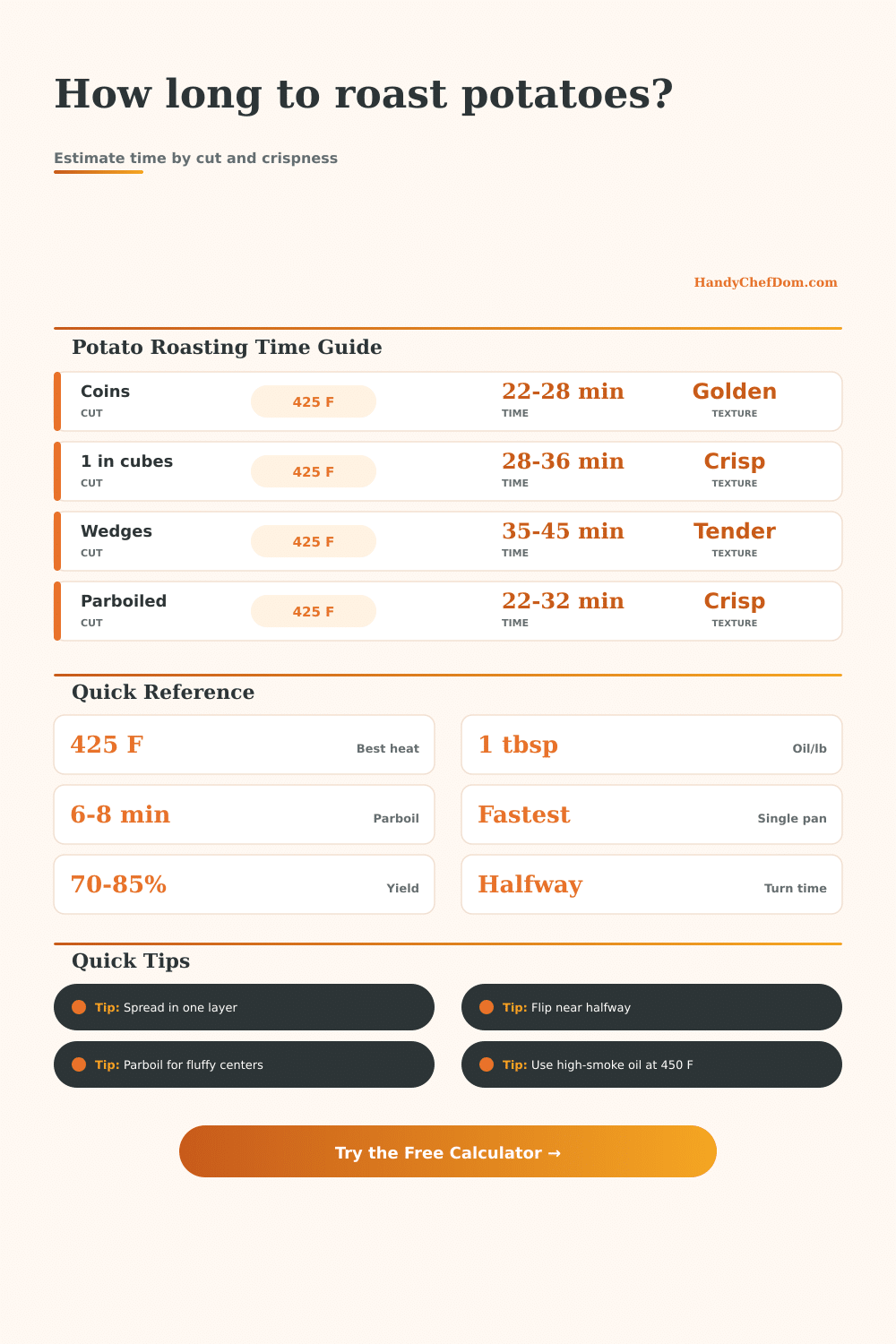
| Cut Size | 400°F / 204°C | 425°F / 218°C | 450°F / 232°C | Best Use |
|---|---|---|---|---|
| Coins or thin slices, about 1/2 inch | 28-34 min | 22-28 min | 19-24 min | Fast sides, breakfast potatoes |
| Small cubes, about 1/2 inch | 30-38 min | 24-30 min | 21-26 min | Crispy hash-style pieces |
| Medium cubes, about 1 inch | 36-44 min | 28-36 min | 24-31 min | Everyday roasted potatoes |
| Wedges or thick batons | 44-55 min | 35-45 min | 30-39 min | Fluffy centers, browned sides |
| Whole baby potatoes | 48-60 min | 38-50 min | 33-43 min | Creamy interiors, less cutting |
| Parboiled rough-edged pieces | 28-38 min | 22-32 min | 20-28 min | Crispiest classic roasties |
| Oil | Typical Smoke Point | Roasting Fit | Notes |
|---|---|---|---|
| Refined avocado oil | About 520°F / 271°C | Excellent at 450°F | High margin for very hot sheet pans. |
| Refined peanut oil | About 450°F / 232°C | Good at 425°F | Watch closely at 450°F. |
| Canola or vegetable oil | About 400-450°F / 204-232°C | Good at 400-425°F | Choose refined oil for hotter roasting. |
| Grapeseed oil | About 420°F / 216°C | Good at 400°F | May smoke sooner at 450°F. |
| Olive oil | About 390-470°F / 199-243°C | Varies by bottle | Refined blends tolerate heat better. |
| Extra virgin olive oil | About 350-410°F / 177-210°C | Best below 425°F | Use moderate heat or blend with neutral oil. |
| Potato Type | Roasted Texture | Typical Yield | Good Cuts | Per 100 g Raw |
|---|---|---|---|---|
| Russet / Idaho | Fluffy center, dry edge | 72-80% | Chunks, wedges, fries | About 77 cal, 18 g carbs |
| Yukon Gold | Creamy and browned | 74-82% | Cubes, wedges, smashed | About 77 cal, 17 g carbs |
| Red potato | Waxy, firm, moist | 78-86% | Halves, cubes, coins | About 70 cal, 16 g carbs |
| Fingerling | Dense, buttery bite | 76-84% | Halved lengthwise | About 77 cal, 17 g carbs |
| Baby creamer | Creamy, compact | 78-86% | Whole or halved | About 74 cal, 16 g carbs |
| Sweet potato | Soft, caramelized edge | 70-80% | Cubes, wedges, coins | About 86 cal, 20 g carbs |
| Side Servings | Raw Weight | Oil at 1 tbsp/lb | Sheet Pan Space |
|---|---|---|---|
| 2 servings | 1 lb / 450 g | 1 tbsp | Quarter sheet or open half sheet |
| 4 servings | 2 lb / 900 g | 2 tbsp | One half sheet pan |
| 6 servings | 3 lb / 1.4 kg | 3 tbsp | One crowded pan or two loose pans |
| 10 servings | 5 lb / 2.3 kg | 5 tbsp | Two half sheet pans |
| 20 servings | 10 lb / 4.5 kg | 10 tbsp | Four half sheet pans |
Space matters, as does surface area. How do you get crisp versus soggy spuds? A hot oven (set it to five hundred) doesn’t matter if the cubes is touching; then it’s steaming, not roasting. With the calculator above, there is no need to guess: focus on the cooking while it’s adjusting for con and yield loss.
The first choice is what kind of potato to use. Texture depends on starch content. High-starch/low-moisture russets (the ones you see in baking-potato sacks) create fluffy insides, but don’t hold together well when tossed around. Middle-ground Yukon Golds brown beautifuly, offering creamy centers while retaining enough shape to stand up to vigorous tossing. Denser, waxy red potatoes holds form, but won’t get crispy as starchy spuds will. Choose based off how much you want to distinguish between mash-soft and other settings. The tool accounts for variations by adjusting the base roast time to match.
How to Cook Perfect Potatoes
The second factor is cut size. The smaller the piece of food, the less distance heat has to travel to get through. It’ll take an hour for a thick wedge to get soft (without burning your skin), but just 20 minutes for a half-inch cube. Uniformity matters. When home cooks combine large chunks with tiny bits, guess what happens? The little guys burns like crazy well before the big guys even start to soften up. Spend five minutes cutting everything the same size and you’ve got a full tray finishing all together. This consistency is what makes the difference between a rushed side dish and something that looks like it was made by a professional.
Pan density is an underrated factor in home roasting. Steam makes potatoes unable to brown; they do better with air circulating so the Maillard reaction can take place. Cooking on crowded trays will reduce browns, so if your recipe calls for using a single sheet pan and you’re feeding a party of six, don’t pack them in; cook in two batches instead. Telling the calculator you’ll be working with crowded trays changes its time estimate by a big margin. People rarely make sure to leave an inch or more between potato pieces, but that’s what recipes mean when they say “use a rimmed baking sheet.
There are several functions served by the oil: It helps carry the spices and salt onto the potato surface and conduct more heat than air does, browning the outside faster. Without enough oil, your potatoes will be pale and dry (tasting like boiled vegetables) while too much will cause them to slide off your fork and become greasy bits. Usually about a tablespoon per pound is plenty for just a single layer; you’re looking for coating but no pooling. What kind of oil? Not as important as many believe, just choose something that won’t smoke at your desired temperature. Canola or standard vegetable oil will do just fine at moderate temps. If you want extra crispy potatoes cooked at the high end of oven temperature range (five-hundred degrees), choose refined peanut oil or avocado oil instead. These have a higher smoke point and won’t add bitter flavors.
Roasting after parboiling seems like a lot of work, but the results are outstanding. The inside is already partly cooked, which means all the roasting time can be focused on developing a crispy crust. Using a fork, I rough up the sides of my boiled potato to make little craters that will crisp up when it go into the oven. Why would you do this? Because if you started from scratch, you’d have to spend twice as much time in the oven. Without fear of burnt insides and uncooked middles, you’ll end up with a firm, golden crust and a meltingly tender center. Ten minutes of boiling and shaking colander before they ever see the oven.
Ovens have wildly different temperatures from their dials, so double-check at the low end of range. I can swear my oven is four hundred and it’s actualy three-hundred-and-eighty (which it is). Begin checking five minutes ahead of schedule. Letting it go longer won’t hurt if it needs it, trying to unburn a potato is more difficult than finishing a slightly underdone one. Go by sight rather then by clock: Those lovely browned edges matter just as much as how tender the inside is to a fork.
It’s all about roasting, which means it’s all about controlled drying. How do you get crisp but keep it moist inside? That’s the tricky part, and it’s really a matter of time and space and heat. Learn how to master those three things and what starts as a basic veggie becomes something special. The trick is that delicious crunch giving way to a tender, starchy bite.