🥒 Cucumbers in Fridge Pickling Time Calculator
Estimate when refrigerator cucumbers reach snack, balanced, bold, or deli-style flavor based on cut size, brine strength, jar loading, and fridge temperature.
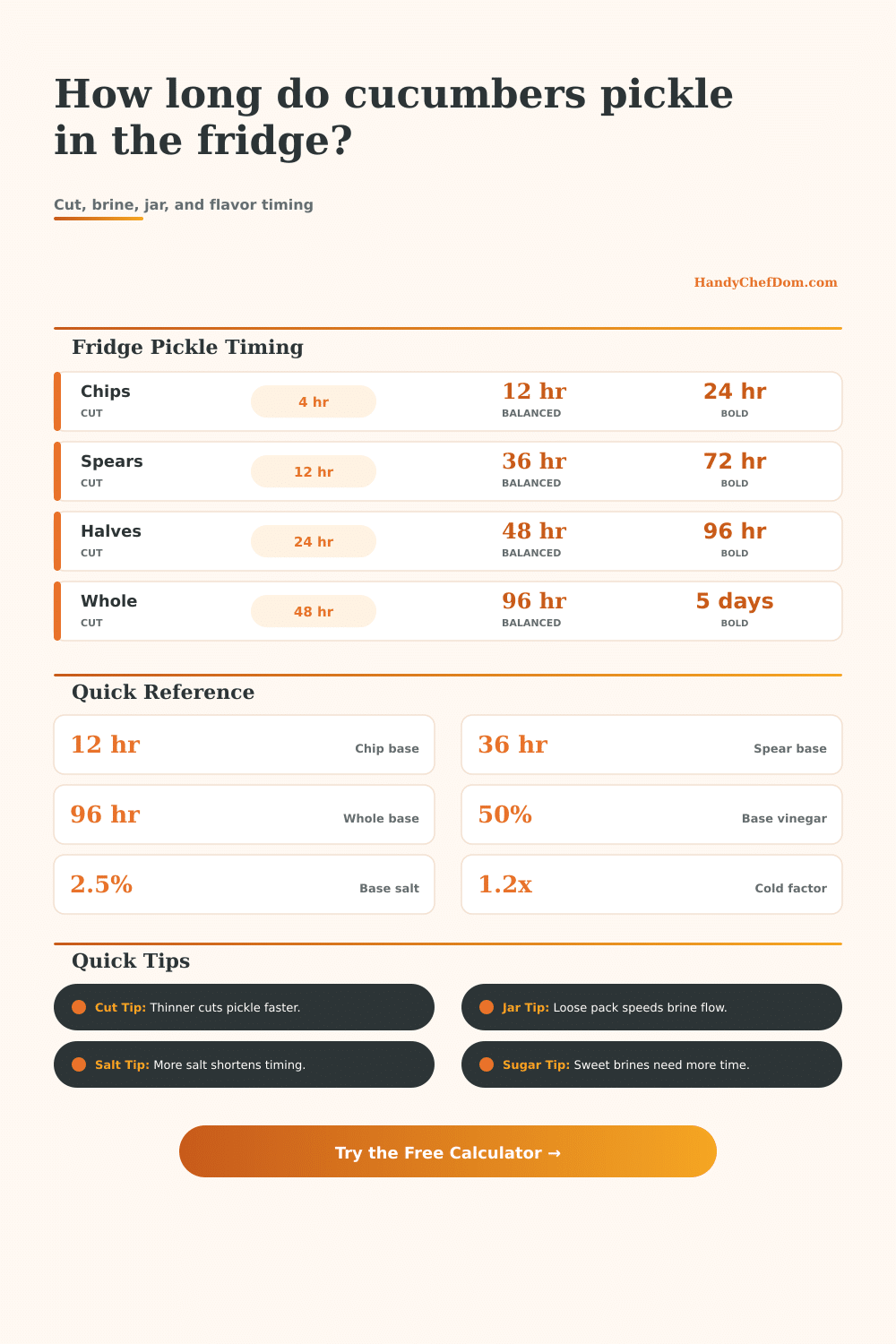
| Cut | Typical Thickness | First Taste | Balanced Flavor |
|---|---|---|---|
| Thin chips | 1/8 in / 3 mm | 3 to 6 hr | 8 to 18 hr |
| Chips | 1/4 in / 6 mm | 6 to 12 hr | 18 to 36 hr |
| Sandwich slices | 3/8 in / 10 mm | 8 to 18 hr | 24 to 48 hr |
| Spears | 1/2 to 3/4 in | 12 to 24 hr | 36 to 72 hr |
| Halves | 1 to 1 1/2 in | 24 to 36 hr | 48 to 96 hr |
| Whole | 1 1/2 to 2 in | 48 to 72 hr | 4 to 7 days |
| Brine Profile | Vinegar Share | Salt Level | Timing Effect |
|---|---|---|---|
| Mild brine | 35 to 45% | 1.5 to 2.0% | Slower, softer flavor |
| Balanced brine | 45 to 55% | 2.0 to 3.0% | Standard fridge pickle pace |
| Bright vinegar-forward | 55 to 70% | 2.0 to 3.0% | Faster tangy flavor |
| Bold salty brine | 50 to 65% | 3.0 to 4.5% | Fast, assertive flavor |
| Sweet pickle brine | 45 to 60% | 1.5 to 2.5% | Slightly slower finish |
| Half-sour style | 20 to 35% | 3.0 to 5.0% | Slow, cucumber-forward |
| Cucumber / Cut / Brine | Best Match | Target Time | Texture Result |
|---|---|---|---|
| Kirby spears + balanced | Classic jar | 36 to 72 hr | Crisp center |
| Persian chips + bright | Snack bowl | 8 to 24 hr | Fast snap |
| English slices + sweet | Sandwich stack | 24 to 48 hr | Soft bite |
| Mini whole + bold | Small jar | 3 to 5 days | Firm core |
| Garden halves + mild | Large batch | 3 to 6 days | Juicy center |
| Diced + bright | Relish cut | 6 to 18 hr | Even flavor |
| Conversion Grid | Imperial | Metric | Use In Calculator |
|---|---|---|---|
| Thin slice | 1/8 inch | 3 mm | Thin chips |
| Standard chip | 1/4 inch | 6 mm | Chips |
| Spear width | 1/2 inch | 13 mm | Spears |
| Quart jar | 32 fl oz | 950 ml | Jar size |
| Batch weight | 1 lb | 454 g | Cucumber weight |
| Brine cup | 1 cup | 237 ml | Brine volume |
There’s a particular brand of kitchen anxiety that comes with taking some fresh cukes out of the fridge, intending to pickle them: What if I overpickled them, and they’re now mush? Or what if I overpickle them, and lose the bright, snappy crunch?
The thing about refrigerator pickles is there is no fixed timeline. A calculator can help estimate range based off how full the jars are, the strength of your brine, and the cut size. It transforms it from a lottery-ticket variable to one you can manage.
How to Pickle Cucumbers Perfectly
The biggest variable here is surface area. Brine penetrates more easiler into thin chips where there’s less of it to traverse to get inside the piece of vegetable. Whole cukes take forever; they has a solid wall of flesh to pierce through. That is why there is a thickness question on the calculator. A quarter-inch-wide cut will behave very differently than a half-inch spear. The math accounts for the shape so you don’t wind up with bland raw middle and still-crunchy outside.
How fast they absorbs depends on the brine. Salt carries flavor and serves as a preservative, but it also extracts water from cucumber cells. Depending on concentration, salt can speed up the process, though too much makes the pickle inedible. Acidity is what gives the pickle its distinctive flavor: More acidic (higher percent) vinegar means a faster pickle. Aggressive acid attack cell structure. Higher percent sugar throws a wrench into this. Because there’s sweetness initially, sweet pickles tend to feel like they takes longer to develop. You may want to wait longer than suggested so the pickles get as tangy as you want. These factors is adjusted for by the calculator, which increases or decreases the base time depending on which brine profile you choose.
There’s also another, more quiet, but equally important factor: temperature. Refrigeration works by slowing down bacterial growth to keep food safe, but that means it won’t help speed things up. Think about pickles as a form of diffusion, diffusion of the brine into the cucumbers. And remember that diffusion is slower in cold. Your brine might creep through a cucumber slowly, even faster if your fridge are running at forty-five rather than thirty-eight degrees. The tool handles this thermal resistance. It’s a small multiplier, but when you’re timing a three-day party, it counts. Waiting for a few degrees can mean waiting several hours longer.
Another overlooked variable is how full you load your jars. When you make a tight pack, the brine can’t realy get through. It requires space to move between layers of cucumber so that it gets into all sides evenly. Stacking them brick-like can mean bland centers with over-sour edges. Loosening the pack lets the brine just flow right through; this accelerates things, too. Your batch weight help the calculator show how many jars and how much brine you’ll need. This lets you see if there’s enough breathing room in your jar.
But various types of cucumbers also has their own traits. For example, Kirby cucumbers are meatier and have very thick skin, which makes them great for pickles. They take longer to pickle and stand up well to stronger brines. More delicate and thinner than a Kirby, Persian cukes will go mushy after a little while. And English cukes is smooth and seedless, which changes how the skin reacts to the brine. Factors like this show up on the tool, changing the time to match the type of vegetable.
Three markers come out of this: When to take a taste. (When it’s still early, and probably mild, but okay for that.) Ready time. It has the best texture and balanced flavor. Finally, it will reach its peak flavor. This last one is often after what would of been considered ready.
Precision matters in fridge pickles: a pinch of this or that determines whether it’s a flop or not. Patience counts too. While you’re waiting, you lose the raw freshness and gain flavor instead. The math reduces the variables. What do YOU like? Pickle that! Tweak the brine to suit; let time be your guide. It’s crunchtime…wait for it.