🍼 Baby Food Sugar Calculator
Estimate total sugars, added sugar flag, sugar cube equivalents, servings, and age serving portions from baby food jars, pouches, cups, and label-style nutrition data.
Values use food-label style sugars per 100 g. Select the closest food type, enter jar or pouch grams, and mark whether the label lists added sugar.
| Food label type | Total sugars per 100 g | Carbs per 100 g | Fiber per 100 g |
|---|---|---|---|
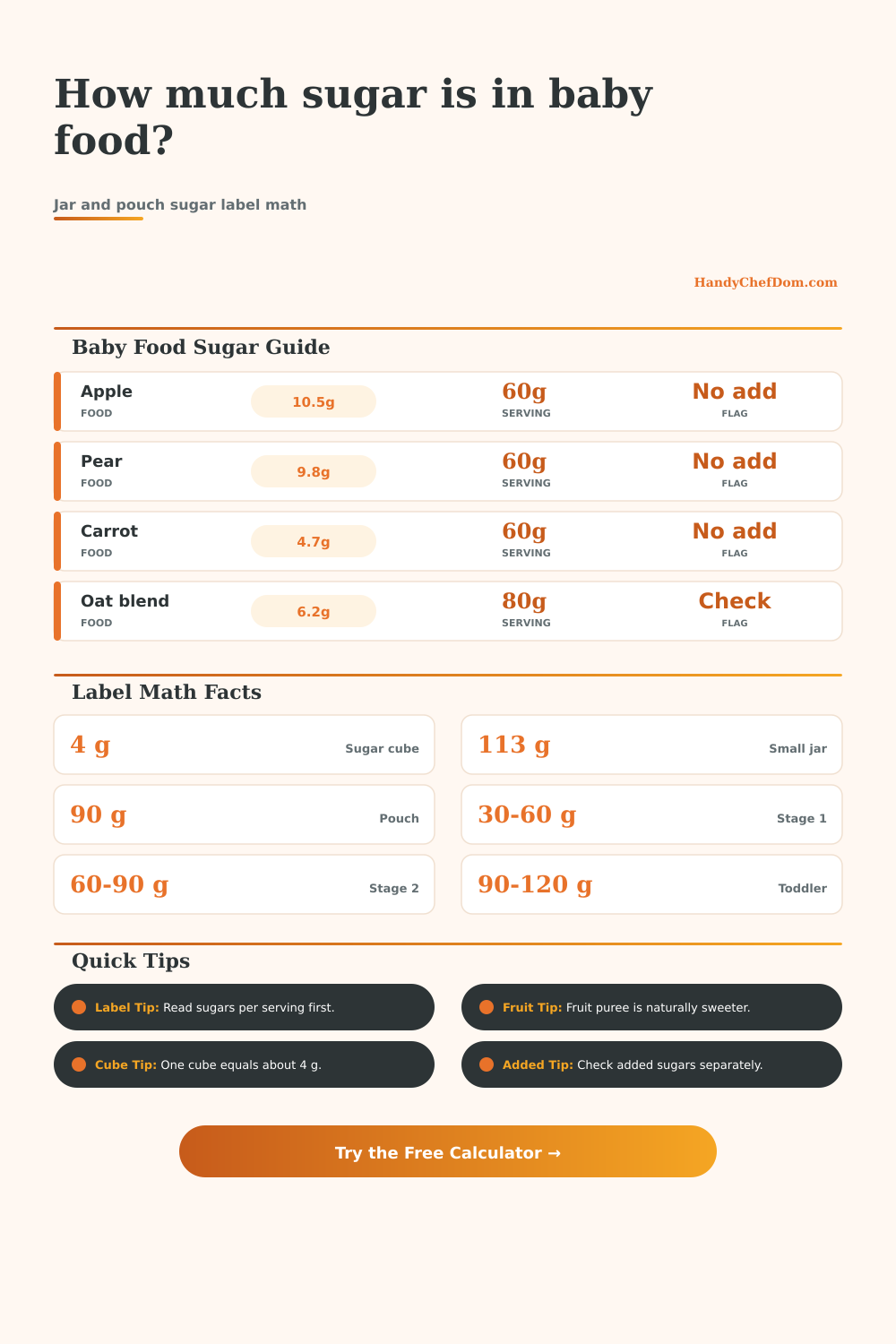
| Apple puree | 10.5 g | 13.6 g | 1.4 g |
| Pear puree | 9.8 g | 14.1 g | 2.0 g |
| Banana puree | 12.2 g | 21.0 g | 1.7 g |
| Mango blend | 11.0 g | 15.0 g | 1.3 g |
| Carrot puree | 4.7 g | 8.2 g | 2.3 g |
| Sweet potato puree | 5.2 g | 16.4 g | 2.4 g |
| Mixed vegetable puree | 2.8 g | 7.8 g | 2.1 g |
| Fruit and oat blend | 6.2 g | 15.8 g | 1.8 g |
| Fruit yogurt blend | 8.8 g | 13.5 g | 0.7 g |
| Vegetable grain meal | 4.8 g | 12.6 g | 1.9 g |
| Container style | Common amount | Apple puree sugar | Pear puree sugar |
|---|---|---|---|
| Small jar | 71 g / 2.5 oz | 7.5 g | 7.0 g |
| Standard jar | 113 g / 4 oz | 11.9 g | 11.1 g |
| Large tub | 128 g / 4.5 oz | 13.4 g | 12.5 g |
| Small pouch | 90 g / 3.2 oz | 9.5 g | 8.8 g |
| Large pouch | 120 g / 4.2 oz | 12.6 g | 11.8 g |
| Age serving band | Reference range | Midpoint used | Calculator role |
|---|---|---|---|
| Early tastes | 30-60 g | 45 g | Compares entered serving size to a small tasting portion |
| Stage 2 | 60-90 g | 75 g | Compares serving size to a common jar or pouch portion |
| Older baby | 90-120 g | 105 g | Compares serving size to a larger meal or snack portion |
| Toddler | 120-150 g | 135 g | Compares serving size to a toddler snack or meal component |
| Total sugars | Cube equivalent | Label math | Example food amount |
|---|---|---|---|
| 4 g | 1.0 cube | 4 divided by 4 | About 85 g carrot puree |
| 8 g | 2.0 cubes | 8 divided by 4 | About 76 g apple puree |
| 12 g | 3.0 cubes | 12 divided by 4 | About one 113 g apple jar |
| 16 g | 4.0 cubes | 16 divided by 4 | About 145 g mango blend |
| 20 g | 5.0 cubes | 20 divided by 4 | About 164 g banana puree |
Most parents don’t feed their babies dessert, but they often overlook the fact that pureed fruit is essentially liquid candy. This isn’t meant as a criticism of healthy foods, but rather a way to set expectations: A jar of apple puree is a container of concentrated sugars. Nature packed those sugars for energy, not necessarily the sweetening of your baby’s first taste buds.
The trick begins when nature meets added. Then the label becomes a puzzler, one you have to decode before each feeding. Did you get sweetness straight from the fruit? Or did you get sweetness after you got to the bottom of ingredient list and found syrup?
How to Check Sugar in Baby Food
Plug in what kind of food you’re making and how many packages and the calculator does the rest for you (the above one calculates ounces). No need to think through conversions or coefficients. Just know what these inputs mean in the real world. For example, there is typically 113 grams per standard jar of puree, and approximately 90 grams per pouch.
When you’re looking at consumption over the course of a week, it makes a big difference to be aware of that difference in volume. The tool takes total sugar content, converts it into sugar cubes, and presents it as something much more tangible than an abstract number on a label. It helps connect the abstract world of nutrition labels to the real world of holding something in your hand.
It’s just 10.5 grams, or nearly three sugar cubes. And that’s what most people gloss over. They don’t notice until they hold it in their hands and see the numbers on the back of the box. That’s where the math gets tricky: separating added sugars from all the other stuff.
Foods with naturally occurring sugars tend to have higher numbers, such as more than 12 grams of sugar per 100-gram serving in something like banana or apple puree. Other items based off veggies, like carrots, will hover around five grams. That doesn’t mean fruit isn’t good for you, though. You just need to be strategic about how often you serve it.
If it has any kind of “added sugars” noted right on the ingredients list? That is a different ballpark altogether. The calculator makes that line very clear for you, so that you can see if the food are relying on additional sweetness to cover up anything that may taste less pleasant. Lots of companies use high-fructose corn syrup or sucrose to sweeten otherwise boring vegetables into something tasty to finicky kids’ tongues. So while you believe you’re giving your kid some healthy carrot sticks, what he’s realy eating is a sugary concoction meant to fool his tongue.
Portion control is another part where it gets complicated. For most parents, this is also hard! Most jars say “one serving” and then label the whole thing, even though most kids don’t eat 113 grams at once. You can change the serving size so that the number matches how many ounces or grams your kid actualy ate. It will provide a far better estimate of how much sugar they consumed.
What happens if your baby does not finish an entire pouch? Well, if the panel says each serving has x amount of sugar and you fed them HALF a pouch, they aren’t eating half that sugar because you gave them half a pouch. The math changes when you split a package into multiple meals. It helps to think about this in context too. This is why there are some age-based serving bands built into the reference tables. They let you see what your input means compared to what other kids typically consume within those same age groups. For example, a three month old may be eating very small amounts and barely tasting new things, whereas a toddler is ready for 120-ish grams of something.
The idea isn’t to ban all sugars; that’s both impossible and unnecessary. Rather, you’re trying to keep their consumption in check, in a conscious way. You don’t want your kid to become addicted to something so sweet that they can no longer stand anything less (i.e., broccoli). That’s why a simple conversion guide can help cut through all that marketing noise.
What’s left is just the raw data: what you need to know in order to make an informed decision. And here it is, laid bare in the reference table on the page: which foods have the most sugar? How does one type of food compare to another? A small thing, perhaps, but when you’re establishing lifelong patterns around food, every little bit counts.
But at the end of the day, it’s another thing you should of learned to read: the label. Read the product breakdown on the back first (trust that). Then read the front of package claims with a healthy dose of skepticism. And run the numbers on the calculator to check if they hold up.
Now you know, down to the exact number of grams of sugar your kid is eating in each meal. Does that match what you want for your family? Take control of the story. Don’t let the design of packaging make decisions for you. After you pay attention to this stuff for awhile, it all becomes clear. You get a sense of what works and doesn’t work in your particular case.
Don’t let the packaging design dictate your choices. The fact that there’s a jar is irrelevant. What happens inside your kid’s mouth when the product touches them is relevant.