🍝 Pasta Dough Calculator
Calculate exact flour, eggs, and water for any number of servings — fresh egg or semolina dough
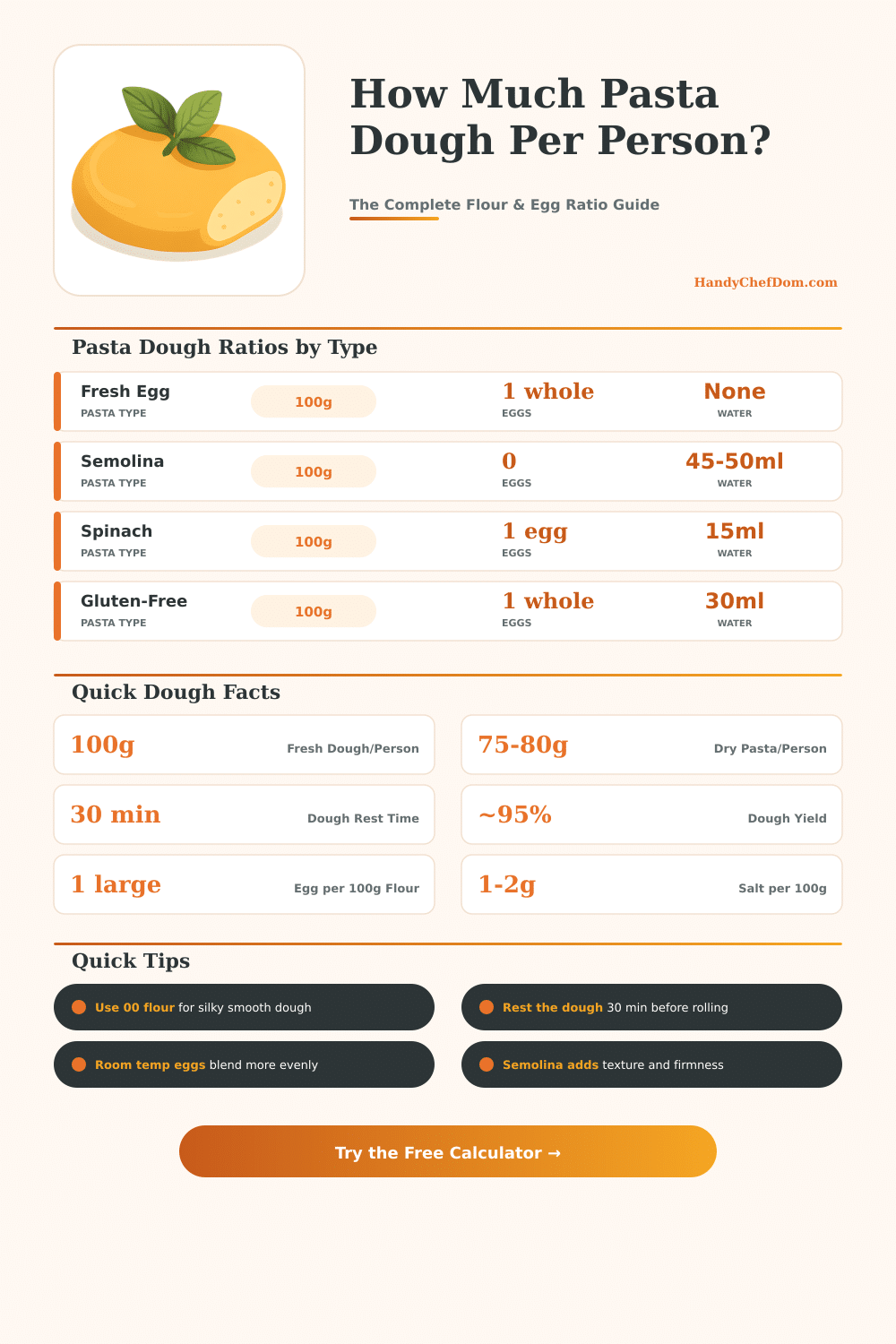
| Dough Type | Flour per Person | Eggs / Yolks | Water / Liquid | Salt |
|---|---|---|---|---|
| Classic Egg (00) | 100g / 3.5 oz | 1 whole egg | None (or 1–2 tsp) | 1g / pinch |
| Egg Yolk Rich | 100g / 3.5 oz | 4–5 yolks | 1–2 tsp water | 1g / pinch |
| Semolina (Water) | 100g / 3.5 oz | None | 45–50ml / 3 tbsp | 2g / 1/3 tsp |
| Spinach Egg | 100g / 3.5 oz | 1 whole egg | 50g spinach pure | 1g / pinch |
| Gluten-Free | 100g / 3.5 oz | 1 whole egg | 2 tbsp (30ml) | 1g / pinch |
| Servings | Main Course (g) | Starter (g) | Stuffed Pasta (g) | Approx. oz |
|---|---|---|---|---|
| 1 person | 100g | 60g | 130g | 3.5 oz |
| 2 people | 200g | 120g | 260g | 7 oz |
| 4 people | 400g | 240g | 520g | 14 oz |
| 6 people | 600g | 360g | 780g | 21 oz |
| 8 people | 800g | 480g | 1,040g | 28.2 oz |
| 10 people | 1,000g | 600g | 1,300g | 35.3 oz |
| 12 people | 1,200g | 720g | 1,560g | 42.3 oz |
| Flour Amount | Whole Eggs | Egg Yolks Only | Approx. Dough Weight |
|---|---|---|---|
| 100g (1 serving) | 1 large | 4–5 yolks | ~160g |
| 200g (2 servings) | 2 large | 8–10 yolks | ~320g |
| 300g (3 servings) | 3 large | 12–15 yolks | ~480g |
| 400g (4 servings) | 4 large | 16–20 yolks | ~640g |
| 500g (5 servings) | 5 large | 20–25 yolks | ~800g |
| 1000g (10 servings) | 10 large | 40–50 yolks | ~1,600g |
| Pasta Shape | Thickness Setting | Dough Yield | Notes |
|---|---|---|---|
| Tagliatelle | Setting 5–6 (1.5mm) | ~95% | Wide flat noodle |
| Spaghetti | Setting 6–7 (1mm) | ~93% | Thin round noodle |
| Lasagne Sheets | Setting 5 (2mm) | ~96% | Pre-boil or dry |
| Ravioli / Tortellini | Setting 6–7 (1mm) | ~70–75% | 2 sheets + filling |
| Pappardelle | Setting 4–5 (2.5mm) | ~95% | Very wide ribbons |
| Fettuccine | Setting 5–6 (1.5mm) | ~95% | Similar to tagliatelle |
Fresh pasta dough is one of the most exciting tasks. No store version can beat the taste of its texture and smell. It is better than all those ready packets.
Although it takes some minutes, do not rush the process
How to Make Fresh Pasta Dough
Usually, you make dough from flour with water or eggs, that later forms sheets or various shapes. Basic recipe simply mixes flour with eggs. For instance, one big egg for every 100 grams of flour.
Do not add extras like yolks, unless you want more yellow color. Rich dough with yolks works well for stuffed pasta as agnolotti or ravioli. You can use only flour and water for pasta dough, but substituting water with eggs, used in North Italy; gives the best result, although it costs more.
Ideal for home dough is Italian 00 flour, because it is the finest grind. Semolina or durum wheat gives it the typical character. Also special flours as einkorn, spelt, red fife or even rye work well, like gluten-free choices from chestnut or chickpea flour.
The volcano mode to make pasta dough helps to control the moisture of the techture and gives same texture. Make a crater in the flour, put the eggs in it and mix with a fork until it thickens. Use a scraper to combine the whole dough.
Too wet? Add flour. Too dry?
A bit of water. People made dough for centuries without exact measures, so there is a lot of flexibility.
An important step is to let the dough rest. During rest it absorbs more moisture. Many tries fail because of impatience.
Good fresh pasta dough must be very stiff. After 30 minutes in the fridge you will be able to knead it without flour, and it will not stick to the hands.
Rolling, start on thick levels and go step by step thinner. The dough must be elastic but smooth. One serving of 100 grams forms a sheet of 30 until 38 cm long through the smallest setting.
Newcomers find fettuccine, linguine or pappardelle the easiest start. Fresh dough almost does not change shape during cooking, so serve it with a sauce that does not hide the texture. As a first plate, 100 grams of dough give around 125 grams of cookedpasta.