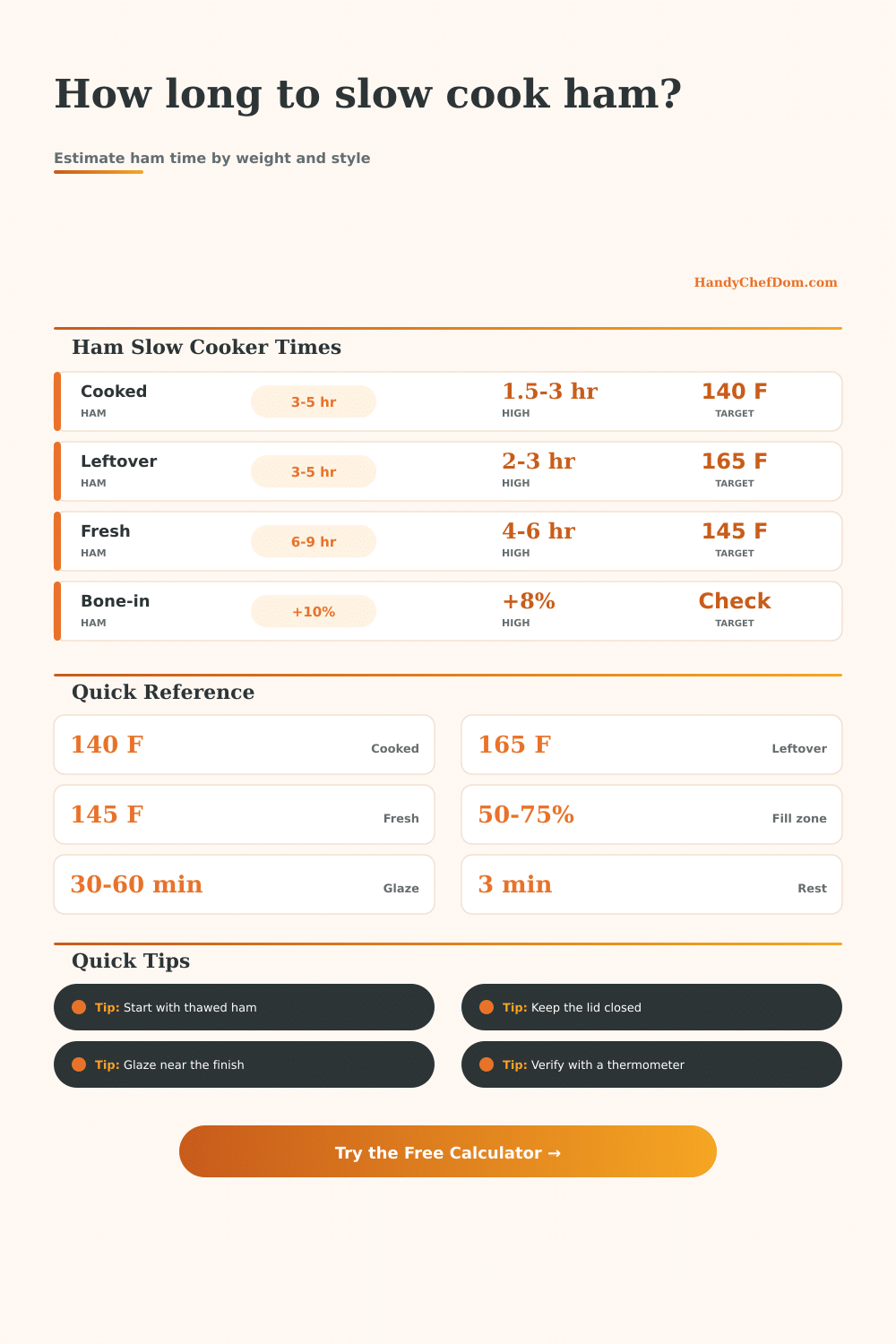
🍖 Ham Slow Cooker Time Calculator
Estimate slow cooker ham time from weight, fully cooked or fresh style, bone-in shape, low or high setting, glaze volume, cooker fill, starting temperature, and target internal temperature.
Choose a common ham setup or enter your own values. The calculator separates the main heating window, first check, glaze timing, rest, target temperature, and cooker fill adjustment.
A compact fully cooked ham usually reheats evenly and works well on low with a late glaze.
The bone and irregular shape slow center heating, so the first check should come later.
Pre-sliced ham benefits from low heat, enough liquid, and a covered cooker to limit dryness.
Fresh ham is a raw pork cut, so it uses a longer cooking window and a pork target temperature.
| Ham type | Calculator mode | Target used | Check note |
|---|---|---|---|
| Fully cooked ham from a USDA-inspected plant | Reheat | 140 F / 60 C | Check the center with a food thermometer before serving. |
| Leftover, repackaged, or non-USDA-inspected cooked ham | Reheat | 165 F / 74 C | Use the higher reheat target when the source is not clear. |
| Fresh ham or cook-before-eating pork ham | Cook | 145 F / 63 C plus rest | Use the fresh ham style and do not rely on color alone. |
| Custom label instruction | Custom target | User entry | The calculator shows the entered target in both unit systems. |
| Ham style | Low setting guide | High setting guide | Best use |
|---|---|---|---|
| Fully cooked boneless ham | 34 to 42 minutes per pound | 20 to 26 minutes per pound | Everyday dinner hams and compact pieces. |
| Fully cooked bone-in ham | 40 to 50 minutes per pound | 24 to 30 minutes per pound | Holiday hams that fit without pressing the lid. |
| Spiral sliced ham | 32 to 40 minutes per pound | 18 to 24 minutes per pound | Gentle reheating with glaze added late. |
| Fresh boneless ham roast | 55 to 68 minutes per pound | 34 to 44 minutes per pound | Raw pork cooked to temperature, then rested. |
| Fresh bone-in ham or picnic | 64 to 78 minutes per pound | 40 to 50 minutes per pound | Dense cuts that need a long steady window. |
| Input | Range | Calculator effect | Planning note |
|---|---|---|---|
| Cooker fill | 50% to 75% | Baseline | Food depth and heat transfer are most predictable here. |
| Low fill | Under 45% | Subtracts about 5% | Small hams heat faster, so check early. |
| High fill | Over 80% | Adds 8% to 14% | A crowded cooker slows heat movement around the ham. |
| Light glaze | 0.25 to 0.75 cup | 30 to 40 min finish point | Add near the end so sugars do not thin too much. |
| Heavy glaze | 1 cup or more | 45 to 60 min finish point | More glaze behaves like extra liquid and needs time to warm. |
| Handling point | USDA-style guidance | Calculator response | Why it matters |
|---|---|---|---|
| Starting state | Thaw meat before slow cooking | Partly frozen starts show a warning | Frozen centers take longer to reach safe heat. |
| Lid position | Keep the lid in place | First check is set late in the window | Lid lifting releases heat and lengthens timing. |
| Thermometer use | Verify safe internal temperature | Target card shows the needed temperature | Time is an estimate; temperature confirms doneness. |
| Warm holding | Hot foods should stay at safe heat | Plan includes finish and rest steps | Do not use warm mode as a shortcut to cook ham. |
Temperature references follow USDA/FSIS ham guidance: many fully cooked USDA-inspected hams reheat to 140 F, other reheated hams to 165 F, and fresh ham cooks to 145 F with rest. Slow cooker handling guidance favors thawed meat and keeping the lid in place.
Labels on holiday hams are more confounding then illuminating. They may suggest roasting at high heat, but what about that handy slow cooker? That’s where the device itself come in: It changes the flow of heat within the meat. This is where a ham-cooking calculator comes in. Enter its size and style and it calculate the timing, so you won’t have to guess when to start.
The thing to know about all this: there’s a big difference between a fully cooked ham and fresh ham, which is simply raw pork shoulder. A fully cooked ham are already prepared and cured, you’re simply reheating it. This should of only take as long as it takes for the inside of the ham to reach about 140 degrees. With a fresh ham, however, you have to cook it all the way through, meaning a much longer, gradual rise to an internal temperature of 145 degrees F or so. The base rate adjust to match; choose fresh ham, and the estimate extend quite a bit. That’s a crucial difference; one that can ruin your dinner if ignored.
How To Cook Ham In A Slow Cooker
Mass matters. But so does fit. Sure, a five pound boneless ham will reach temperature faster then a ten pound bone-in ham. It is obvious. But here’s the thing: it also has to do with shape of the cut and whether or not it fits snugly inside the pot. Hams, especially bone-ins, are not uniform in shape; there are cold spots around middle where the meat is uneven. That’s why the calculator allow for bone-in cuts by adding a percentage buffer. That cut is denser, which makes sense. But it also has to do with thermal conduction. How well your ham fit into the cooker matters, because wedging it tightly between side walls stops heat from flowing.
The other ignored variable is the cooker fill level. Most recipes don’t account for this. Slow cookers works best at about halfway (or perhaps three quarters) of the way up. If it is less than halfway, they cooks too fast. There is not enough liquid to keep things from drying out before the flavors come together. Above eighty percent, and you’re just asking for trouble with a crowded, thermal-barrier-filled pot that has difficulty reaching and holding uniform temperatures. The chart on the page makes all that clear, and shows how filling it more or less affect your timing window. Small detail, but it adds up if you want to be precise with your cooking.
Many cooks go off the rails at this point: Glazing. Sugar burns quickly; if you apply it too early in a slow cooker, it will get washed off by trapped steaming vapors before its work is done. Apply the glaze during final half hour to an hour (or however long your estimate says). This gives the sugar time to caramelize without burning or thinning out into a watery liquid. The calculator provides a target time… Meaning “when” rather than “maybe”; based off how much time you think it’ll take. Sweet and sticky, not wet and gloppy, is what’s desired here.
A meat thermometer is essential. Time is not a guarantee; these times is guidelines. Hams come in different states of defrosting; appliances also runs at different rates. A ham fresh from the fridge will take longer then a ham that has had time to warm up on the counter. The thermometer takes this variation in starting temp into account, but don’t trust it: always check finished product yourself. Place the thermometer probe where the meat is thickest (try to avoid the bone).
When it’s done, remove and allow to rest. There’s no negotiation: there must be rest. Whether it’s reheated ham or anything else, let it sit for several minutes to allow its juices to settle. If you cut now, all that juice come out and goes on the cutting board rather than staying inside the meat. It sounds obvious, but being patient is important to keep the texture. Hours you’ve already waited, three more won’t ruin your plans.
Finally, keep the lid on. Each time you lift it, you let out a bunch of heat and add an unpredictable number of minutes to total cooking time. You’ve got this. Believe in the process and use the expected window given. The variables is complicated but the calculator above takes care of them for you, leaving your head free to attend to guests, the glaze, etc. When the timer goes off, take the temperature, let it rest, and cut with confidence. Little effort is needed for a good ham; only accurate planning.