Potato Fiber Calculator
Estimate total fiber, per-serving fiber, peel contribution, cooling adjustment, and daily goal share for a potato recipe batch.
🥔Potato Fiber Presets
⚖Batch Inputs
Potato Fiber Estimate
📊Potato Peel, Method, and Fiber Grid
📝Reference Tables
| Potato type | Average size | Skin-on fiber | Peeled fiber | Best calculator use |
|---|---|---|---|---|
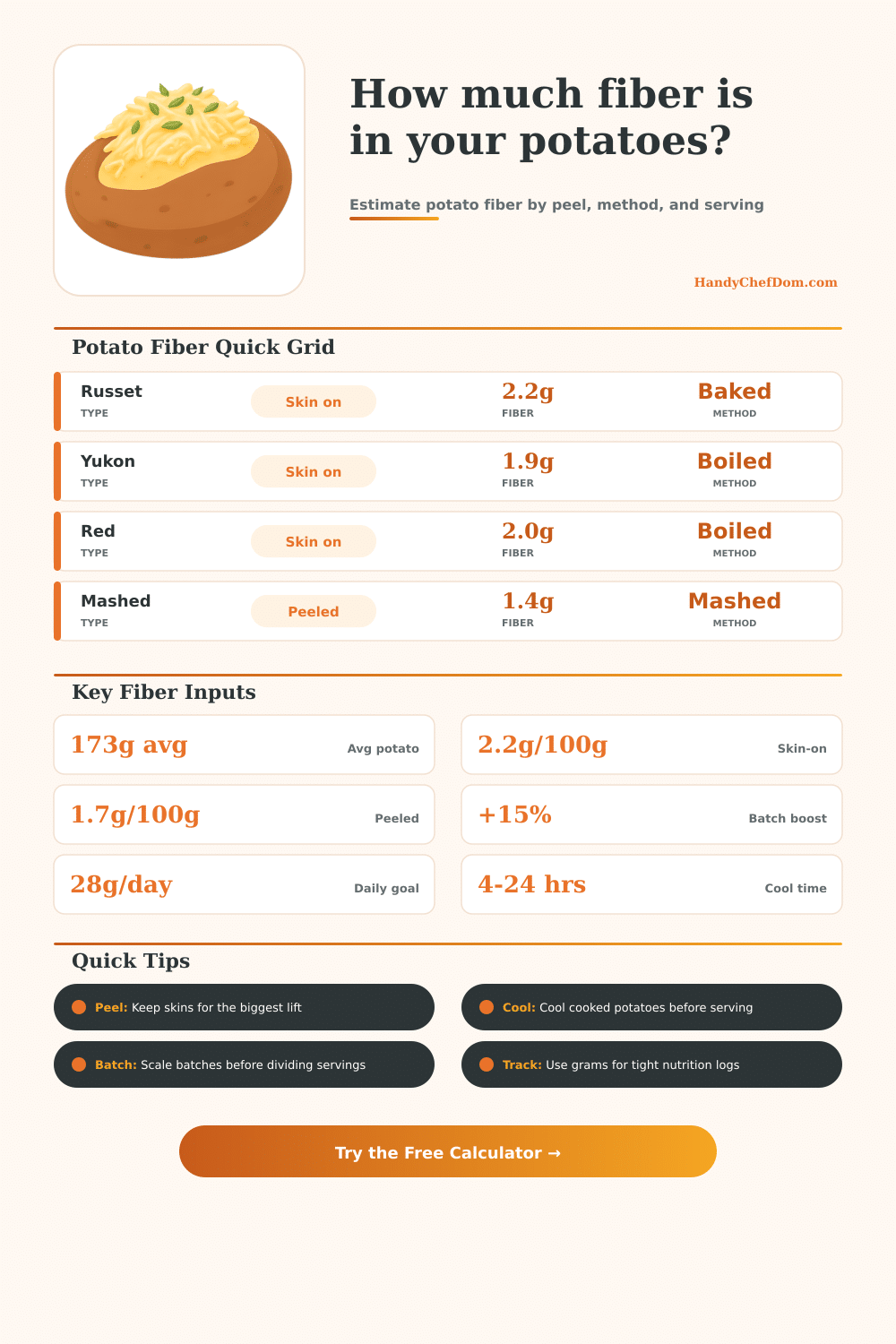
| Russet | 173 g medium | 2.2 g per 100 g | 1.7 g per 100 g | Baked potatoes and wedges |
| Yukon Gold | 148 g medium | 1.9 g per 100 g | 1.5 g per 100 g | Boiled sides and golden mash |
| Red potato | 136 g medium | 2.0 g per 100 g | 1.6 g per 100 g | Salad, boiled, and smashed potatoes |
| White potato | 156 g medium | 1.8 g per 100 g | 1.4 g per 100 g | All-purpose sides |
| Fingerling | 45 g each | 2.1 g per 100 g | 1.6 g per 100 g | Small roasted portions |
| Purple potato | 110 g small | 2.4 g per 100 g | 1.8 g per 100 g | Colorful meal prep portions |
| New potato | 55 g each | 2.0 g per 100 g | 1.5 g per 100 g | Skin-on spring potato dishes |
| Sweet potato | 130 g medium | 3.0 g per 100 g | 2.5 g per 100 g | Higher-fiber potato-style side |
| Method | Fiber adjustment | Moisture effect | Best peel setting | Serving note |
|---|---|---|---|---|
| Baked or roasted | 1.05x | Slight concentration | Skin on | Great for whole-potato tracking |
| Boiled or steamed | 0.98x | Small dilution | Skin on or half peeled | Drain well before weighing |
| Mashed | 0.92x | Added liquids dilute per scoop | Peeled or half peeled | Use cooked batch weight when known |
| Smashed with skins | 1.03x | Mostly retained | Skin on | Fiber stays high if skins remain |
| Daily goal | Low serving | Moderate serving | High serving | How to read it |
|---|---|---|---|---|
| 25 g goal | 1.5 g = 6% | 3 g = 12% | 5 g = 20% | Common target for many adults |
| 28 g goal | 1.5 g = 5% | 3 g = 11% | 5 g = 18% | Useful balanced default |
| 30 g goal | 1.5 g = 5% | 3 g = 10% | 5 g = 17% | Simple planning target |
| 38 g goal | 1.5 g = 4% | 3 g = 8% | 5 g = 13% | Higher daily fiber planning |
| Cooling option | Bonus used | When to use | Calculator meaning | Batch example |
|---|---|---|---|---|
| Served hot | 0.0 g per 100 g | Immediate dinner | No resistant-starch add-on | Baked potato night |
| Cooled 4 hours | 0.2 g per 100 g | Make-ahead salad | Small fiber-like bonus | Lunch meal prep |
| Cooled overnight | 0.4 g per 100 g | Chilled batch | Largest bonus estimate | Potato salad or bowls |
| Cooled then reheated | 0.3 g per 100 g | Prep once, serve warm | Partial retained bonus | Roasted leftovers |
🍝Serving and Nutrition Planning Grid
💡Potato Fiber Tips
How you cook your potatoes determines their nutritional impact. Many people thinks potatoes are unhealthy, but certain cooking methods takes away there nutritional benefits. For example, when boiled and then peeled, the potato is nothing more than a starchy food with limited gut health benefits. When baked with skin intact and eaten nice and crispy, the potato contain fiber and is considered a good food choice. Additionally, letting the baked potato cool will increases the resistant starch content. So it’s not the vegetable, but rather how you cook it! Knowing this allow you to include potatoes in your diet to help digestion instead of simply using them as an empty filler.
Potatoes are thought to be one size fits all in terms of nutrient content. That’s why we end up making boring food that doesn’t get us anywhere towards our health goals. There is no one-size-fits-all potato (or rather, there is). Some varieties such as red or Yukon Gold contain less fiber then a Russet; while peeling your potato change the fiber composition, as does whether you leave skin intact or not. Leaving skin on will give you a bump in insoluble fiber (the stuff that bulks up stools and helps them move along). Scrubbing the taters is healthier than removing their skins with a paring knife. Besides the obvious benefit of getting rid of the dirt, you’re also throwing away some of the structure (and nutrients) from the potato itself. Check out skin-on vs. Skin-off differences on the page, and see for yourself just how many nutrient get cut down by that paring knife instead of a scrub brush.
How You Cook Potatoes Changes Their Health Benefits
There’s also one more twist: How are you going to prepare it? Roasting and baking thicken the solids (as the water cooks off). Boiled potatoes loses some water-soluble nutrients into the pot of boiling water. Potatoes mashed with butter/cream/milk usually recieve those ingredients in addition to the potato. Which will dilute fiber amount per gram, even if the overall mass remain unchanged. All these little tweaks add up fast when trying to reach a full day’s worth. Each preparation do change the nutrition composition; see below for the reference table. Again, don’t memorize this stuff, but understand that preparation matters.
Cooked potatoes are also beneficial because of what happens when they cool down. When they do, a process called retrogradation take place that turns some digestible starch into resistant starch. In the body, this behave similarly to fiber; it does not break down in the small intestine but instead ferments in the colon where it becomes food for the good bacteria. So, by cooling your cooked potatoes, ideally overnight or for at least four hours, you’re making them more nutritionally valuable. If you’d rather get maximum benefit from meals with minimum additional bulk, this simple trick is for you.
The next variable in accurately tracking fiber is scaling recipes. So what if you’re cooking for one and making enough for two? What if you tripled the recipe and are taking it to a potluck? The proportional fiber load goes up but your ability to estimate this load by eye diminishes quickly. Unfortunately, as portions get bigger the eyeball method becomes less reliable quickly. Guessing will lead you astray. You may believe you’ve served 2g of fiber per person, only to realize you served half that much. This can occur when you scale the recipe, yet fail to factor in the fact that you threw away some peel while prepping potatoes. Tracking requires knowledge of the entire batch. Multiplying an individual serving estimate wouldn’t of cut it.
With potatoes, we have something that can fill nearly every dietary pattern. Don’t be afraid to kick your fiber up by using potatoes correctly. Just don’t go around thinking its not nutritious! Leaving on the skins will help maintain nutrient content. Preparing potatoes with ways that keep nutrients aids, too. Finally, take advantage of cool-down and transform this simple foodstuff into a key part of an overall healthy eating pattern. The data points you in the right direction; it’s the behavior that makes the difference for your well-being.