🍠 Sweet Potato Air Fryer Time Calculator
Estimate air fryer timing for whole sweet potatoes, crispy fries, weeknight cubes, wedges, halves, rounds, and meal prep trays.
Choose the cut, size, basket load, air fryer temperature, and texture target. The calculator adjusts the base sweet potato air fryer time for thickness, weight, preheat, crowding, and shake timing.
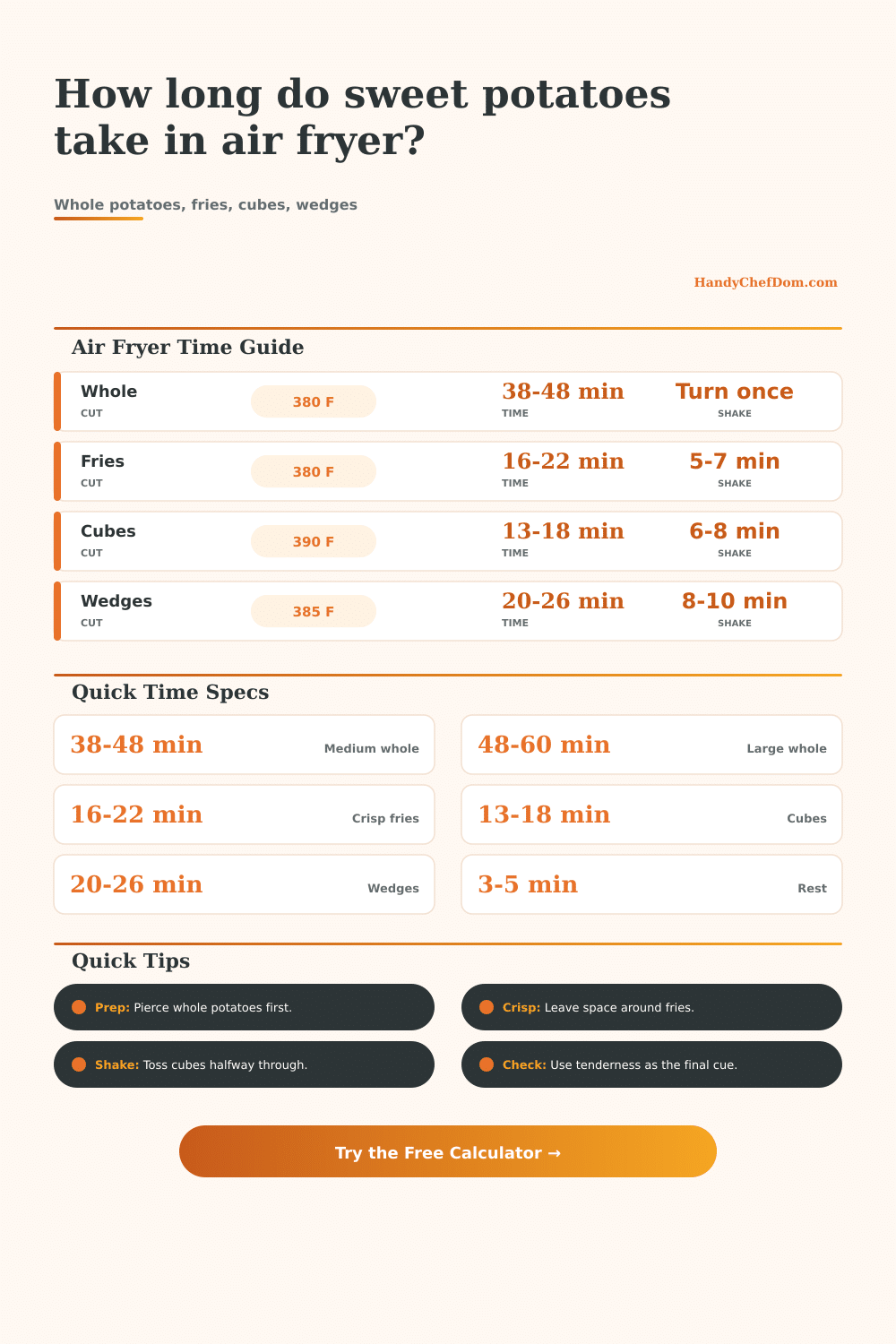
| Sweet Potato Style | Reference Size | Temperature | Starting Time |
|---|---|---|---|
| Whole medium sweet potato | 8-10 oz each | 380 F | 38-48 minutes |
| Whole large sweet potato | 12-14 oz each | 380 F | 48-60 minutes |
| Halved sweet potatoes | 1.5 in center | 375 F | 28-36 minutes |
| Crispy sweet potato fries | 0.35 in sticks | 380 F | 16-22 minutes |
| Weeknight cubes | 0.75 in cubes | 390 F | 13-18 minutes |
| Thick wedges | 0.85 in wedge | 385 F | 20-26 minutes |
| Sweet potato rounds | 0.45 in coins | 380 F | 14-19 minutes |
| Breakfast hash cubes | 0.5 in dice | 390 F | 12-16 minutes |
| Thickness Change | Fries | Cubes | Wedges |
|---|---|---|---|
| Very thin | 12-16 min at 0.25 in | Not ideal | Not ideal |
| Thin | 14-18 min at 0.30 in | 11-15 min at 0.50 in | 17-22 min at 0.65 in |
| Standard | 16-22 min at 0.35 in | 13-18 min at 0.75 in | 20-26 min at 0.85 in |
| Thick | 19-25 min at 0.50 in | 17-23 min at 1.00 in | 24-32 min at 1.10 in |
| Basket Condition | Timing Effect | Best For | Handling |
|---|---|---|---|
| Single layer with gaps | Subtract 1-2 min | Fries and wedges | Shake once or twice |
| Normal single layer | Use base time | Most batches | Shake at midpoint |
| Crowded but shakeable | Add 2-4 min | Family sides | Shake often |
| Packed meal prep load | Add 4-7 min | Cubes and hash | Cook in batches if crispness matters |
| Texture Goal | Whole Potatoes | Fries and Wedges | Cubes and Rounds |
|---|---|---|---|
| Tender | Soft center, light skin | Flexible edges | Fork-tender bite |
| Balanced | Creamy center, browned skin | Caramelized edges | Browned corners |
| Crisper edges | Prickly skin, soft center | Firm outside | Toasty surfaces |
| Extra crisp edges | Best for halves only | Dark browned ridges | Deep browned corners |
Timing is an estimate for common basket-style air fryers. Start checking at the first-check time and use the doneness cue in the result breakdown for the final decision.
It’s hard to mess up sweet potatoes, but it’s also simple to bore your dinner party with them.
Maybe you’ve pulled them out of an air fryer anticipating a crisp exterior, only to end up with limp, steamed vegetables that gives up their shape without much fight. For home cooks, there’s typically one factor at play, here, I’m talking about the relationship between airflow in your basket and physical density of whatever you’re frying. Get that wrong, and you’ll end up with either a soggy failure or a crispy success.
Why Sweet Potatoes Get Soft in Air Fryers
To account for this, the calculator (above) takes into consideration your specific cut, weight, and desired texture. It do all the math for you and avoids guesswork: do I need more time? Or am I burning it?
Basically, we think of the sweet potato as a thermal mass that requires some amount of time for its interior to come up to temperature, and also enough time for the exterior to dry out just enough to start browning. The style you choose determine how much of its surface area is exposed to heat source. That geometry affects the base time, which is why whole potatoes takes a long time to cook (very little exposed skin) and fries cook quickly (lots).
But it also factors in your cooking habits. Everyone jams too much into their basket. People want to cook faster by cooking more at once. That’s not how an air fryer works. It uses circulation rather than conduction, so if things is touching, there are steam pockets. They trap moisture, lower the local temp and your potato boils in its own juices.
The calculator gives you a lower score for a crowded basket, but air won’t flow if you don’t shake the basket. Breaking up those steam pocket every couple minutes exposes new surfaces to warmth. To go even crisper, maybe you’ll shake more frequently, but then be prepared for darkening on the edges before center softens.
It’s also a place where intuition often fails: the temperature choice. Naturaly, we believe that hotter = quicker, and that’s true for browning (which occurs at higher temperatures), but not so much for insides (as it can be if pushed too high). Crank up your air fryer to max and expect your thick wedge to go from pale yellow to black on the exterior by the time center reaches warm. That’s why the sweet spot (pun intended) tends to be around three hundred eighty degrees, enough to fully soften the starchy interiors without torching the sugary exteriors.
And speaking of sugar: Because sweet potatoes has a lot of it, they’ll burn more quickly different than something like a russet potato. Which is why the desired texture plays an important role. A tender outcome tells the software to focus on getting the inside soft, whereas a crisp goal pushes the timer forward to give the outer layer time to dry out.
And don’t forget the rest time. After all that cooking, it’s tempting to rush in and eat, but the leftover heat is still working its way deep into the dense center. A few more minutes just standing will give moisture a chance to redistribute so that every bite will be the same from the core to the skin.
It is small. But it is important.
Then when you do serve up your side dish you’ll know why this one was better than the last. You controlled the air flow, you respected how heat moves, and you gave the food time to do its job. And what you get? You get a sweet potato that’s perfectly soft on the inside and crisp on the outside.