🍰 Whipped Cream Sugar Calculator
Size sweetener for whipped cream by cream volume, sugar type, stabilizer, servings, dessert use, expansion, and topping thickness.
Enter your cream amount, desired sweetness, sweetener style, serving plan, and whipped volume target. The calculator estimates sugar equivalent, kitchen spoon measures, final whipped yield, and per-dollop portions.
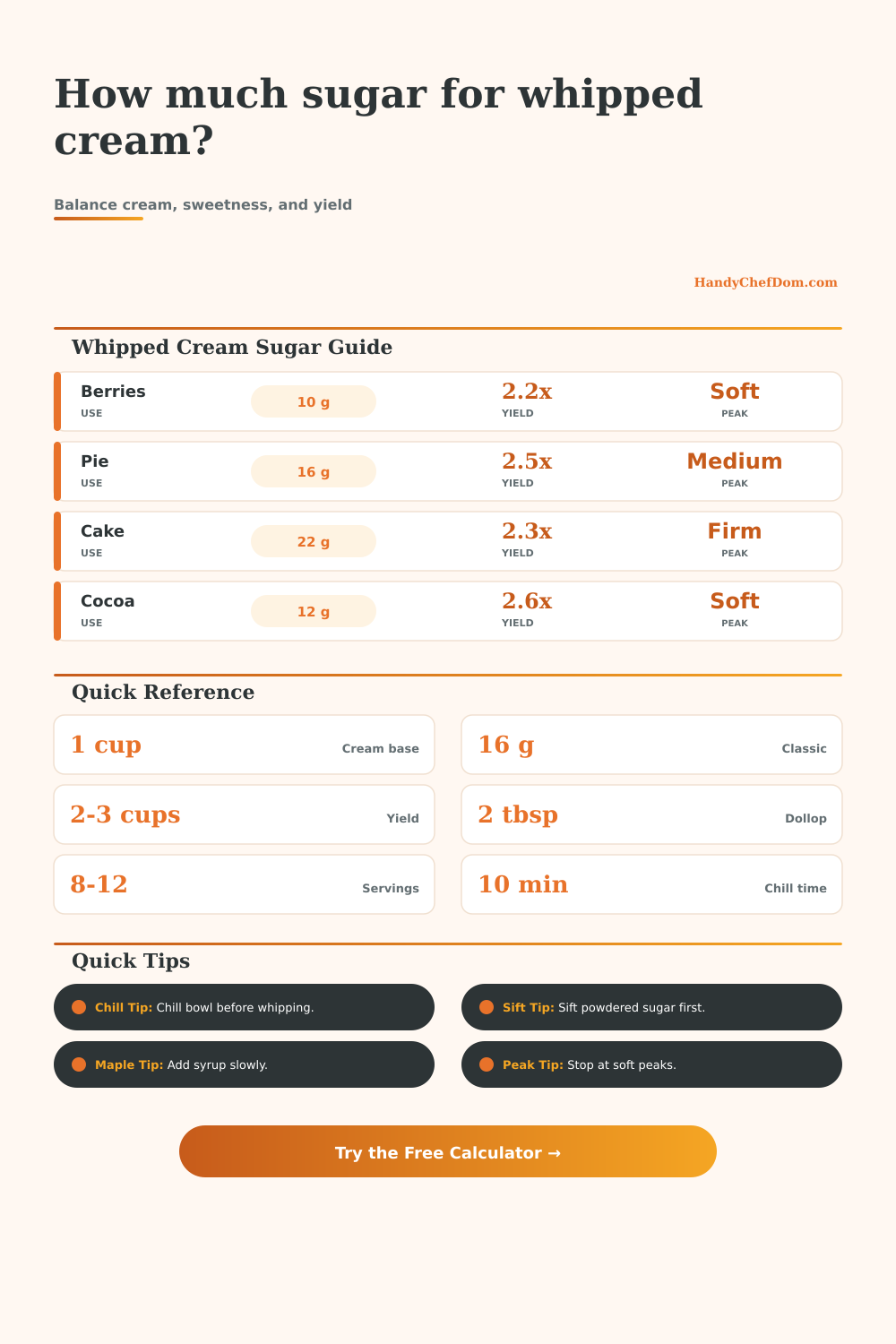
| Sweetness | Sugar Per Cup | Best Use | Flavor Result |
|---|---|---|---|
| Barely sweet | 8 g | Berries | Fresh dairy |
| Lightly sweet | 12 g | Cocoa | Gentle sweet |
| Classic dessert | 16 g | Pie topping | Balanced |
| Sweet topping | 24 g | Trifle | Noticeable |
| Cake filling | 28 g | Layer cake | Rich sweet |
| Extra sweet piping | 32 g | Cupcakes | Bakery style |
| Sugar Type | Sweetness Factor | Tablespoon | Texture Note |
|---|---|---|---|
| Powdered sugar | 0.92x | 7.5 g | Smooth body |
| Granulated sugar | 1.00x | 12.5 g | Needs dissolve |
| Maple syrup | 0.67x | 20 g | Looser whip |
| Powdered sugar | 1 cup | 120 g | Easy sifting |
| Granulated sugar | 1 cup | 200 g | Clean sweet |
| Maple syrup | 1 cup | 320 g | Maple flavor |
| Stabilizer | Amount Per Cup | Sugar Impact | Best For |
|---|---|---|---|
| None | 0 g | Neutral | Same day |
| Gelatin | 1 g | Neutral | Clean slices |
| Mascarpone | 30 g | Reduce slight | Layer cakes |
| Cream cheese | 28 g | Add slight | Tangy fill |
| Dry milk powder | 8 g | Neutral | Soft body |
| Pudding mix | 10 g | Reduce more | Firm piping |
| Dessert Style | Expansion | Dollop Size | Sweetness Cue |
|---|---|---|---|
| Pie topping | 2.5x | 3 tbsp | Classic |
| Hot cocoa | 2.6x | 2 tbsp | Light |
| Cake filling | 2.3x | 4 tbsp | Firmer |
| Berries | 2.4x | 2 tbsp | Low sugar |
| Cupcake swirls | 2.1x | 3 tbsp | Sweet |
| Dessert bar | 2.4x | 2.5 tbsp | Crowd batch |
The next time you whip up some cream, only to find that it’s become all floppy and buttery and sad, you might panic: What went wrong? Why did my whipped cream fail? This is something that plagues home bakers all the time, typically at the exact moment you’re adding the last layer before company arrive.
Typically, when the cream fails, the cause isn’t the temperature of bowl (or even whether you whipped it fast enough). It’s nearly always because you didn’t get the sugar-to-cream ratio correct. But why does the sugar matter so much, beyond taste? Because getting it wrong doesn’t just make your whipped cream unpleasant, it messes with the structure, making it impossible to maintain any kind of texture.
How to Fix Failed Whipped Cream
As an emulsifier, sugar help the fat hold onto air, and also keeps big ice crystals from forming, so if you don’t have enough, then…your cream will melt. Too much, and it’ll become heavy and overly sweet. To get it just right takes a little math, and this tool here is built to do all that work for you.
Each input affects the chemical makeup of your batch, so they’re not all as straightforward as they initialy appear. First, there’s the volume of heavy cream you’ll begin with. Is this a quarter-cup dollop for a single serving of something, or are you aiming for a whole pint (or more) to layer into a big trifle?
Next up: the sweetness factor, running the gamut from nearly-not-there to extra sweet piping. Why does that matter? Because if you’re filling a cake, you want plenty of sugar to counteract the heft of sponge; and if you’re dressing some just-picked fruit, you’d rather the natural acidity come shining through. Get it wrong here, and you’ve got yourself the quickest shortcut to a disastrous dessert.
Sugar selection makes quite a difference, too. For example, powdered sugar is used because it has cornstarch, which adds stability to the whipped structure and absorbs some moisture. Using granulated sugar will dissolve more slowly and may become slightly gritty if not beaten long enough. Adding maple syrup provides flavor, but also contributes additional liquid that might soften the whip and prevent reaching stiff peaks.
The calculator accounts for all this so you don’t have to guess at equivalent maple syrup amounts for every tablespoon of powdered sugar. It converts your taste preferences into exact measurements.
Similarly, your gut is rarely going to be accurate with respect to stabilizers. Plain whipped cream isn’t going to stand up on the counter for a couple of hours while you finish the rest of your cake. But add some sort of stabilizing ingredient… Whether it’s mascarpone, gelatin, or even just a packet of instant pudding mix, and suddenly everything changes. It gives the air bubbles something to hang onto.
That comes at the cost of changing the end result: different flavors and textures. Gelatin won’t change the taste, except perhaps by giving a bit of a chewiness when used too much. Mascarpone will lend a touch of tanginess and richness, so you may be able to get away with using a bit less sugar without affecting feeling of sweetness. The tool accounts for all this.
People unfamiliar with whipping cream sometimes confuse yield expansion, which is totally normal! When whipped, heavy cream increases in volume by about two or three times. Knowing how it’s going to expand can guide you in figuring out how much finished product you’ll end up with. If you’re making a pie and want 12 large dollops, you’re going to need to start with enough liquid cream to account for expansion.
Using the interface, there are reference tables that break down all those numbers so you know: how much cream equals how much dolloped cream? No more guessing on the portion control front.
And then lastly, consider the environment. Because yes, temperature matters when whipping up whipped cream. Even if you’ve got your sugar-to-cream ratio just right, a warm kitchen and bowl will cause the fat to liquefy before you can whip in all that air. Keep your tools cold. Work fast. And stop short of perfection; it’ll firm up a bit more while resting.
Use the calculator to get the numbers right; use your fingers to know what the texture should be. Believe the math on the measurements; believe your eyes on the peaks. Within this setup, experiment a bit… You’ll soon have a sense of how various creams and sugars react in your own kitchen.
To top it off, structure is physics and sweetness is subjective. Nail the structural elements, and you can go wild with flavor without fearing that your creation will implode. It’s the same approach whether you’re adding a dollop of it to a pancake in the morning or slathering it on a layer cake for a birthday. It is just sweet enough to play up the other ingredients, yet light and stable. A little calculation would of worth that balance.