🥩 Meat Sit-Out Time Calculator
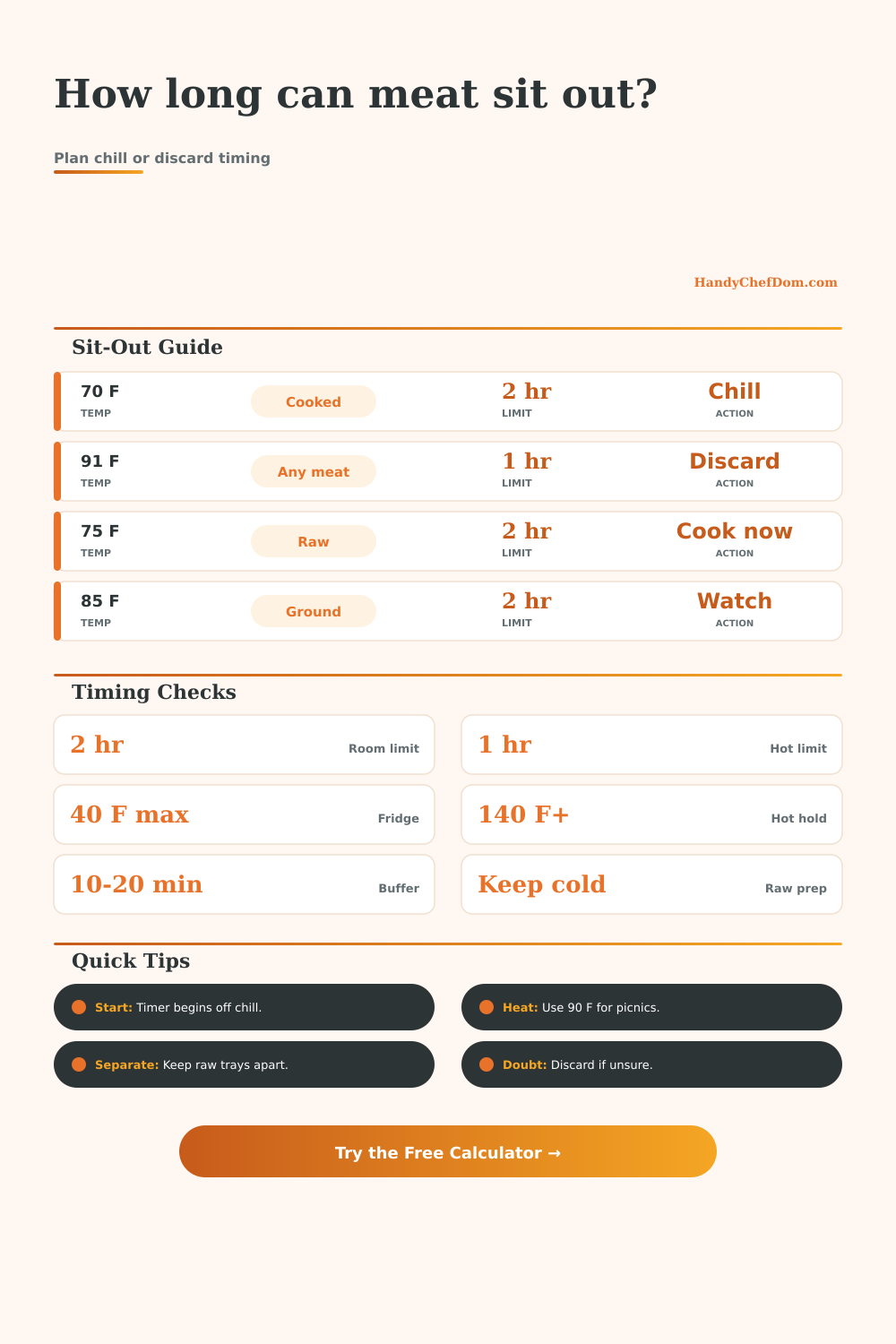
Plan when raw or cooked meat needs to be chilled, served, or discarded using standard kitchen timing limits and a practical discard buffer.
Use the moment meat leaves refrigeration, hot holding, or active cooking as the start time. This planner does not extend the standard limit; buffers only create an earlier action target.
| Condition | Air Temp | Window | Planning Action |
|---|---|---|---|
| Indoor counter | Below 90 F | 2 hours | Chill, cook, or discard by the hard limit. |
| Outdoor table | Below 90 F | 2 hours | Use a buffer for sun, handling, and travel. |
| Hot weather | Over 90 F | 1 hour | Use the shorter hot-weather limit. |
| Warm vehicle | Often hot | 1 hour | Treat as hot weather unless verified cooler. |
| Cold cooler | 40 F or less | Chilled | Keep below 40 F and restart timing at service. |
| Hot holding | 140 F or more | Held hot | Keep at hot-hold temperature until serving. |
| Meat Setup | Typical State | Buffer Style | Reason |
|---|---|---|---|
| Raw steak prep | Raw whole cut | Moderate | Cook promptly after counter prep. |
| Ground beef delay | Raw ground | High | More surface area and handling risk. |
| Cooked burger tray | Ready to eat | Moderate | Guests may open the tray repeatedly. |
| BBQ pulled pork | Cooked tray | High | Buffet service often lasts longer. |
| Ham slices | Cooked slices | Moderate | Thin portions warm quickly. |
| Chicken portions | Cooked or raw | High | Use conservative timing for poultry. |
| Turkey platter | Cooked slices | Moderate | Chill leftovers before the target time. |
| Deli roast beef | Ready to eat | High | Ready-to-eat slices should stay cold. |
| Serving Plan | Best Fit | Use Buffer | Timing Note |
|---|---|---|---|
| Family dinner | Small platter | 10 min | Move leftovers after serving. |
| Holiday carving | Sliced meat | 15 min | Chill extra meat in shallow pans. |
| BBQ buffet | Covered tray | 20 min | Set a phone alarm before the limit. |
| Picnic table | Small portions | 20 min | Use hot-weather timing when over 90 F. |
| Meal prep | Cooked batches | 15 min | Divide large amounts for quick chilling. |
| Raw prep | Counter work | 10 min | Return unused meat to chill quickly. |
| Result Status | Meaning | Action | Planner Use |
|---|---|---|---|
| Good margin | Time remains | Serve or cook | Finish within the planned window. |
| Buffer zone | Near target | Chill now | Do not start a long service window. |
| At hard limit | No margin | Discard | Do not rely on reheating to fix timing. |
| Unknown time | Unclear start | Be cautious | Use the earliest plausible start time. |
| Cold held | At 40 F max | Keep cold | Timer begins when cold control ends. |
| Hot held | At 140 F+ | Keep hot | Timer begins when hot control ends. |
Meat Sit-Out Time Calculator is a solution for anyone who’s worried about food safety at events. No more slicing up some turkey only to wonder “is this still OK?” once you realize it has been sitting out since appetizers arrived. Enter the start time, the room temperature, and whether it’s in a covered tray. Let the meat sit-out time calculator do its thing. It’ll tell you exactly when to throw it out, chill it down, or eat it up.
The calculator doesn’t alter the rules. It just makes following them easier by removing guesswork so you don’t feel like you’re always watching the clock.
Why You Should Use a Meat Sit-Out Time Calculator
It’s a simple concept: monitor the danger zone. Between forty and one-hundred forty degrees Fahrenheit, bacteria multiplies rapidly. For example, two hours are the traditional guideline for keeping cooked meats safe at regular room temperature. If it’s hotter then ninety degrees, that window shrinks to one hour. The calculator does the math for you. No more constantly tweaking in your head for each variable.
Forget about whether the meat smells okay or appears right. Most pathogens won’t alter the taste or texture of your food. Instead they quietly reproduce until their numbers becomes too great. A time buffer will shield you from what you can’t see.
Take the input as actual constraints in the world. The covered tray may slow down cooling and reduce handling, but doesn’t halt passage of time. People often think that a lid adds extra serving time. Nope. It merely keeps the environment steady. This adjustment change the risk assessment, while keeping the safety limit strict for the tool.
Grinding meat also disperses any bacteria present into entire mass, so raw ground beef has a higher risk than a whole steak. The calculator plays it safe for ground items. Maybe you’d like to leave your food out another 20 minutes. The tool tells you why that’s not safe. It replaces wishful thinking with the cold reality of bacteria growing.
As you’ll notice from the reference table, the safe time changes based off scenario. For example, warmer temperatures shorten the safe window. Bacteria multiply more quickly in warm environments. So 90 degrees marks the cut-off for safety. In warm weather, that means an hour instead of two. That’s where many people go wrong: They assume their patio (or other outdoor space) feels as cool and breezy as the kitchen. With the calculator, you’re forced to think about context. Does it feel hot outside? If so, time pass even faster. It sounds minor, but this little adjustment makes all the difference. Fifteen minutes is the difference between a safe meal and a risky one.
The size is not all that matters. The way the food is cut makes a difference too. A thin slice will get warm sooner then a thick roast of ham. The surface area affects how fast meat gets to room temperature. The tool allows you to define the shape of your portions. That can help it figure out how much heat gets transferred.
So now you’re dealing with both time and temperature. And if you’ve got a holiday meal on your hands, the calculator will help tell you when to put the leftovers in the fridge. So you don’t mistakenly let the food hang around while you do dishes.
You might think you have an hour. But the tool may be telling you you only have fifteen minutes before you’re done with the food’s safe limit. It eliminates guesswork from the equation. You won’t have to wonder about whether something is OK. You won’t have any more questions about when to discard leftovers.
It’s an easy step-by-step plan that will give you confidence in keeping your food safe. The rules apply equally to burgers as they do to a raw piece of steak. Cooked food needs to be hot, uncooked food must remain cold, and leftover food needs to go into the refrigerator… fast.
When exactly should you take action? The calculator tells you exactly when to act. There’s no doubt anymore. There’s just doing what’s needed to get everything ready for serving, serving the food, eating the food, and then throwing away the rest at the correct time.
You should of used it sooner. Before anybody even sees the turkey, it’s back in the fridge. It was naturaly a good idea. The moddern way is better than old ways. It felt comfortabley for everyone. We didnt want any luxurius meals to go bad too.