🍔 Burgers per Cow Calculator
Estimate burger patties from a cow using live, hanging, or boneless beef weight, then tune ground share, patty size, shrink, blend, servings, and freezer packs.
Choose the starting weight you actually have. Live weight uses dressing and boneless yield. Hanging weight skips dressing. Boneless beef skips both and goes straight to the grind share.
| Starting point | Calculator path | Best for | Watch item |
|---|---|---|---|
| Live animal weight | Live to hanging to boneless | Buying a whole animal | Dressing percentage |
| Hanging carcass weight | Hanging to boneless | Butcher order review | Bone-out yield |
| Boneless take-home beef | Boneless to burger grind | Freezer inventory | Ground beef share |
| Ground beef weight | Ground to patties | Party patty counts | Patty size |
| Trim and fat blend | Extra blend into grind | Custom burger texture | Final lean ratio |
| Freezer packs | Ground into pack count | Storage planning | Pack rounding |
| Yield factor | Common low | Common middle | Common high |
|---|---|---|---|
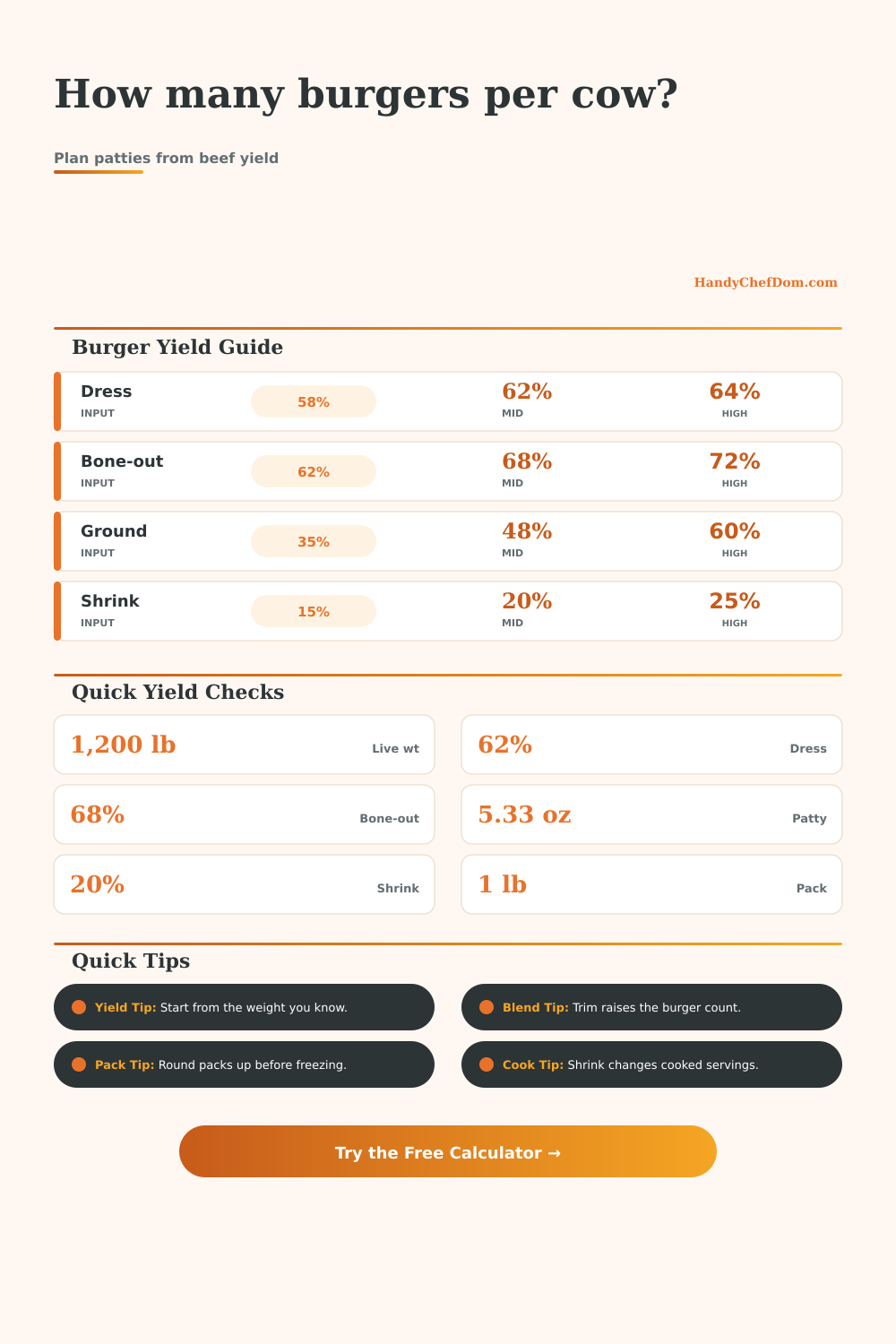
| Live to hanging dressing | 58% | 62% | 64% |
| Hanging to boneless beef | 62% | 68% | 72% |
| Boneless beef to ground | 35% | 48% | 60% |
| Trim or fat addition | 0% | 8% | 15% |
| Loose ground reserve | 0% | 10% | 25% |
| Cook shrink on patties | 15% | 20% | 25% |
| Raw patty style | Imperial size | Metric size | Use case |
|---|---|---|---|
| Slider | 2 oz | 57 g | Appetizer trays |
| Thin diner patty | 3 oz | 85 g | Double burgers |
| Quarter-pounder | 4 oz | 113 g | Standard cookout |
| Third-pounder | 5.33 oz | 151 g | Hearty grill plan |
| Pub burger | 6 oz | 170 g | Large plate burger |
| Steakhouse patty | 8 oz | 227 g | Big single burger |
| Freezer plan | Pack size | Patties per pack | Planning note |
|---|---|---|---|
| Small household | 1 lb | 3 to 4 | Fast weeknight thaw |
| Family grill pack | 1.5 lb | 4 to 6 | Good for one meal |
| Cookout stack | 2 lb | 6 to 8 | Works for gatherings |
| Slider tray | 2 lb | 12 to 16 | Many small patties |
| Bulk grind brick | 5 lb | 15 to 20 | Flexible later use |
| Metric family bag | 1 kg | 5 to 8 | Simple freezer count |
It’s easy to see buying a quarter of a cow as some sort of party trick, suddenly you have all this meat to last your neighborhood a month. It fills your freezer quickly, but where the real benefit come in is thinking about burgers. Burgers is a useful equalizer because they transform odd-shaped pieces, trim, and even tough cuts into predictable meals. But it can be hard to estimate how many patties you get from a boneless box or based off the weight of a whole hanging carcass. And if people aren’t getting the number of dinners they expected they’ll either end up with a freezer full of raw ground beef, or not quite enough to make it through, which means tacos.
Luckily, there’s an app for that, or rather a calculator that does the math for you. You don’t have to do the conversion from live weight to hanging weight to boneless yield in your brain. What it does require is for you to understand what it mean at each stage.
How to Count Your Burgers
A cow isn’t all burger meat; it’s a combination of muscle, fat, bone, and internal organs. If you purchase a whole animal, the dressing percentage is the portion of the live weight remaining after the hide, blood, and internal organs are removed. Typically this is around sixty-two percent. From there, you get the boneless beef that ends up in your freezer once trim and bones is removed.
That’s when most people lose their minds and screw up all their planning: now it’s time to figure out what percentage of that boneless beef will be ground beef. You can’t grind all the beef if you’re getting roasts and steaks, right? Realistically speaking, let’s say roughly forty-eight percent of your take-home beef turn into ground beef. Everything else gets chopped up into roasts, stew meat, or maybe some chops. But the calculator takes care of those percentages for you; it’s just nice to know why they exist.
If you’d prefer double the number of burgers, well, that means less steak. That’s the tradeoff. Want to play with the grinder setting? Go ahead: tweak the percentage of the beef that goes to grinding, and see how many roasts you lose for every hundred extra patties.
This section covers beef weight. Weight also comes into play with patty size. Four ounces, or a quarter pound, is common for a run-of-the-mill cookout burger. For a heartier grill plan, you may go up to five and a third ounces for a third-pounder. So that little bit of variance in size make a big difference in the overall number of patties you’ll end up making. And if you’re serving a crowd, you may want to drop down to some sliders. So the chart on the page breaks it down nicely: Going to two-ounce sliders doubles your servings from the same amount of meat.
It’s a simple volume game, but it will change the cooking/ thawing logistics. Don’t forget to account for the fact that your beef will shrink as it cooks. Water evaporates, fat renders out, and all in all, your beef will lose some weight. For example, a raw four-ounce patty will become a three-ounce cooked patty, with a standard twenty percent shrink. At a large event, this can add up. What do you think: Can you make enough burgers for 30 people? Turns out, maybe only 25 once they’re cooked. This tool lets you set your shrink percentage. This ensures you get the right number of cooked servings for the amount of people you are serving.
The last element to this puzzle is freezer organization. Nobody wants a three-day-thawing block of ground beef. Life’s better when your beef is broken down into one pound package. Three or four standard patties fit nicely into each package, just right for a family meal. If you’re like me, the calculator will translate your total amount of ground beef into the number of freezer packs. This might sound like a little bit, but it’s something when you stand there in front of your open freezer and need to figure out what to make for Tuesday night dinner.
Begin with the weight you possess. Use the boneless or hanging weight if you’re beginning with a bill from your butcher. Use the live weight if you’re guessing based on a visit to the farm. From there, the calculator fills in the blanks (the blanks between animal and plate). It makes those percentages tangible to meals.
And suddenly, instead of wondering how many burgers you’ll have from your cow, you’ll know exactly how many… And that’s what brings the party trick back to reality. Knowing exactly what’s in your freezer is valuable. It also puts the whole process back into real life, where each ounce matters.