🥚 Egg Whites Per Cup Calculator
Convert egg whites to cups, tablespoons, grams, and carton servings for baking, meringue, omelets, and recipe scaling.
Choose what your recipe gives you, then convert to separated egg whites, cups, tablespoons, grams, and carton liquid egg white equivalents.
| Egg Size | White Weight | Tablespoons | Whites Per Cup |
|---|---|---|---|
| Peewee | 23 g | 1.55 tbsp | 10.4 whites |
| Small | 28 g | 1.90 tbsp | 8.6 whites |
| Medium | 30 g | 2.00 tbsp | 8.0 whites |
| Large | 30 g | 2.00 tbsp | 8.0 whites |
| Extra-large | 33 g | 2.20 tbsp | 7.3 whites |
| Jumbo | 37 g | 2.45 tbsp | 6.5 whites |
| Recipe Use | Typical Amount | Best Unit | Buffer |
|---|---|---|---|
| Omelet or scramble | 1/2 cup | Cups | 0-5% |
| Meringue pie | 4 large whites | Whites | 5-10% |
| Macarons | 100 g | Grams | 0-3% |
| Angel food cake | 12 large whites | Whites | 5% |
| Royal icing | 3 large whites | Grams | 3-5% |
| Meal prep carton | 1 cup | Tablespoons | 0-5% |
| Common Measure | Large Whites | Tablespoons | Grams |
|---|---|---|---|
| 1/8 cup | 1 white | 2 tbsp | 30 g |
| 1/4 cup | 2 whites | 4 tbsp | 60 g |
| 1/3 cup | 2.7 whites | 5.3 tbsp | 80 g |
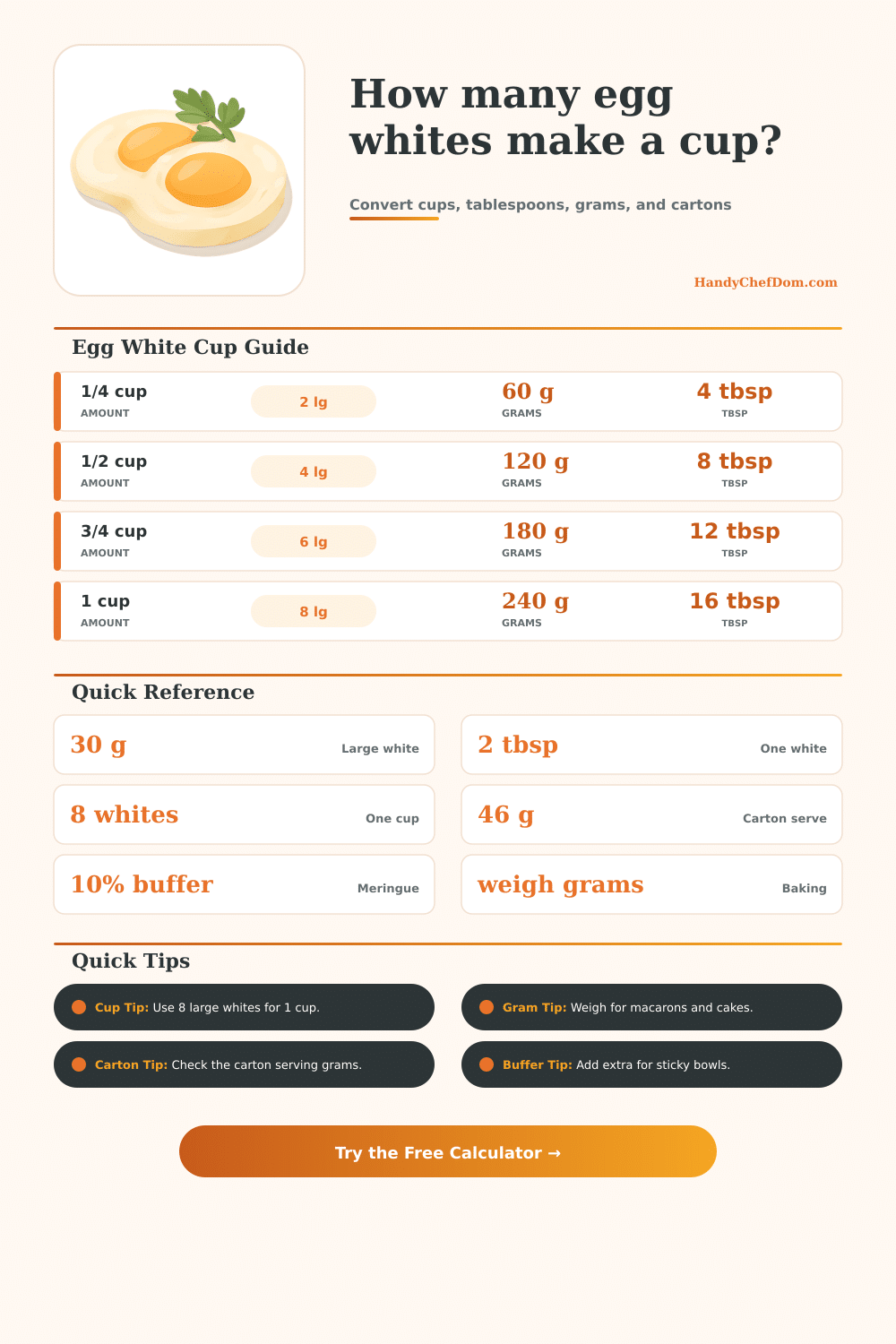
| 1/2 cup | 4 whites | 8 tbsp | 120 g |
| 3/4 cup | 6 whites | 12 tbsp | 180 g |
| 1 cup | 8 whites | 16 tbsp | 240 g |
| Carton Label | Serving | Large White Equal | Cups Per Carton |
|---|---|---|---|
| 16 oz carton | 46 g / 3 tbsp | 1.5 whites | About 2 cups |
| 24 oz carton | 46 g / 3 tbsp | 1.5 whites | About 3 cups |
| 32 oz carton | 46 g / 3 tbsp | 1.5 whites | About 4 cups |
| 46 oz carton | 46 g / 3 tbsp | 1.5 whites | About 5.8 cups |
| 64 oz carton | 46 g / 3 tbsp | 1.5 whites | About 8 cups |
| Recipe pour | 15 g / tbsp | 2 tbsp | 16 tbsp per cup |
You see the phrase “whites of 4 large eggs (or 1 cup)” all over recipes and have no idea what “large” even means, much less how any other size might differ from that. For something like scrambling an egg: just get whatever seems appropriate and go for it. But you might be trying to stabilize some sort of meringue. Nope… It’s going to be more like collapse city unless you gets the proteins right. And since proper measuring is everything with precise desserts, this calculator can help.
It takes imprecise recipe language and turns it into actual numbers based off the specific volumes/weights of your actual eggs. First: Eggs aren’t all the same (even though we pretend they are). A large egg white weigh about thirty grams, a medium white may be twenty-eight, and a jumbo might reach as high as thirty-seven. If you’re making a big batch of macarons, for example, and using twelve whites, that little difference multiplied by twelve sound a lot less tiny, so the calculator takes these differences into account.
Why Egg Size Matters for Baking Success
Rather than assuming every white in your fridge weigh exactly the same, you can choose the true size of your eggs and avoid the slightest bit of overmixing or under-aeration that can ruin delicate bakes. Enter the recipe quantity and tool converts cups into specific numbers of whites. With thick liquids such as egg whites, volume measures can be notoriously unreliable. You hold up a cup measure to eye level and think that’s a full cup, but then you pack it down and there’s a bubble on top of it: now you have quite a different amount of mass.
So that’s why pros weigh their ingredients; this tool bridges the gap between the familiar tablespoon and cup measures and the grams they use instead. Because you see weight, not just the volume, you understand how much structure you’re putting into your bowl, and you can stop thinking about filling containers and start thinking about reaching the right strength for your batter.
Another complexity is carton eggs, which are pasteurized and pre-separated, and have different serving sizes depending on the brand. This means the calculator has an input for grams in each serving from cartons of egg whites. So if you see forty-six gram servings listed on your carton, it will tell you exactly how much to pour out, no guessing at vaguely marked cups required. It makes sure you have exact amount of liquid the recipe calls for without any confusion.
Another part most folks miss is the buffer setting, which make life easier over time. Because egg whites cling to spatulas and bowls, when you scrape them out to one cup, chances are good you’ll fall just shy of that mark. Adding some sort of buffer… Typically between five and ten percent, to an ingredient means you get what you want into your bowl. It is a little change but it avoids the heart-stopping moment of finding yourself a white or two short while beating egg whites for meringue.
The page has some reference tables laying it all out in such a way that you can check the reason why the answer comes out the way it does. See how many tablespoons line up with weight and how eggs of different sizes affects the amount needed per cup. This lets you trust the results without having to do math in your head while holding a whisk. It’s meant to help you feel confident that you have the right ratio before you begin whipping away at some air into protein.
At its heart, baking is a precise and controlled effort. You reclaim control over your baking by measuring in the correct units or by factoring in real-world details like loss from bowls and different egg size. Measuring with intent means better results every time because you’re not just relying on luck; you know why you need the number you have to work with.
You can use that sense of clarity to make decisions about your ingredients, whether to scale things up or down with confidence, to understand how you can adjust other elements of a recipe to achieve your desired outcome. It would of helped more if it was even simpler.