🍗 Protein Servings Calculator
Turn a daily protein target into practical servings by food type, cooked or raw weight, serving size, meal count, yield, and appetite level.
Enter the protein goal and portion style. The calculator uses protein density per 100 g, cooked/raw yield, meal count, serving size, and appetite adjustment to estimate how many servings to prep.
| Food Type | Common Serving | Protein Per Serving | Best Planning Use |
|---|---|---|---|
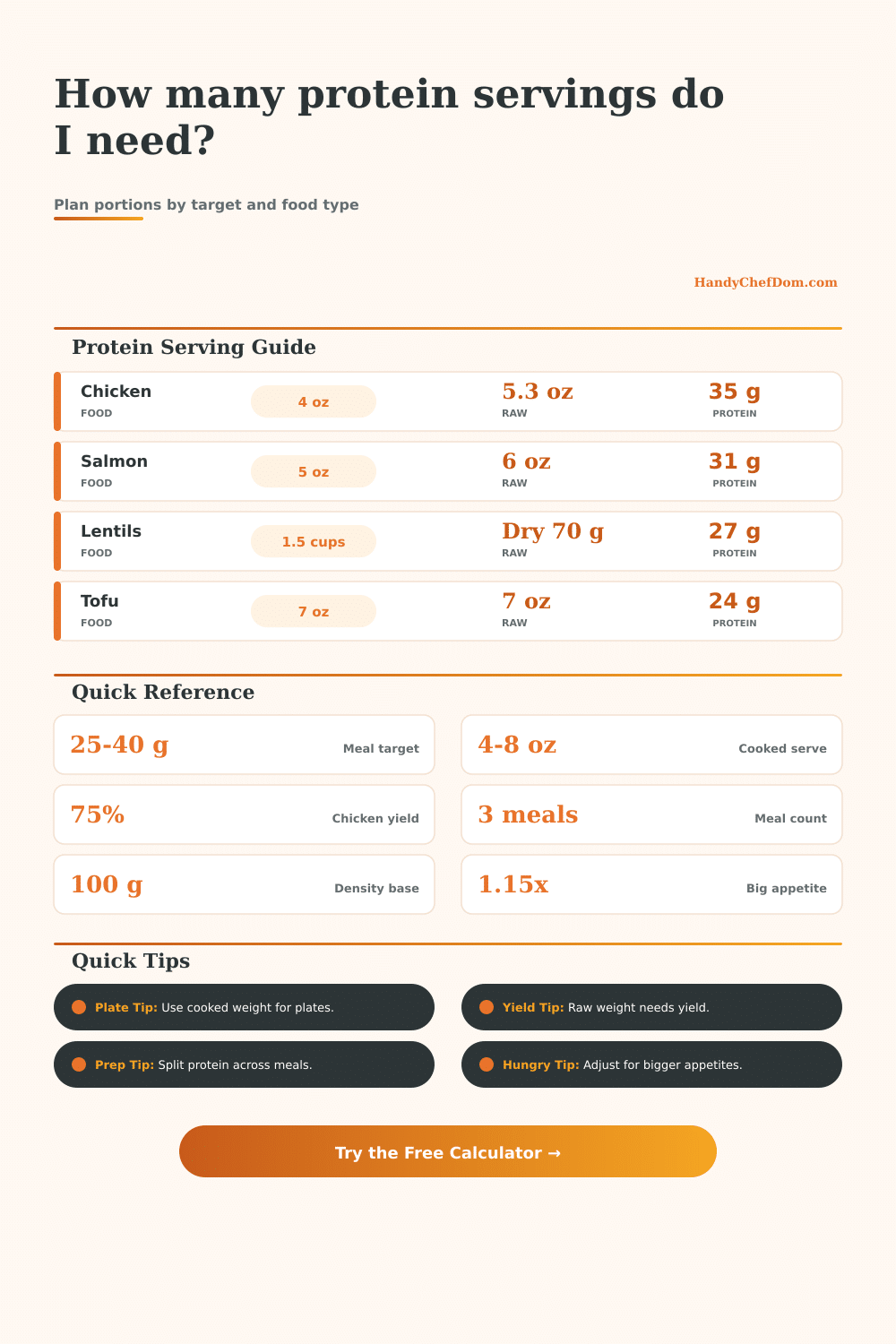
| Chicken breast | 4 oz cooked | 35 g | Meal prep bowls |
| Salmon fillet | 5 oz cooked | 31 g | Dinner portions |
| Lean steak | 5 oz cooked | 37 g | Single main plate |
| Greek yogurt | 1 cup | 23 g | Snack bowl |
| Firm tofu | 7 oz cooked | 24 g | Family stir bowl |
| Large eggs | 3 eggs | 19 g | Breakfast prep |
| Food Type | Protein Density | Cook Yield | Raw For 100 g Cooked |
|---|---|---|---|
| Chicken breast | 31 g per 100 g | 75% | 133 g raw |
| Salmon fillet | 22 g per 100 g | 83% | 120 g raw |
| Lean steak | 26 g per 100 g | 72% | 139 g raw |
| Turkey mince | 29 g per 100 g | 76% | 132 g raw |
| Firm tofu | 12 g per 100 g | 95% | 105 g raw |
| Cooked lentils | 9 g per 100 g | 240% | 42 g dry |
| Plan Size | Chicken Cooked | Salmon Cooked | Lentils Cooked |
|---|---|---|---|
| 25 g protein | 2.8 oz | 4.0 oz | 9.8 oz |
| 30 g protein | 3.4 oz | 4.8 oz | 11.8 oz |
| 40 g protein | 4.6 oz | 6.4 oz | 15.7 oz |
| 4 meals at 30 g | 13.7 oz | 19.2 oz | 47.1 oz |
| 7 meals at 35 g | 27.9 oz | 39.3 oz | 96.0 oz |
| Family 4 at 30 g | 13.7 oz | 19.2 oz | 47.1 oz |
| Appetite Level | Multiplier | Use Case | Example 30 g Target |
|---|---|---|---|
| Light appetite | 0.90x | Smaller plate | 27 g protein |
| Standard appetite | 1.00x | Normal meal | 30 g protein |
| Hungry appetite | 1.15x | Long day | 35 g protein |
| Athlete appetite | 1.30x | Heavy training | 39 g protein |
| Meal prep buffer | 1.05x | Extra portion | 32 g protein |
| Snack split | 0.50x | Half serving | 15 g protein |
When you’re beginning your meal prep, do you grab four ounces of chicken first? That’s what nutrition labels lead you to believe: this is the typical serving size. It makes sense; after all, nutrition labels often use that number as a baseline. But the problem is that four ounces on a nutrition label usually refers to cooked weight, which means if you weigh it raw, you’ll end up with less food than you planned for once it’s cooked.
And if you’re aiming for a certain amount of protein per day (for fat loss or muscle maintenance), the math isn’t in your favor. So that’s where the calculator above come in. Enter in your preferences and let it do the math for you. No more guesstimating whether something will expand or shrink as it cooks.
How to Use the Protein Calculator
The key here is knowing your food’s state along every step of the process. Is your shopping list in terms of raw weight? Or is your final plate in terms of cooked weight? Those two thing don’t equate. For example, cooked chicken weigh about 25 percent less than raw chicken. So one pound of raw chicken breast equals roughly five ounces of cooked chicken. Without taking that yield factor into account, you’re probably actualy under-eating protein (and that’s no fun).
This is where food density matter. Different type of proteins have different amounts of amino acids per ounce. For example, chicken breast is dense: you get a lot of protein from a very small volume. But then there’s something like lentils. These soak up water and swell in size. While a cup of cooked lentils might weigh as much as a cup of chicken, it contain less protein.
To account for this, the tool takes into account how densely packed with proteins each food is (per hundred grams). This doesn’t require that you remember these numbers; you simply need to pick the correct type of food so the tool understands what sort of profile to expect, is this going to be a dense meaty profile? Or a water-soaked, plant-based profile?
Another mistake I see often is splitting up the same target throughout the day over multiple meals. For example, some people will attempt to get all of their day’s protein into only two big meal. Sure, that might fill them up for now but it’ll leave them wanting more later and can cause problems with digestion. You can specify how many meal slots there are on the calculator. If you typically have three main meals plus two snacks during the day, enter five slots. This will spread out the workload equally. It will also make it easier to maintain portion control. Preparing and eating less food at once is simpler than making one huge plate.
If you’re an athlete who just has a healthy appetite, then you may want to increase the multiplier by a hair (to one-point-fifteen or beyond). This small adjustment adds enough food to satisfy you without requiring you to recalculate your baseline numbers.
A week’s plan differs from a night’s plan. A week requires some wiggle room to account for things like spillage or extra hunger. It is better to have a little leftover chicken than to fall short of your protein goals on a busy Tuesday. That’s what the overage setting is for; it will automatically add an additional five to ten percent as an overage amount. For example, you might have a taste test, accidentally spill something, or be particularly hungry that day. Better to end up with more than needed then not enough protein on a hectic Tuesday night.
The page explains all this nicely with their reference table. This explains the yield of cooked food versus the raw weight of various foods.
To conclude. Protein planning isn’t about being a robot who weighs each bite to the milligram. It’s about having a system that works in a messy world. Food has weight. It expands. It shrinks. And it’s never quite what you expect. If you understand how much protein is in one gram of food, both when raw and after cooking, then you’ve taken the guesswork out of nutrition. No more wondering if you got enough protein; now you know exactly what fuel you fed your body. That sense of clarity makes this a simple routine instead of a chore. And as anyone knows, routines becomes invisible over time. Until you need them most.