🍖 Roast Gammon Cooking Time Calculator
Estimate roast gammon timing from joint weight, smoked or unsmoked cure, boil-then-roast or roast-only method, glaze window, oven temperature, target internal temperature, rest, and servings.
Use the raw gammon joint weight from the label. The calculator separates simmer time, roast time, glaze minutes, rest time, and serving yield so a boil-then-roast joint and a roast-only joint can be planned differently.
A tidy rolled joint cooks predictably and gives good carved slices for dinner plates.
Bone-in legs need more time and produce less carved meat from the same raw weight.
A horseshoe shape suits boil-then-roast plans and medium glaze windows.
The calculator keeps simmer minutes separate from the roast and glaze finish.
Roast-only plans rely on oven time, with a final uncovered glaze window.
Smoked and dense joints get a small timing cushion and a wider check window.
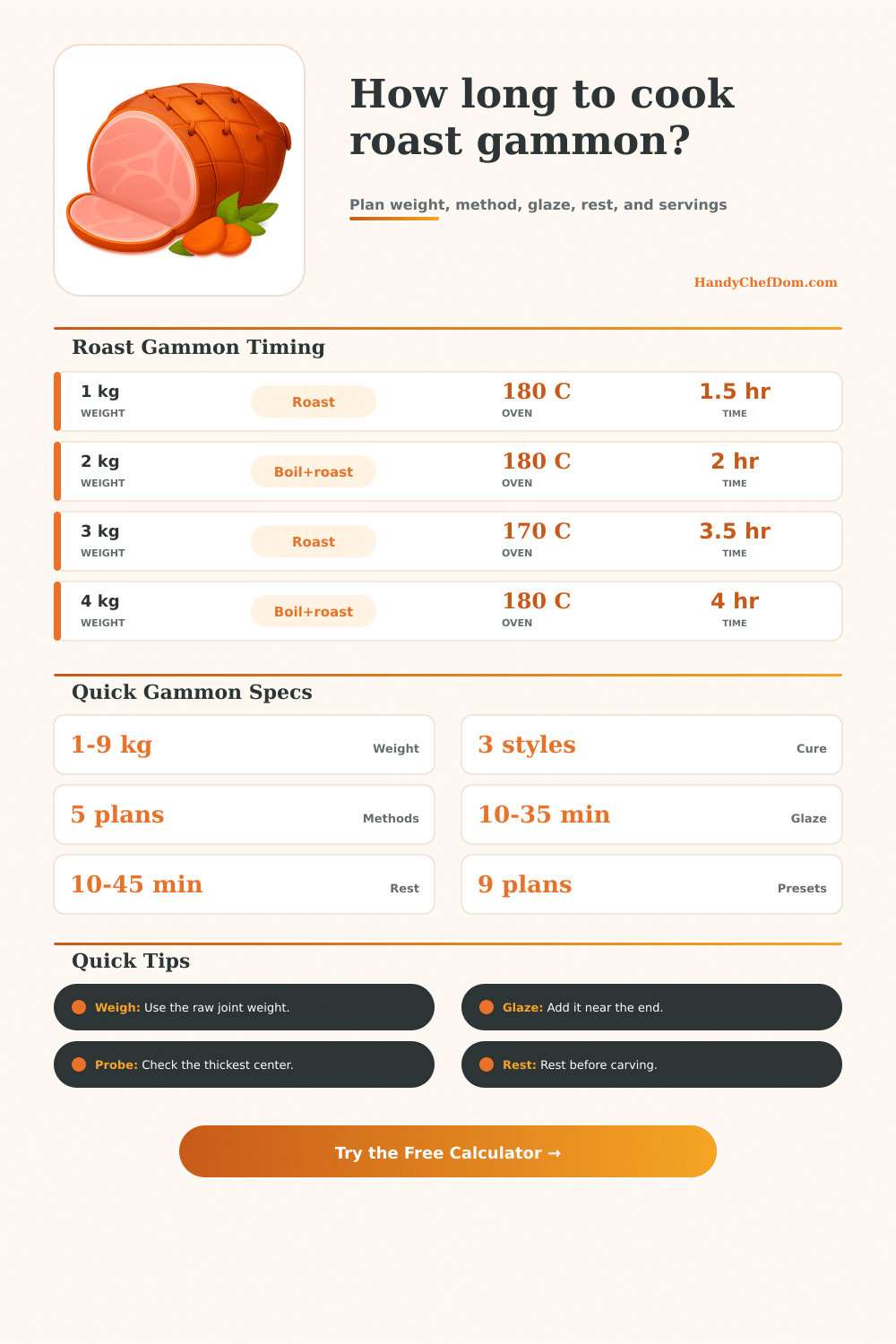
| Raw gammon weight | Boil-then-roast plan | Roast-only plan | Typical glaze window | Serving note |
|---|---|---|---|---|
| 1 to 1.5 kg / 2.2 to 3.3 lb | 45 to 75 min simmer plus 15 to 25 min roast | 75 to 115 min oven time | 10 to 20 minutes | Small dinner joint |
| 2 to 2.5 kg / 4.4 to 5.5 lb | 1 hr 20 min to 2 hr simmer plus 20 to 30 min roast | 2 hr to 2 hr 45 min oven time | 20 to 30 minutes | Family roast dinner |
| 3 to 3.5 kg / 6.6 to 7.7 lb | 2 hr 20 min to 3 hr simmer plus 25 to 35 min roast | 3 hr to 4 hr oven time | 25 to 35 minutes | Holiday table joint |
| 4 to 5 kg / 8.8 to 11 lb | 3 hr 15 min to 4 hr 20 min simmer plus 30 to 40 min roast | 4 hr 15 min to 5 hr 45 min oven time | 30 to 40 minutes | Large buffet carving |
| 6 kg plus / 13.2 lb plus | Use wide simmer window and check early | Use a lower oven and wider window | 30 to 45 minutes | Often easier as two joints |
| Method setting | Base timing rule | Oven stage | Glaze handling | Best calculator use |
|---|---|---|---|---|
| Boil then roast and glaze | About 20 min per lb plus 20 min simmer | Short roast finish | Glaze during final entered window | Classic glazed gammon joints |
| Boil then longer glaze finish | Same simmer rule with a longer roast finish | Moderate uncovered finish | Layered or thicker glaze | Showpiece glazed ham-style joints |
| Roast only, covered start | About 30 min per lb plus 30 min oven time | Covered first, uncovered late | Glaze near the end | Simple oven-only roasting |
| Roast only, open roasting | Slightly faster browning but wider window | Uncovered oven stage | Watch the glaze window closely | Small to medium boneless joints |
| Lower oven roast-only plan | Longer gentle oven timing | Lower temperature factor | Glaze later at the end | Large or thick center joints |
| Joint or cut | Timing adjustment | Cooked yield estimate | Slice character | Useful method match |
|---|---|---|---|---|
| Boneless rolled gammon | Baseline timing | 72 to 76 percent | Neat round slices | Boil-then-roast or roast only |
| Bone-in gammon leg | Add 10 to 16 percent | 58 to 66 percent | Carved around bone | Boil-then-roast for large joints |
| Horseshoe gammon joint | Near baseline | 68 to 73 percent | Mixed slice sizes | Boil-then-roast with glaze |
| Thick center-cut joint | Add 8 to 14 percent | 70 to 74 percent | Thicker center slices | Lower oven or wider check window |
| Two smaller joints | Shorter main cook | 72 to 76 percent | More end slices | Large party planning |
| Planning item | Common range | Calculator effect | When to adjust | Result to watch |
|---|---|---|---|---|
| Glaze window | 10 to 35 minutes | Adds final active oven time | Thicker glaze needs more time | Glaze timing card |
| Oven temperature | 160 to 200 C / 325 to 400 F | Changes roast-only pace | Lower oven for dense large joints | Cook time window |
| Target internal temperature | 63 to 74 C / 145 to 165 F | Changes pull point and timing | Higher target for firmer slices | Pull temperature card |
| Rest time | 10 to 45 minutes | Adds to total serving timeline | Use longer rests for larger joints | Total timeline row |
| Serving style | Light to leftover planning | Changes portion coverage | Buffet slices need less per person | Serving coverage card |
Timing estimates are planning windows for roast gammon. Oven behavior, joint shape, curing style, glaze thickness, pan depth, and thermometer placement can shift the final result.
Cooking a gammon joint require attention to detail due to the fact that the gammon joint is salted. When cooking the gammon joint, you should reach the proper internal temperature for food safety yet ensure that the joint doesnt becomes too dry on the outside. The cooking process for a gammon joint change according to whether the gammon joint is smoked or unsmoked, as well as the thickness of the gammon joint.
The calculator can determine the weight of the gammon joint and the cooking method that will be used to prepare the gammon. Thus, the calculator removes the guesswork involve in preparing a gammon joint. While the weight of the gammon joint is one of the most important factors to consider when cooking a gammon joint, it isnt the only factor that must be considered.
Simple Guide to Cooking a Gammon Joint
For instance, the joint may be boneless or it may contain a bone; the presence of the bone will impact the cooking process because the bone will slow the transfer of heat from the hot oven to the interior of the gammon joint. Additionally, a gammon joint that contains a bone will yield less usable meat than a boneless joint; the calculator account for this factor in the cooking time. Furthermore, if the joint is smoked, it will require an additional period of cooking due to the density of smoked gammon joints.
Each of these small difference in the joint are essential to consider if the goal is to cook the joint to a precise time. Gammon joints can be simmered prior to roasting to draw out the salt and to retain moisture from the meat. Additionally, it is also possible to roast the joint without simmer the joint first.
Each of these cooking methods have an impact on the time required to cook the joint. The calculator separates the simmer time from the roast time, as well as separates the glaze period for the joint from the cooking stage. This separation in the cooking stage allows individuals to determine if glazing the joint will impact the timing of the dinner.
A separate stage for glazing the joint must be accounted for in the cooking of the joint. When glazing the joint, you uncover it so that the sugars in the glaze can cook and darken. A thick glaze will require more time to cook than a thin glaze.
Thus, the glaze time can be adjusted according to the thickness of the glaze. The calculator allows for adjustments to the glaze period in addition to the roasting time of the joint so that the glaze is not cooked into the roast time of the joint that would otherwise lead to an overly dark glazed joint. The joint need to rest once it is cooked.
Small joints will rest for around ten minutes while large joints may require a rest period of thirty minutes. The resting of the joint allows the meat to continue cooking while the joint rests so that the joint can be easily sliced. Thus, the calculator accounts for the rest time of the joint in the calculation of the total time that the joint will be cooked.
The temperature to which the joint will be cooked relates to the oven and the target internal temperature of the joint. If the oven is set to a lower temperature, the cooking time will be longer yet the exterior of the joint will be less likely to be overcooked. Additionally, higher target temperatures will yield firmer slices of gammon but will require the joint to be removed from the oven at an earlier time.
The calculator allows individuals to determine the desired temperature to which the joint should be cooked so that they can decide whether the center of the joint should be pink or whether the joint should be firm throughout. In cooking the joint, it is also possible to prepare the joint in different ways so that the portion will differ. For instance, the joint may be prepared as a buffet where the slices of the joint will be thin or it may be prepared as a dinner joint where the gammon will be thick slices of the joint.
The calculator can convert the serving style to the number of servings so that the cook can determine if they have enough gammon for there guest. Additionally, two smaller joints can be cooked at the same time as one large joint. No calculator is perfect and there are no ways of accounting for every aspect of the kitchen in which the calculator will be used.
For instance, the oven may be incorrectly calibrated to the true oven temperatures, the joint may not be uniform in shape, the joint may start at a colder temperature from the refrigerator than the joint that has been sitting on the counter, and there are an infinite number of other factor that may play a role in the actual cooking time of the joint. Thus, the calculator only gives a range of time in which the joint should be cooked. Always use a probe to ensure that the joint is cooked to the proper internal temperature.
By accounting for simmer time, roast time, glaze time, and rest time for the joint, an individual can successfully plan the dinner around the cooking of the gammon joint. Thus, you will avoid stress during the cooking stage of the joint. By following the time calculations made by the calculator, the joint will be easy to slice and will have a delicious and balanced taste.